Trump touts his peacemaking skills as Thailand and Cambodia sign ceasefire deal


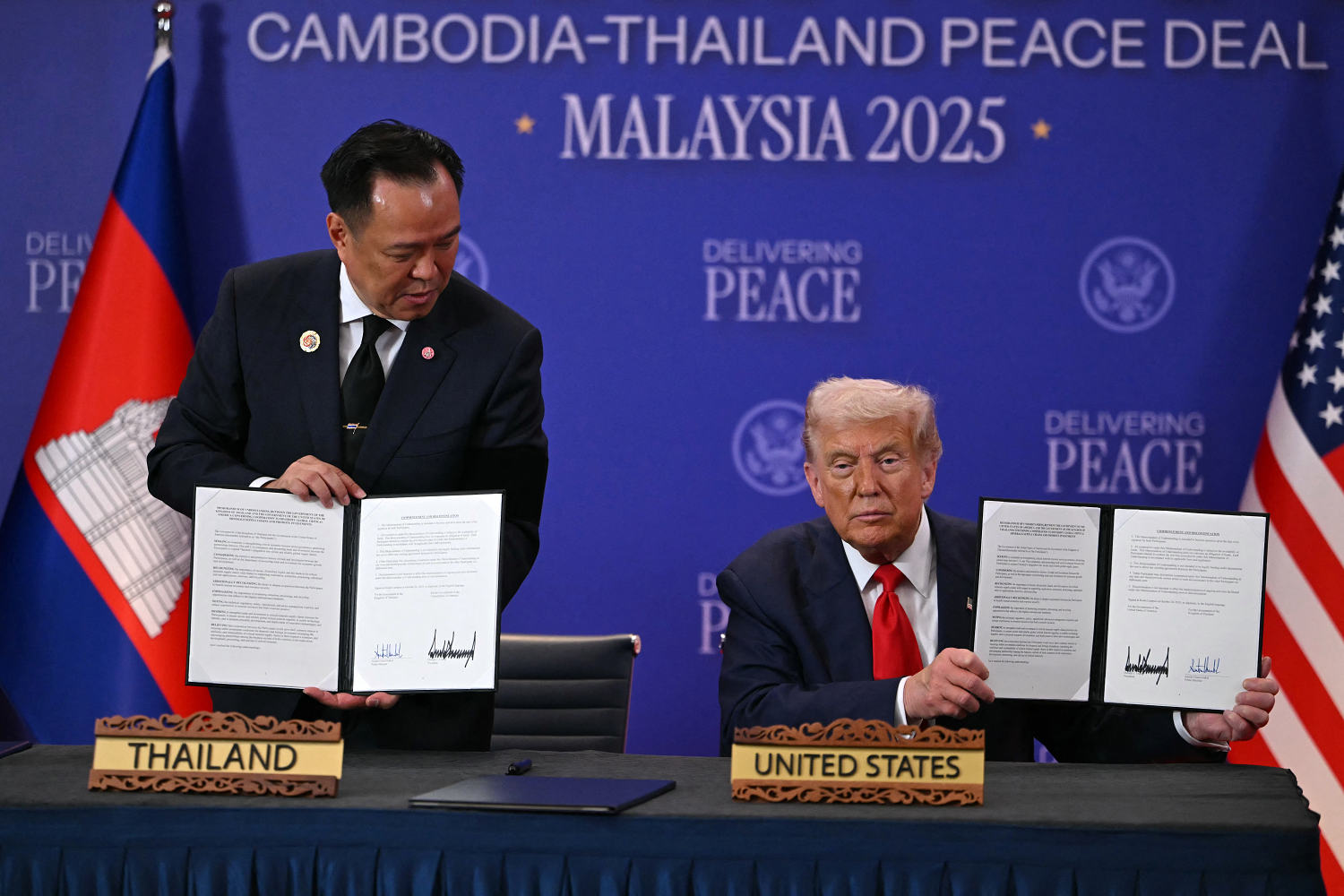
KUALA LUMPUR, Malaysia — President Donald Trump began his trip to Asia on Sunday by presiding over the signing of a strengthened ceasefire agreement between Thailand and Cambodia that he helped mediate earlier this year.
The five-day border conflict in July between the two Southeast Asian neighbors killed dozens of people and displaced hundreds of thousands of civilians in both countries.
The leaders of Thailand, Cambodia and Malaysia were on stage alongside Trump for the signing of the Kuala Lumpur peace accords, named for the Malaysian capital where negotiations took place in July.
In front of a backdrop that read “Deliver Peace,” Trump said the conflict between Thailand and Cambodia was one of eight wars his administration had ended since taking office in January.
“On behalf of the United States, I am proud to help resolve this conflict and forge a future for the region,” Trump said.
Trump recalled receiving phone calls from the prime ministers of Thailand and Cambodia during a visit to his Scottish golf course this summer.
“Turnberry is a great place, but I said this is way more important than playing a round of golf,” Trump said. “So we sat around all day making phone calls. »
Trump also took a moment to recognize the death Friday of Thailand’s Queen Mother Sirikit, 93, who he said embodied “dignity, kindness and grace.”
Under the agreement, Thailand will release 18 detained Cambodian soldiers and observers from the Association of Southeast Asian Nations (ASEAN) will be deployed.
Trump thanked Malaysian Prime Minister Anwar Ibrahim, chairman of ASEAN, for facilitating the negotiations. Anwar in turn thanked Trump for his role in mediating the ceasefire.
“The world needs leaders who firmly promote peace, and to achieve that you have to break some rules, as you did today,” he said, referring to Trump’s invitation to accompany him from the airport to the ceremony at the Kuala Lumpur Convention Centre, in violation of security protocols.
Cambodian Prime Minister Hun Manet also thanked Trump for his “tireless efforts” to make the peace deal a reality, reiterating an earlier promise that Cambodia would nominate Trump for the Nobel Peace Prize.
Thai Prime Minister Anutin Charnvirakul said the agreement would “provide the building blocks for lasting peace.”
After signing the peace agreement, Trump – who had threatened to impose harsh tariffs on both Thailand and Cambodia if the two countries did not reach an agreement – signed a reciprocal trade agreement with Cambodia as well as a framework for a reciprocal trade agreement with Thailand.
Thailand eliminates tariffs on 99% of American products, while Cambodia eliminates them on all American products. The United States will maintain a 19% tariff rate on imports from both countries.
Trump also signed a trade deal with Malaysia, which U.S. Trade Representative Jamieson Greer said would “change its tariffs and non-tariff barriers.” Malaysia also faces a US tariff rate of 19%.
Additionally, Trump signed deals with Malaysia and Thailand on critical minerals, which are key components of electronic devices and defense technologies.
Finding alternative sources of critical minerals has become a pressing issue for the United States after China, which holds a near-monopoly on their production and processing, announced export controls amid the ongoing U.S.-China trade war.
Speaking at the signing of the US-Malaysia trade deal, Greer said it was important to secure supply chains for critical minerals “for our people and the security of our economies”.
Malaysia is the first stop on Trump’s Asia trip, which will also take him to Japan and South Korea.
In Malaysia, Trump is also attending the annual summit of ASEAN, an 11-member regional grouping following the formal admission of East Timor on Sunday.
During his first presidential term, Trump attended the ASEAN summit only once, raising questions about his administration’s engagement in a strategically important region courted by both the United States and China.
Attendance at this year’s summit “sends an enduring message that the United States is back and ready to provide strong countermeasures and deterrence against China in the economic and security areas,” said Collins Chong Yew Keat, a foreign affairs, security and strategy analyst at Universiti Malaya in Kuala Lumpur.