Trump’s Brazil tariffs are more about political revenge: analysis


Corresponding to South America in São Paulo

 Getty images
Brazil thought it had passed slightly on Trump’s pricing front.
In April, US President Donald Trump announced that Brazilian goods imported in the United States would face prices of 10% – the lowest basic rate applied to most countries.
Now, while the 90 -day break on these targeted American prices should expire, Trump has increased the 50% Brazil rate – potentially launching a business war with the greatest economy in Latin America, which sells large amounts of beef, coffee, steel and other products in the United States.
Wednesday’s announcement means that Brazil will face one of the highest American price rates in the world, at least so far. But this new policy does not even really concern trade.
Earlier this month, Trump said the United States was running a trade deficit with Brazil. In fact, it manages a surplus of several million dollars, which means that the United States is sold more in Brazil than it buys.
This new rate rate does not consist in leveling a commercial playground. It is political and is part of an increasing quarrel between the United States and Brazil.
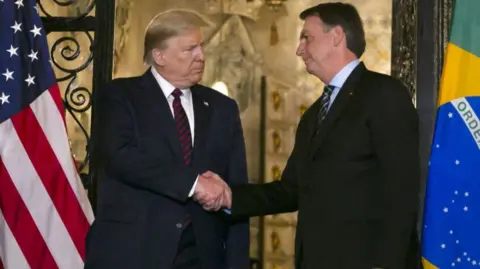
President Trump designed these prices as reprisals on the continuation of his ally, the former right -wing Brazilian president, Jair Bolsonaro.
Bolsonaro is under judgment for an alleged coup attempt after losing the 2022 presidential election, when his supporters stormed government buildings in Brasilia. The case includes the allegations of a plot to kill President Luiz Inacio Lula Da Silva, who won the race.
Bolsonaro denies the charges and Trump criticized them as a “witch hunt”.
 Reuters
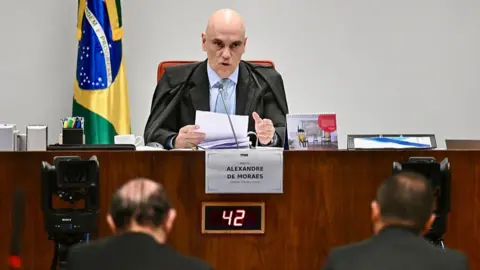
Much of the anger of the American administration was directed against Alexandre de Moraes, the judge of the Brazilian Supreme Court responsible for investigating Bolsonaro.
By announcing the price hike, the White House also accused Brazil of “actions harming American companies”, targeting “rights of freedom of expression of American people” and what it described as “politically motivated persecution, Brazil, intimidation, harassment, censorship and” Bolsonaro.
The “actions” and the “rights of freedom of expression” mentioned in the declaration of the White House are probably references to the previous judicial orders of Moraes to certain social media companies to close the accounts associated with the former president, which Moraes accused of having spread a harmful disinformation.
Moraes is renowned in Brazil for its actions targeting disinformation.
Last year, he temporarily closed the X of Elon Musk in Brazil – one of the largest markets in the platform – for having omitted to appoint a legal representative in the country after having ordered the suspension of dozens of accounts for the spread of disinformation, which Musk called “censorship”.
In Brazil, some are making Moraes hail as a champion of democracy. Others share Bolsonaro’s point of view that he is “authoritarian”, or even a “dictator”, according to Musk’s words.
Earlier this year, Trump’s own media group, which operates its social platform Truth, continued the Supreme Court judge for accusations of censorship.
Shortly before the announcement of the price, the United States also imposed sanctions in Moraes and delivered him, he and his family, a visa ban.
Some analysts argue that this line on the police on social media companies is itself a commercial problem.
Fabio Andrade, political scientist and professor of international relations at the Higher School of Advertising and Marketing in Brazil, argued that the motivations of the prices are “not only” political.
He said large technological companies are important in the American economy and were “crucial in the financing of Trump’s campaign” and could now face significant cost increases in the increase in regulations in Brazil.
 Getty images
But these new American tariff and sanction policies are also partly the result of a long campaign of the son of former president Eduardo Bolsonaro, who has spent the last months of putting pressure on American officials on behalf of his father.
Moraes ordered that Eduardo, a federal legislator, is the subject of an investigation for an alleged obstruction of justice, and asked Jair Bolsonaro to wear an electronic ankle label before his trial, to comply with a curfew, to stay outside the social media and to avoid contacting his son.
To support his friend, Trump slapped Brasilia with these rates, sanctions and visa prohibitions – all designed to put pressure on the Brazilian authorities to retreat criminal procedures against Bolsonaro.
So far, they do not seem to work – and could harm the two nations in the meantime.
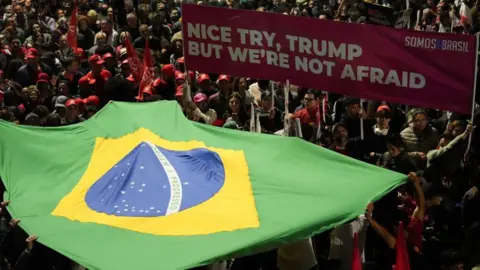
The leftist president Lula has repeatedly rejected the measures and rejected them as a foreign interference, defending the measures of the Supreme Court as judicial independence and urged the United States to negotiate.
“The interference of the American government in Brazilian justice is unacceptable,” said Lula on Wednesday in response, adding that even if the country remained open to negotiation with the United States on trade, it was preparing measures to “protect Brazilian workers, businesses and families”.
Relations remain frozen – Lula and Trump have never even exchanged a phone call.
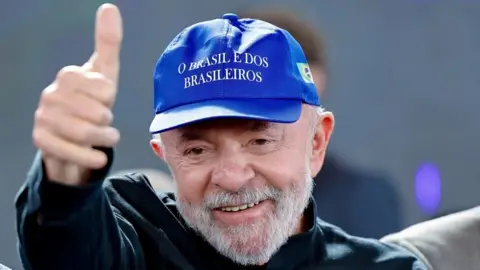
The rise of Lula, he benefited from a bouncing opinion survey at the national level when he responds to Trump’s pricing threats, in the same way as Mark Carney in Canada.
He even started wearing a blue cap, not different from Trump’s red “Make America Great Again” One, who says “O Brasil é Dosaleiros” or “Brazil belongs to Brazilians”.
In fact, some analysts in Brazil say that these prices, imposed on behalf of Bolsonaro, could turn against the former president, who is currently prohibited to appear again during the next year’s presidential election.
No less because some producers – including those more likely to support Bolsonaro – will be seriously affected by the new rate.
 Brazilian presidency / Reuters
Brazil has a huge agricultural business and sells a lot of beef, oil and steel products in the United States.
The United States has obtained about a third of its coffee and more than half of its Brazil orange juice, including through major brands like Tropicana and Starbucks.
Some items – including many oils, orange juice and certain plane pieces – have been excluded from prices for the moment.
But the new price rate of 50% – which should take effect in October – will probably make other goods more expensive for Americans, companies have higher costs for consumers, and that Brazilian producers will have to absorb some of the higher prices themselves.
Brazil can seek new buyers worldwide, but exporters say that this will not compensate for the short -term impact.
Cecafé, the Brazil Coffee Exporting Council, said the impact on Brazilian roasters and exporters will be “important” and expect price increases for Americans, because the United States is the largest coffee customer in Brazil.
Brazilian producers and exporters make emergency plans in anticipation of prices of 50%. But those I spoke of emphasizing that replacing the American trade will not be possible in the short term.
Cecafé told me that it would not be easy to find other markets for the 8.1 million tonnes of coffee currently exported to the United States, which would require an increase in demand from other countries.
New markets open in Brazil in Asia, which imported 19.4% Brazilian coffee plus last year, because the Arab countries also imported 31.5% more, according to Cecafé, but these increases are not sufficient to absorb any potential American deficit.
What is not yet clear is still the next move of Brazil: will Brasilia and Washington negotiate a new agreement, like the other nations? Or is Brazil riding, transforming this spit into a mutual trade war?
Lula says he will not be intimidated. Trump shows no sign of decline. The two are great personalities, with supporting bases of the opposite ends of the political spectrum to impress.
What (others) could go wrong?
Follow the BBC coverage of American prices