Trump’s Retribution Cases Are Fundamentally Weak


A lot has happened. Here are some of the things. This is the TPM Morning Memo.
How low can they go?
Three major developments in Donald Trump’s retaliatory campaign yesterday laid bare more than ever — as hard as it may be to believe — just how far the Justice Department will go under Acting Attorney General Todd Blanche to carry out the president’s orders.
And yet… amid the carnage, there was proof positive that Trump’s vendettas are fundamentally weak cases that can be fought and won effectively. While this does not spare the Comey family or dozens of other putative defendants from the financial and emotional costs of Trump’s retaliation, it does stiffen the spine as we prepare for a long siege on the rule of law.
1. SPLC goes out with a bang
In its first official response to the deeply flawed federal indictment against its paid informant program, the Southern Poverty Law Center issued a one-two punch at the Justice Department.
The civil rights organization — which added D.C. attorney Abbe Lowell to its defense team — fired back with two motions that sounded like backroom arguments:
The overall issue that concerns both motions is the SPLC’s history of providing law enforcement, including the FBI, with information it obtained from its paid informants.
The first motion above takes aim at Blanche’s out-of-court statements on Laura Ingraham’s Fox News show, asserting, “We have no information to suggest that the money that they were paying to these informants and these members of these organizations, they then turned around and shared what they learned with law enforcement.” »
Not just wrong in the abstract, says the SPLC. She claims that weeks before the indictment, she gave federal prosecutors in Alabama information showing instances in which the organization had shared information from its informants with federal law enforcement.
SPLC lawyers went so far as to send a letter April 17 to federal prosecutors imploring them to inform the grand jury of six categories of exculpatory evidence. Prosecutors did not respond to the letter. The indictment was handed down on April 21.
The SPLC wants the DOJ to correct or retract Blanche’s comments.
The more substantive of the two motions requests the grand jury transcripts in an effort to get the indictment dismissed before even having to argue that this is a vindictive prosecution and legally flawed in other respects.
The possibility that prosecutors had improperly instructed the grand jury was evident from the indictment’s release. An element of intent essential to the fraud allegations was not included in the indictment, and the SPLC seized on it along with statements from Blanche, FBI Director Kash Patel, and President Trump to assert that the grand jury was “actively armed” against him:
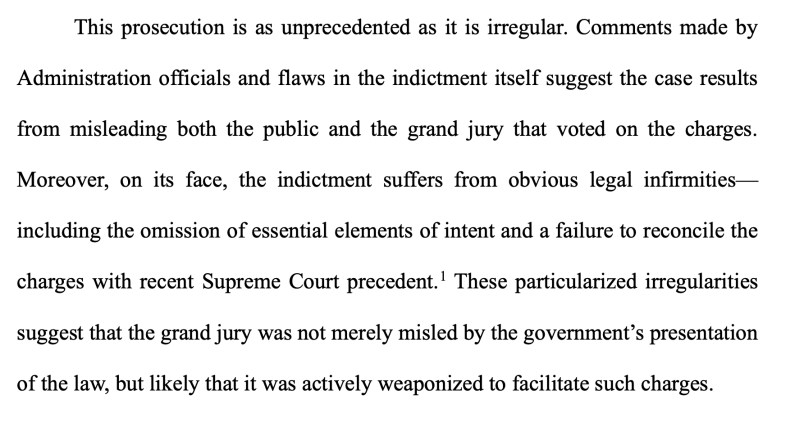
The SPLC says it was never contacted or subpoenaed by prosecutors before the indictment. Instead, his lawyers contacted the U.S. attorney’s office in Alabama. Prosecutors told them they believed the informant program files had been destroyed. This is not the case, the SPLC said. He claims he accepted a subsequent grand jury subpoena and produced some 15,000 pages of records on April 17. The indictment was returned two business days later.
In its motion seeking the grand jury transcripts, the SPLC (in what turned out to be a particularly timely move) cites Comey’s first lawsuit in Virginia, where he managed to obtain the grand jury transcripts because of notable irregularities in the way Trump’s DOJ handled his case.
2. Comey’s new indictment is laughable
The First Amendment problems with James Comey’s new indictment, this time in North Carolina, are so obvious that the effect is to avoid any pretense that this is anything other than a vindictive prosecution, despite Blanche’s agitated protests at yesterday’s tense press conference at Main Justice:
A sample of the informed reaction:
- “No reasonable person would believe that Comey intended to threaten the president with shellfish,” a DOJ official told NBC News’ Ryan Reilly. “Everyone at DOJ should be ashamed. I know they are.”
- Eugene Volokh delves into the elements of the alleged shellfish crime and concludes: “I believe that these prosecutions are unjustified and will be dismissed. »
- Ken White, former federal prosecutor and longtime criminal defense attorney:
The point of the indictment is to demonstrate that the United States Department of Justice is entirely an instrument of Donald Trump’s senescent nostrum, no more independent of him than a boil on his ass. The goal is to show that the administration can, and will, use the mechanisms of the ministry to punish its enemies. The goal is to show that the ministry can, and will, punish protected speech. The goal is to show that the department is made up of committed fanatics who will do anything, even unethically and unconstitutionally, to promote Trump.
3. THE OTHER Comey Affair
There are good arguments to be made. The biggest news of the day came from the civil lawsuit filed by Comey’s daughter Maurene, who won a major judgment as she challenged his illegal dismissal as a federal prosecutor.
Maurene’s case is shaping up to be a major one, not because of who her father is, but because she confronts head-on the trap the Trump administration has set for fired civil servants. In short, Trump’s trap looks like this:
- Firing public officials without cause or notice, simply invoking Trump’s powers under Article II of the Constitution.
- The force fired civil servants to take their complaints to the Merit Systems Protection Board.
- Stack the once-independent Merit Systems Protection Board with loyalists and make it clear that their job depends on carrying out Trump’s orders.
It’s a little more complicated than that specifically, but that’s the box the Trump administration was trying to put Maurene in. She decided to dismiss her lawsuit on the grounds that she needed to pursue her complaint with the MSPB.
U.S. District Judge Jesse Furman of Manhattan elegantly sidestepped many of the most stubborn legal arguments in yesterday’s ruling. He denied the Trump administration’s motion to dismiss, ruling that Trump’s invocation of his Article II powers to fire Maurene removed her case from the auspices of the MSPB and allowed her to proceed in federal court.
It’s a major victory for her and potentially for some of the federal workers who were summarily fired in a broad and vague gesture in favor of Article II powers, but there is a long way to go in this litigation.
Exclusive TPM
Hunter Walker and Josh Kovensky: Inside the House Anti-Democratic Task Force “Red Team” That Runs War Games and Responds to Trump’s Election Threats
Lawless boat strike campaign gathers pace
New York Times: “In recent weeks, the military has, without notice, increased the number of secret fixed-wing attack aircraft and armed MQ-9 Reaper drones operating from bases in El Salvador and Puerto Rico, allowing the military to ramp up strikes, the two people said, speaking on the condition of anonymity to discuss operational matters. »
Latest news on CIA deaths in Mexico
We are slowly getting closer to some semblance of truth about the CIA’s role in Mexico’s counternarcotics operations.
Chihuahua’s special prosecutor confirmed yesterday that there were two other “foreigners” at the scene of the car crash that killed two CIA agents after a raid on a Mexican drug lab, but did not confirm that they were other American CIA agents.
The Los Angeles Times reported last week that two other CIA agents “were present during the raid” and followed the vehicle that crashed down the mountainside, and at that point they “walked down the mountain in hopes of saving their colleagues, but it was too late.”
Monitoring mass deportations
- Circuit Division on Mandatory Detentions: In a 3-0 ruling, the 2nd Circuit Court of Appeals rejected the Trump administration’s ahistorical interpretation of a 30-year-old law that has flooded federal courts with habeas cases. The appeals court, in an opinion written by a Trump appointee, found significant constitutional questions regarding “what would be the broadest no-bail mass detention mandate in our nation’s history for millions of noncitizens.”
- Nightmare of deportation to a third country: NPR interviews five of the 15 Latin American migrants shipped to the Democratic Republic of Congo by the Trump administration.
- Asylum seekers blocked again: After losing an appeals court ruling last week over its policy of restricting asylum seekers at the border, Trump’s State Department implemented a new policy to try to get ahead of asylum seekers by refusing to issue travel documents to anyone fearful of returning to their home country.
Retribution: ABC Edition
The FCC, chaired by Trump toad Brendan Carr, has launched an early review of all station licenses owned by ABC, a frontal attack on a major broadcaster behind the thin veil of an investigation into the network’s DEI policies. The move comes after President Trump and the first lady demanded that ABC fire late night host Jimmy Kimmel over a joke.
Any hot tips? A juicy scuttlebutt? Any interesting ideas? Let me know. For sensitive information, use encrypted methods here.


