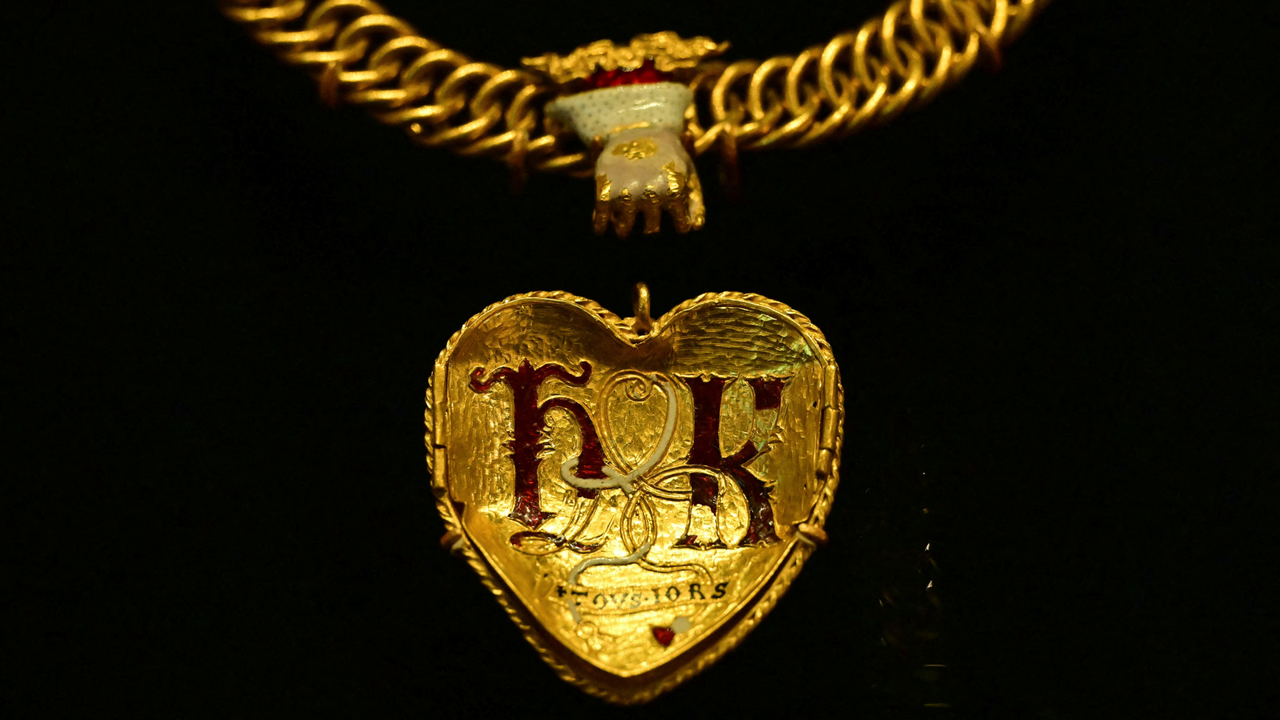
Tudor Heart: A Renaissance gold necklace featuring a French-English pun on the love between Henry VIII and his first wife, Katherine of Aragon


QUICK FACTS
Name: Tudor heart
What is this : A gold necklace with a red enamel pendant
Where does it come from: Warwickshire, central England
When it was made: Around 1518
Half a millennium after a solidgold A Renaissance necklace was forged, a metal detector spotted it emerging from a dried-up pond in central England. The necklace’s heart-shaped pendant, which features the initials H and K in red enamel, as well as a rose and a pomegranate, is one of the few pieces of jewelry from the Tudor period to survive the bitter divorce of King Henry VIII and his first wife, Catherine of Aragon. (The Queen’s name is often written “Catherine”, but she I usually signed it “Katherine” while at court in England.)
On the front of the Tudor heart, a white and red rose is intertwined with a pomegranate tree, which respectively represent the home of the Tudor dynasty, led by Henry VIII, and the Spanish homeland of Queen Catherine of Aragon. The back of the heart pendant is decorated with their initials connected by a cord with pompoms. Katherine had originally married Prince Arthur of England, but was widowed after only five months of marriage. She later became the first wife of Henry VIII (who reigned from 1509 to 1547) and their marriage lasted from 1509 until they were divorced in 1533.
Article continues below
Both sides of the Tudor Heart bear the motto ‘tout’, French for ‘always’. But the motto could actually be a bilingual play on words, depending on the British Museumsince the spacing of the word makes “all” sound “yours” when read aloud.
Experts at the British Museum have confirmed that the composition of the gold and the style of the jewelry matches an early 16th century manufacturing date, meaning the accessory was likely made during Henry VIII’s marriage to Katherine. But as the necklace is not listed in royal jewelry inventories from the early 16th century, it is unlikely that any of the monarchs owned it. This raises the question of why or for whom the necklace was made.
One possibility is that the heart was created to celebrate the Princess Mary’s engagement (later Queen Mary I) in 1518. Mary was the only child of Henry and Katherine to survive infancy and was initially betrothed to Francis III, the Dauphin of France, when she was only 2 years old. The engagement plan failed a few years later.
MORE AMAZING ARTIFACTS
Another possibility is that the necklace was made for a high-ranking person, who would have worn it to show their allegiance to the monarchs. Evidence from the necklace suggests that although it was made of high-quality gold, the workmanship was not of the same caliber, according to the British Portable Antiquities program. If the object was designed to be seen from a distance, it might have been given as a reward for victory in a royal joust or other equestrian event.
The Tudor Heart Pendant is a rare example of jewelry from the early Tudor dynasty and is on display at the British Museum, which raised £3.5 million ($4.7 million) in early 2026 to purchase the artifact.
For more stunning archaeological discoveries, check out our Amazing artifacts archives.


