Two stars spiraling toward catastrophe are putting Einstein’s gravity to the test


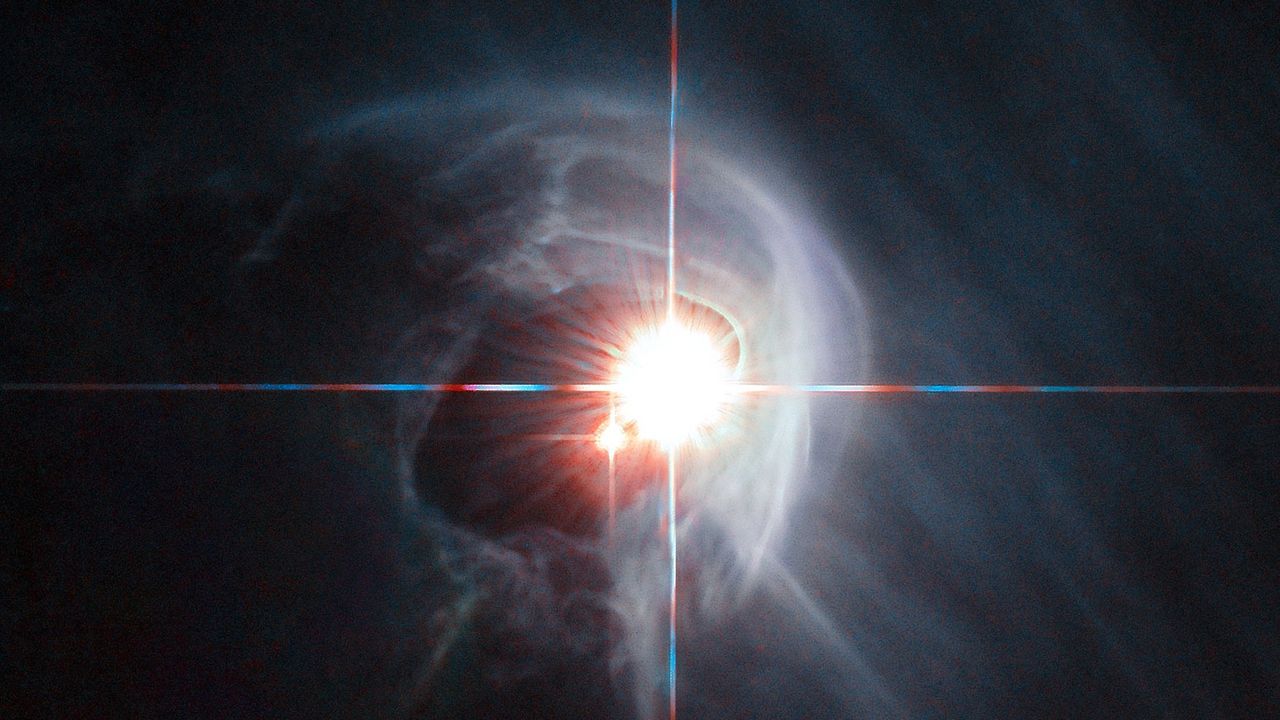
Astronomers have observed two stars locked in a death spiral, and their dance of doom reveals more about how gravity works.
The system, called ZTF J2130, is about 4,000 light years away. Although astronomers have known about this system for some time, this is the first time they have observed it with such clarity.
This is a very old system. One of the stars is a white dwarf, the white-hot core of a sun-like star. The other is what’s called a sub-dwarf star, which is a small star near the end of its life cycle. The two stars are so close to each other that they complete their orbit in just under 40 minutes. In fact, they’ve already started kissing. Their mutual gravity is so strong that they have stretched and warped, with matter from the subdwarf flowing onto the white dwarf companion.
Because stars are quite heavy and move very quickly, they emit gravitational waveswhich are ripples in the fabric of spacetime first predicted by Albert Einstein and confirmed in 2015. This emission of gravitational waves saps the system’s energy, bringing the two stars closer and closer each year.
Using a combination of data from the Oskar Luhning Telescope at the Hamburg Observatory in Germany and the CAHA Observatory in Germany and Spain, the astronomers undertook a careful campaign to measure the orbital period as precisely as possible. They found that the orbit is slowly deteriorating; with each passing second, the orbital period decreases by approximately two trillion seconds.
This is consistent with calculations based on our current theoretical understanding of gravity. But scientists are eager to go beyond Einstein’s theory of general relativity for more than a century, any opportunity to test it immediately arouses interest.
Astronomers have discovered that an upcoming gravitational wave observatory, known as the Laser Interferometer Space Antenna (LISA), should be able to directly measure gravitational waves emanating from this system. The European Space Agency plans to launch LISA in the 2030s, and this stellar pair will still exist into the next decade.
When the stars finally merge, they will trigger a supernova-level explosion that could be bright enough to be seen with the naked eye. In the meantime, before we can enjoy these fireworks, we’ll just have to test gravity.


:max_bytes(150000):strip_icc()/Health-GettyImages-OatmealBreakfast2-e4f59c2dbe924e499a915d2609be7470.jpg?w=390&resize=390,220&ssl=1 "What Happens to Your Blood Sugar When You Eat Oatmeal for Breakfast")