U.S. passengers flying from Ebola-affected countries rerouted Virginia, Texas and Georgia : NPR

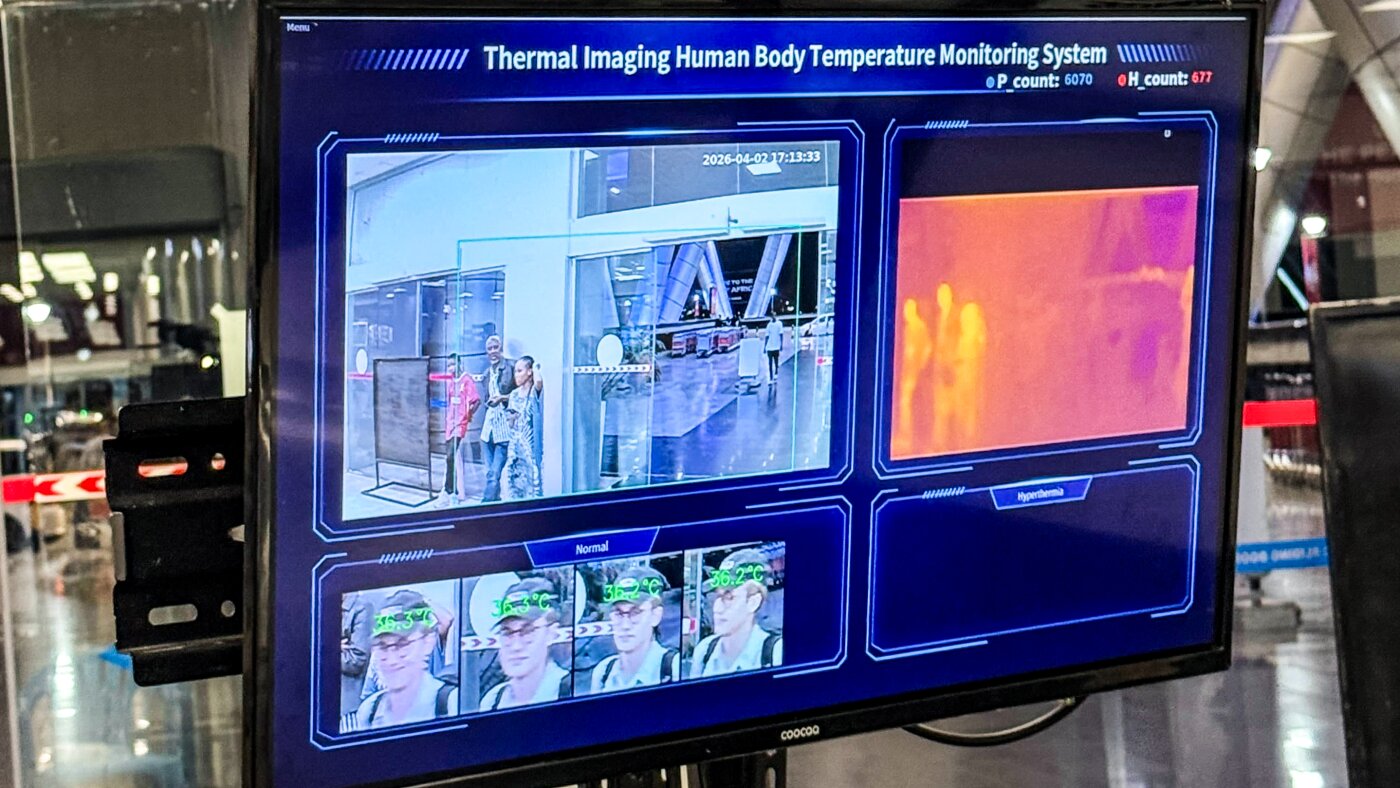

As the travelers entered Uganda’s Entebbe International Airport on May 21, they were screened by a thermal camera that detects their temperature. In the photo below, journalist Michal Ruprecht.
Michal Ruprecht for NPR
hide caption
toggle caption
Michal Ruprecht for NPR
Early Thursday morning, Michal Ruprecht went to Uganda’s Entebbe International Airport at 2 a.m. to catch a flight. At the airline counter, he told the agent he was heading to Michigan.
“He did this kind of double look and asked me: Was I sure I was going to Michigan?” he remembers.
Ruprecht, a medical student and freelance journalist, was returning home after a month-long trip to Uganda, where he was working on stories for NPR.
The man at the counter showed Ruprecht a memo from U.S. Customs and Border Protection. “He tells me that I we must arrive at Washington Dulles International Airport (IAD),” Ruprecht said, “The first thing that came to mind was denial. I wasn’t sure it was real.”
Ruprecht was one of the first passengers to travel under a policy announced hours earlier: all Americans who have transited through Uganda, South Sudan or the Democratic Republic of Congo (DRC) in the past 21 days must land at IAD, an airport in the Washington, D.C., Virginia suburbs.
Two additional US airports options have been added Friday evening: Hartsfield-Jackson Atlanta International Airport and George Bush Intercontinental Airport in Houston.
African countries DRC and Uganda have been hit by a growing Ebola outbreak, which the World Health Organization has declared “serious”. public health emergency of international concern on May 17. There are already 800 suspected cases and more than 180 suspected deaths, according to the WHO.

A major element of the US response has been travel restrictions imposed on recent arrivals by affected countries: routing US citizens to specified points of entry, booking the right to refuse entry to permanent residents and except for most others.
At the Ugandan airport, Ruprecht frantically changed his reservations. When he arrived at Dulles Airport after 20 hours of travel, he was flagged for additional screening.
Officials from the U.S. Centers for Disease Control and Prevention took him to a temporary clinic. “They put up these tarps that created pseudo-doctor offices,” Ruprecht says. “It looked like a makeshift campsite.”
A CDC official checked her temperature with a hand-held thermometer pointed at her forehead. “He actually told me my temperature was a little high,” Ruprecht said. “He asked me if I was nervous? I said, ‘Yes!’ “Her second and third temperature checks were within the normal range, so they moved on to questions.
Ruprecht confirmed that he had no symptoms of Ebola and had not treated any patients or attended funerals in Uganda. They ended up taking his contact details. “It took 5-10 minutes, it was pretty quick,” he says, “I’ll be honest, it was pretty disappointing.”
During the Ebola epidemic from 2014 to 2016, many passengers Flights from affected areas were provided with thermometers and burner phones along with printed instructions for next steps.
Ruprecht didn’t get any of that, but he did catch his connecting flight back to Michigan.
On Friday afternoon, he received a text message from the CDC describing Ebola symptoms, including fever, rash, nausea and vomiting, and instructing him to call his health department for advice and to isolate himself immediately if he developed any.
States will monitor
Once CDC staff complete initial risk assessments on passengers arriving at airports, they will notify state health departments at the travelers’ destinations.
Health departments would then follow up, says Dr. Laurie Forlano, Virginia’s state epidemiologist. “Some people will be monitored or checked daily. Others won’t need that frequency, and it depends on their risk of exposure,” says Forlano.
Forlano says the state is prepared for this effort and has done so in previous outbreaks, but it requires “a tremendous amount of work.” How did it go after the first day? “I think at the beginning of any response like this, a little chaos is part of the gig,” Forlano says.
The Ebola surveillance adds to a list of other health issues facing Virginia, including a measles outbreak and hantavirus surveillance.
And the country’s public health system is not at its peak, according to Dr Jeanne Marrazzoformer senior official at the National Institutes of Health and CEO of the Infectious Diseases Society of America. “Over the last five years in particular, we have seen a decimation of local, regional and state public health staffing and program funding,” Marrazzo said during a May 21 IDSA press briefing. “I don’t know if we’re as prepared as we should be at these levels.”
Travel bans work with accompanying measures
For travelers who have recently been to countries affected by Ebola, only U.S. citizens and nationals entry is guaranteed in Virginia, Houston or Atlanta.
Those with a green card will be considered, and others will not be able to come at all, according to a Title 42 Ordinance published and modified by the CDC this week.
No such travel ban was imposed during the 2014 to 2016 Ebola outbreak in West Africa, which remains the largest on record. At the time, U.S. policymakers opted to allow travelers from all countries to enter “under certain conditions that required daily monitoring for 21 days,” says Dr. Marty Cetron, former chief of the CDC’s division of global migration and quarantine.
Travel bans “rarely work on their own,” says Cetron. “When people feel like there is a restriction but they desperately need to travel, they often find a way.”
During the 2014 to 2016 Ebola outbreak, U.S. health officials encouraged safe entry through information and tracking. “If you can educate people on how to do this safely and what the goals are for them, their families and the communities they join, they are often more likely to comply,” Cetron says.
Restrictions and controls at points of entry into the United States offer little protection on their own, Cetron says: “We’re not going to be safe enough if that’s the main priority and it comes at the expense of doing other things that have more impact.”
In addition to testing – and perhaps even more critical, Cetron says – resources should be increased to help contain the spread of the virus. Pathogens do not respect borders, he says: to truly end the danger, the epidemic must be stopped at its source.
The CDC currently has several dozen employees in affected countries in central and eastern Africa, according to Dr. Satish Pillai, who is leading the agency’s response to Ebola, at a news conference Friday.
During the Ebola outbreak in West Africa from 2014 to 2016, the United States took major leadership rolesending more than 3,000 troops to the region, from the CDC and USAID, an agency that was abruptly closed last year.


