Deaths reported during widening protests in Iran sparked by ailing economy : NPR

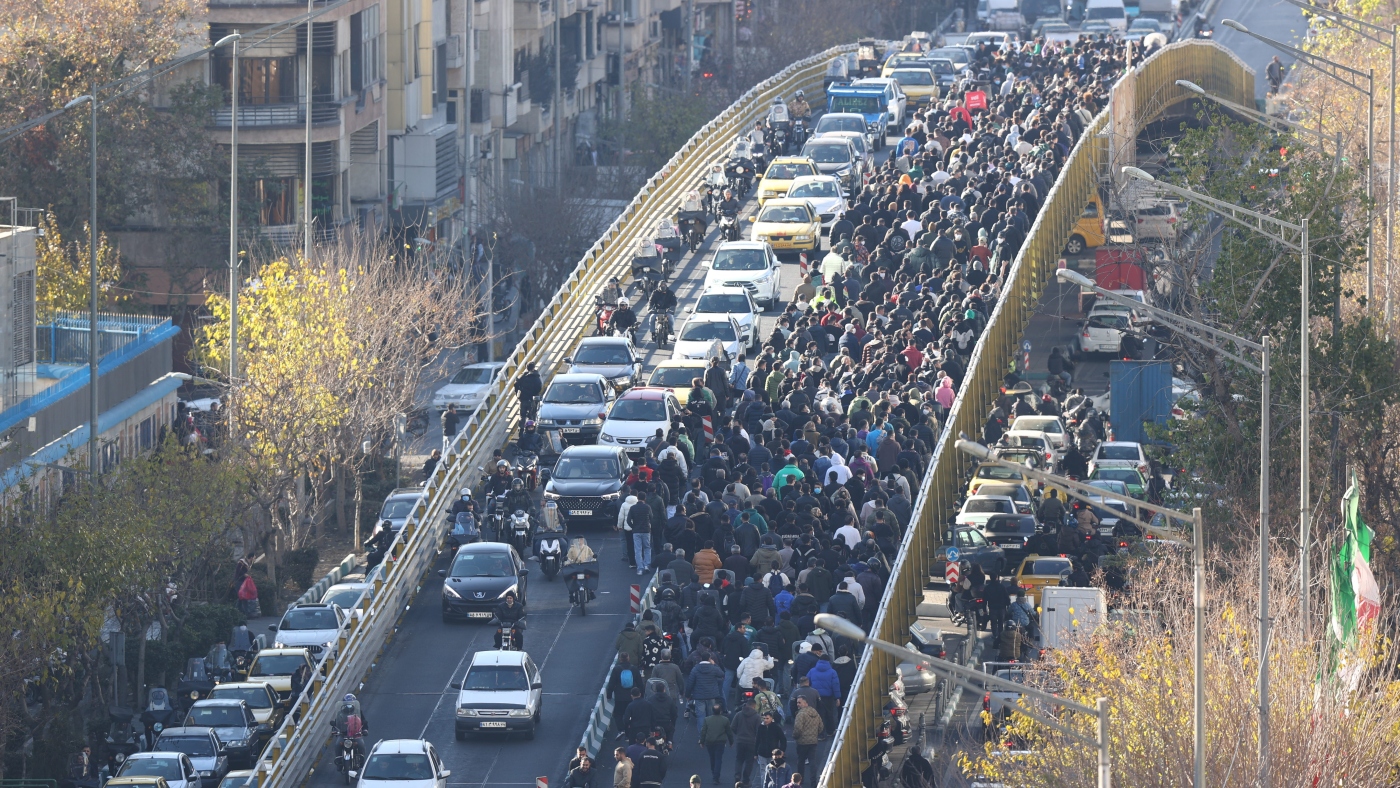

Protesters march through downtown Tehran, Iran, December 29, 2025.
Fars/AP News Agency
hide caption
toggle caption
Fars/AP News Agency
DUBAI, United Arab Emirates — Growing protests sparked by Iran’s struggling economy spread Thursday to the Islamic Republic’s rural provinces, with at least six people killed in the first reported deaths among security forces and protesters, authorities said.
The deaths could mark the start of a more muscular response from Iran’s theocracy to the protests, which have slowed in the capital, Tehran, but have spread elsewhere. The deaths, one on Wednesday and five on Thursday, occurred in three towns primarily home to the Iranian Lur ethnic group.
The protests became the largest in Iran since 2022, when the death of 22-year-old Mahsa Amini in police custody sparked nationwide protests. However, the protests have not yet reached the whole country and have not been as intense as those surrounding the death of Amini, who was arrested because she did not wear her hijab, or headscarf, at the request of authorities.
The most intense violence appeared to hit Azna, a town in Iran’s Lorestan province, about 300 kilometers (185 miles) southwest of Tehran. There, online videos purported to show objects burning in the street and gunshots ringing out as people shouted, “Shameless!” Shameless!

Women wave national flags while holding posters of the late commander of the Iranian Revolutionary Guards Quds Expeditionary Force, General Qassem Soleimani, who was killed in a 2020 US drone attack in Iraq, during a ceremony commemorating the anniversary of his death at the Imam Khomeini Grand Mosque in Tehran, Iran, Thursday, January 1.
Vahid Salemi/AP
hide caption
toggle caption
Vahid Salemi/AP
The semi-official Fars news agency reported that three people were killed. Other media outlets, including pro-reform outlets, cited Fars for its report, while state media did not fully acknowledge the violence there or elsewhere. It is unclear why there has not been more reporting on the unrest, but journalists have been arrested for their reporting in 2022.
In Lordegan, a town in Iran’s Chaharmahal and Bakhtiari province, online videos showed protesters gathered on a street, with the sound of gunfire in the background. The images match known features of Lordegan, about 470 kilometers (290 miles) south of Tehran.
Fars, citing an unnamed official, said two people were killed during Thursday’s protests.
The Washington-based Abdorrahman Boroumand Center for Human Rights in Iran said two people were killed there, identifying the dead as protesters. He also shared a still image of what appeared to be an Iranian police officer, wearing a bulletproof vest and brandishing a hunting rifle.
In 2019, the area around Lordegan was the scene of widespread protests and protesters reportedly damaged government buildings after a report said people there had been infected with HIV through contaminated needles used at a local health clinic.
“Protests due to economic pressures”
A separate protest Wednesday evening reportedly led to the 21-year-old volunteering with the Revolutionary Guards’ Basij paramilitary force.
The official IRNA news agency reported the death of the Guard member, but gave no further details. An Iranian news agency called Student News Network, said to be close to the Basij, directly blamed the Guard member’s death on protesters, citing comments from Saeed Pourali, deputy governor of Lorestan province.
The member of the Guard “was martyred (…) by rioters during demonstrations in this city to defend public order”, he reportedly declared. Thirteen other Basij members and police officers were injured, he added.
“The protests that have taken place are due to economic pressures, inflation and currency fluctuations, and are an expression of concerns about livelihoods,” Pourali said. “Citizens’ voices must be heard carefully and tactfully, but people must not allow their demands to be undermined by profit-seeking individuals.”
The protests took place in the town of Kouhdasht, more than 400 kilometers southwest of Tehran. Local prosecutor Kazem Nazari said 20 people were arrested after the protests and calm had returned to the city, the Mizan legal news agency reported.
Falling currency sparks protests
Iran’s civilian government led by reformist President Masoud Pezeshkian has tried to signal that it wants to negotiate with the protesters. However, Pezeshkian acknowledged there was little he could do as the Iranian rial rapidly depreciated, with one dollar now costing around 1.4 million rials.
Meanwhile, state television separately reported the arrests of seven people, including five it described as monarchists and two others it said were linked to groups based in Europe. State television also said another operation saw security forces confiscate 100 contraband pistols, without elaborating.
Iran’s theocracy declared Wednesday a public holiday in much of the country, citing the cold, likely in an attempt to draw people out of the capital for a long weekend. The Iranian weekend occurs on Thursday and Friday, while Saturday marks Imam Ali’s birthday, another public holiday for many.
The protests, which are rooted in economic issues, have also heard demonstrators shouting against Iran’s theocracy. The country’s leaders are still reeling after Israel launched a 12-day war against the country in June. The United States also bombed Iranian nuclear sites during the war.
Iran has said it is no longer enriching uranium at any site in the country, trying to signal to the West that it remains open to possible negotiations on its nuclear program in order to ease sanctions. However, these negotiations have not yet taken place as US President Donald Trump and Israeli Prime Minister Benjamin Netanyahu have warned Tehran against reconstituting its atomic program.