UK households to get £15bn for solar and green tech to lower energy bills


Esme Stallard,Climate journalist and scientistAnd
Justin Rowlatt,Climate Editor

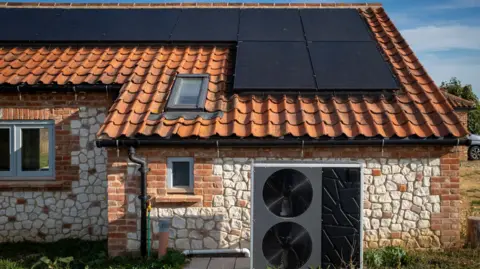 Andrew Aitchison/Getty Images
Households will be entitled to thousands of pounds worth of solar panels and other green technology to cut their energy bills, the government has announced.
The much-anticipated Warm Homes plan promises to deliver £15 billion to UK households over the next five years, as well as introducing new rights for tenants.
The government has said it wants to create a “roof revolution”, triple the number of homes equipped with solar energy and lift a million people out of fuel poverty.
The plan was strongly welcomed by the energy and finance sectors, but the Conservative Party said the project would “impose high ongoing running costs on households”.
First presented in 2024, the Warm Homes plan promised to address the “national emergency” over rising energy bills, but it took two years for the final details to be released.
The government said the plan, published on Wednesday, would focus on financing solar panels, heat pumps and batteries for UK households through low-interest loans and grants.
For households able to pay, even with the subsidies, installing the technologies will likely incur additional costs. For a heat pump after subsidy, households pay on average £5,000.
But for an average three-bedroom semi-detached house, installing all three of these technologies could save £500 a year on energy bills, he estimates.
Although social charity Nesta and green energy charity MCS Foundation have estimated it could be more than £1,000.
“A warm home should not be a privilege, it should be a fundamental guarantee for every family in Britain,” Prime Minister Sir Keir Starmer said.
The plan’s measures include:
- Extension of Boiler Upgrade Scheme for a further year until 2029/30, offering £7,500 grants for heat pumps
- An additional £600 million for low-income households to receive funding for the full cost of solar panels and batteries, bringing the total available to £5 billion
- Reduced or zero rate loans for households, regardless of their income
The plan has been strongly welcomed by the energy industry, workers’ unions and the financial sector, who see the government’s long-term financial commitment as crucial to boosting private investment in green technologies.
“£15 billion is a substantial commitment, it provides certainty for investors and businesses in the energy market,” said Dhara Vyas, chief executive of trade body Energy UK.
Camilla Born, CEO of Electrify Britain – a joint campaign group of Octopus and EDF aimed at encouraging the switch to electric heating – also welcomed the announcement and said it would help reduce bills in the long term, but said “the bad part is that it is a plan and we have to deliver on it”.
Some programs already distribute subsidies, but for new funding, the government has not yet decided how and when households will receive the money. He said “deeper engagement with the financial sector” was needed this year.
Richard Tice, deputy leader of the Reform Party, sharply criticized the plan: “A scandalous waste of up to £15 billion of taxpayers’ money, mainly on buying solar panels, batteries and heat pumps made in China, which is bad for British industry. »
Two thirds (68%) of solar panels imported by the UK came from China in 2024, according to HMRC trade data.
The government said the project would help create 180,000 new jobs in the clean heating sector, although some of these would likely come from retraining existing engineers.
Insulation financing is degraded
The original plan aimed to speed up the installation of insulation in homes, which was seen as a cost-effective way to reduce heat loss from Britain’s leaky housing stock.
But ongoing controversy over a government-funded insulation program, ECO, involving shoddy installations has led to the program not being extended.
Aadil Qureshi, CEO of Heat Geek, which trains heating engineers to install heat pumps, said it was the right decision and that a focus on green technology was better value for the government’s money.
Unlike insulation, he said heat pumps are a technology in its infancy and need government support to catalyze the industry.
“[The plan] It allows the industry to engage, to redouble its efforts – it allows investors, manufacturers to say: let’s continue to invest to get to a certain point where they are on par with the alternative to hydrocarbons,” he said.
By abandoning oil heaters and gas boilers for households in favor of electric heat pumps, powered by renewable energy, the government hopes to reduce the country’s emissions linked to global warming, around 18% of which come from domestic heating.

Dozens of people have contacted Your Voice Your BBC News about their experiences installing low carbon technology like heat pumps.
Chris and Penny Harcourt, a retired couple living in Stowmarket, bought a heat pump two years ago and said it was “the best renovation we’ve done to our house in 20 years.”
But they said that with current electricity prices, it was expensive to operate and it wasn’t until they got solar panels that they saw the costs come down.
You can watch a conversation BBC climate editor Justin Rowlatt had with Penny below.
Heat pumps can be three to four times more efficient than gas boilers, but higher electricity prices mean they can end up being the same or even more expensive to run.
But abandoning gas heating is a government priority.
Energy Secretary Ed Miliband has previously said the UK’s reliance on fossil fuels was its “Achilles heel” – after significant price swings – and that clean energy was the only way to reduce energy bills.
But the UK has some of the highest electricity bills in Europe due to network upgrades, government taxes and the impact of wholesale prices driven by the price of gas.
Claire Coutinho, shadow energy secretary, said: “Unless the Government gets serious about reducing electricity bills now, many of these taxpayer-funded projects will impose high ongoing running costs on households every year. »
The government hopes that increasing the number of solar panels will be the solution.
The Warm Homes Plan will encourage households to opt for the trio of low-carbon technologies: heat pumps, solar panels and batteries.
This will see a greater share of heat pump electricity demand met by household-generated solar power rather than the grid; thus lowering prices.
Miliband told the BBC that the government’s plan is “the most cost-effective way in the long term to make a difference to people” and reduce energy bills.
“We saw the highest demand for solar panels last year, the highest demand for heat pumps we’ve ever seen, but we don’t want that to be the preserve of the rich,” he said.
Not everyone in the green industry is in favor of all measures. Dale Vince, CEO of energy company Ecotricity, welcomed the new funding for solar power but criticized the high level of subsidy for heat pumps.
While he said they have a role to play, he said they are not the national solution to reducing heating costs and greenhouse gas emissions.
“Solar panels give us the best value for money, there’s no doubt about it: the cheapest to install and the most productive in terms of reducing energy bills. Heat pumps are at the other end of that scale,” Vince said.
“We could install solar panels on 10 million roofs or heat pumps in a million homes.”
Tenant rights reforms
Installation of low carbon technology will only be available to homeowners or social housing, but the Warm Homes plan also includes recent announcements about changes to tenants’ rights.
From 2030, landlords will need to ensure rental properties have a minimum energy efficiency score of EPC C – instead of E.
But currently the way a home obtains an EPC score is based on estimated running costs rather than energy efficiency, which can mean the score is downgraded following the installation of a heat pump.
In that plan, the government said it intended to announce changes to the assessment process later this year.
The industry also hoped the Warm Homes plan would set out updated efficiency requirements for new builds – the Future Homes Standard – but said these would be published in the coming months.
Environmentalists feared the requirement for solar panels on new homes would be scrapped.
But the plan states: “We have confirmed that under these standards new homes will have low carbon heating, high levels of energy efficiency and solar panels by default.”
Jess Ralston, an energy analyst at the Energy and Climate Intelligence Unit (ECIU), said these decisions were long overdue.
“The fact that the deadlines are being pushed back is likely to be frustrating for those who are even colder and poorer in poor quality rental housing, but the public is overwhelmingly in favor of better standards for new builds and so should be encouraged to finally see new requirements placed on housebuilders,” she said.
Additional reporting Miho Tanaka



