US intelligence assesses China has no fixed timeline to invade Taiwan


NEWYou can now listen to Fox News articles!
Despite years of warnings that China could intervene in Taiwan within a decade, the U.S. intelligence community now believes that Beijing is not planning an invasion of Taiwan by 2027 and has no set timetable for doing so.
“The IC believes that Chinese leaders are not currently planning an invasion of Taiwan in 2027, nor do they have a fixed timetable for achieving unification,” according to a recently released annual threat assessment.
The finding marks a shift from Washington’s earlier warnings that China would have the ability to act on Taiwan in an increasingly narrow window — often called the “Davidson window,” after a 2021 warning from a top U.S. commander for the Indo-Pacific.
That reference gained traction after then-Indo-Pacific Commander Admiral Philip Davidson told lawmakers in 2021 that China could attempt to take control of Taiwan “within the next six years,” warning that the threat would “manifest itself within this decade.”
Beijing exploits UN troops, funding to expand global influence, House report warns
China is “currently building a force with the goal of being able to deter U.S. and allied forces in the region and to achieve its stated goal of developing the capability to seize Taiwan by force if necessary,” Director of National Intelligence Tulsi Gabbard told Congress on Wednesday during a global threat hearing. “However, the IC believes that China probably prefers to set the terms for possible peaceful reunification with Taiwan, without conflict.”
Unlike previous assessments, which focused on China’s growing military pressure and invasion capabilities, previous reports did not make a definitive judgment on whether Beijing planned to use force. The 2024 and 2025 assessments described Taiwan as a potential flashpoint and warned that China was building up its capabilities for a cross-Strait campaign, but stopped short of assigning a timetable or declaring intent.
Despite this assessment, the report emphasizes that China has not abandoned its goal of bringing Taiwan under its control and continues to build the military capabilities necessary to achieve this.
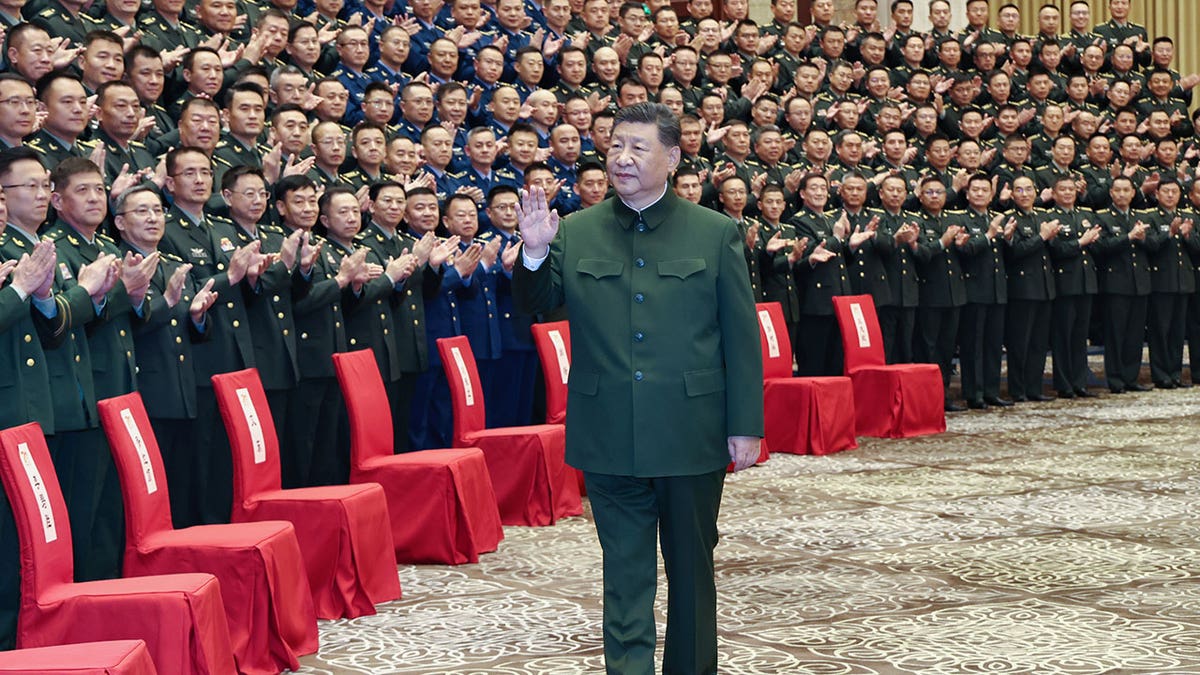
Chinese President Xi Jinping, also general secretary of the Communist Party of China Central Committee and chairman of the Central Military Commission, meets with representatives of military personnel. (Li Gang/Xinhua via Getty Images)
Beijing “prefers to achieve unification without the use of force, if possible,” but the People’s Liberation Army is still developing plans and capabilities for a possible military operation, the report said.
Retired Navy Capt. Brent Sadler, a senior fellow at the Heritage Foundation, said the assessment risks being interpreted too broadly if policymakers focus only on China’s current intentions rather than its growing capabilities.
“Intentions can change in a second in New York,” Sadler told Fox News Digital. “Xi Jinping might wake up and decide, ‘I don’t want to go to war today,’ but he might wake up tomorrow morning and say, ‘Yeah, it’s the big day.’ The real problem is where the money goes and where the equipment goes. »
The annual threat assessment, produced by the Office of the Director of National Intelligence, reflects the coordinated analysis of the U.S. intelligence community and is mandated by Congress to provide lawmakers with an unclassified overview of the most pressing global threats. The report is compiled with input from all intelligence agencies based on updates over the past year.
The assessment is released annually in classified and unclassified forms, with a public version intended to describe key threats without revealing sensitive intelligence sources or methods.
U.S. intelligence officials also note that any decision by China to use force would depend on several factors, including military readiness, Taiwan’s political trajectory and possible U.S. intervention on behalf of the island.
The report warns that a full-scale invasion would be difficult and risky, particularly if US forces were involved, with Chinese officials acknowledging that such an operation would be “extremely difficult” and carry a high risk of failure.
Piero Tozzi, a senior fellow at the America First Policy Institute’s China Center, said Beijing was still focused on trying to take Taiwan without direct military confrontation.
“What they want is to win Taiwan without war,” Tozzi told Fox News Digital, instead highlighting what he described as ongoing “cognitive warfare” efforts targeting Taiwan’s political system and public opinion.
He added that a full-scale amphibious invasion would come at a high cost to China.
“A real invasion of Taiwan would be very bloody,” Tozzi said. “If you had a maritime invasion of Taiwan and casualties, that would mean the annihilation of entire family lines by the tens of thousands. That would cause serious internal unrest in China and threaten the regime.”
More broadly, the intelligence community believes that China continues to expand its military power and global influence while seeking to “buy time to strengthen its position” in its long-term competition with the United States.
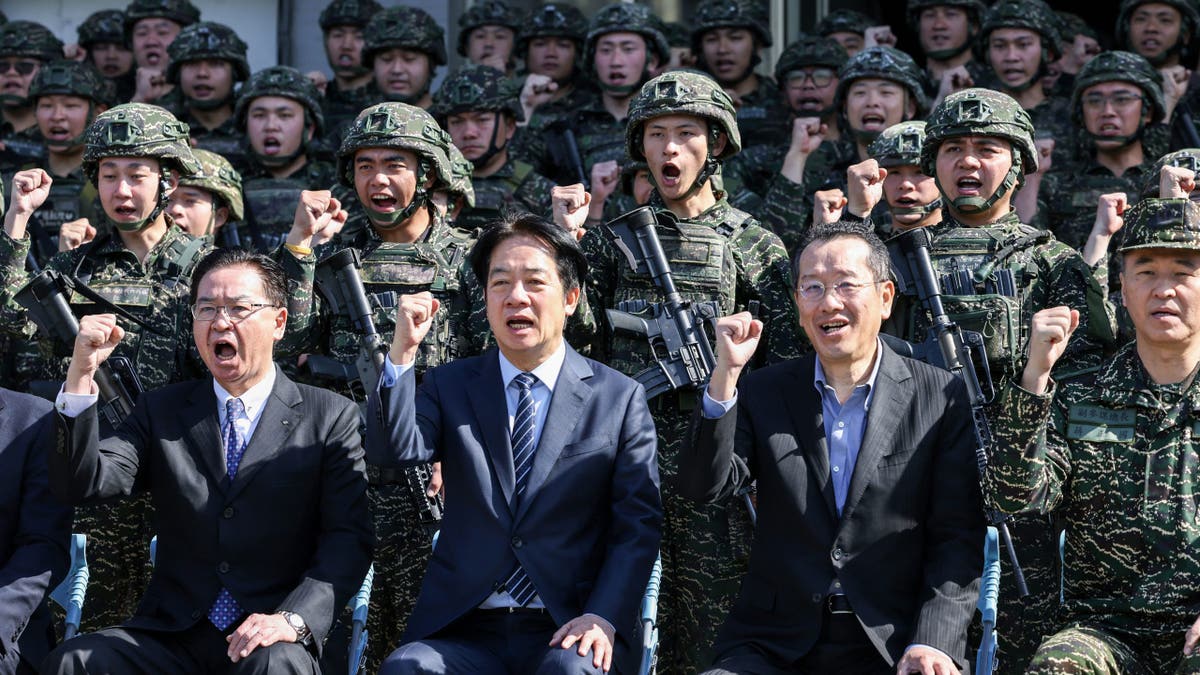
Taiwan National Security Council Secretary General Joseph Wu, Taiwan President William Lai and Taiwan Defense Minister Wellington Koo pose for photos with soldiers during their visit to the troops. (I-HWA CHENG/AFP via Getty Images)
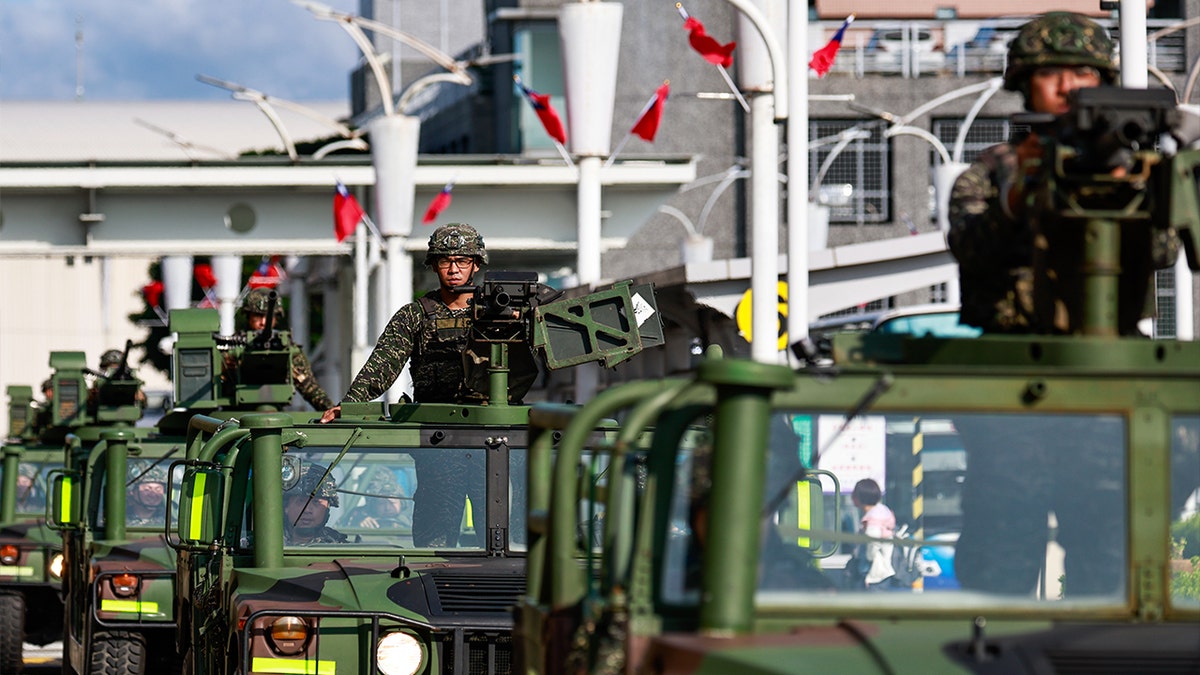
The updated assessment comes as the United States remains heavily engaged in a high-intensity conflict with Iran, raising new questions among defense analysts about how global tensions could shape Beijing’s calculus on Taiwan. (Daniel Ceng/Anadolu via Getty Images)
CHINA-LINKED BIRTH TOURISM UNDER EXAMINATION AS GOP LAWS PACK TRUMP ADMIN FOR ANSWERS
The updated assessment comes as the United States remains heavily engaged in a high-intensity conflict with Iran, raising new questions among defense analysts about how global tensions could shape Beijing’s calculus on Taiwan.
Although the report does not directly connect the recent Iranian conflict to China’s timeline, it highlights a broader environment of growing geopolitical competition, military modernization and regional instability that could influence Beijing’s future decisions.
CLICK HERE TO DOWNLOAD THE FOX NEWS APP
At the same time, the intelligence community warns that Iran will likely continue to pose a threat to U.S. interests following recent military strikes, noting that Iran “will almost certainly seek revenge” for the death of its supreme leader.
Even without near-term action regarding Taiwan, the report makes clear that the risk of conflict with China remains, as Beijing continues to prepare for a range of military contingencies while pursuing its long-term goal of unification.


