US lawmakers vote to cut science spending—but reject Trump’s sweeping reductions


May 1, 2026
3 min reading
 Add us on GoogleAdd SciAm
US lawmakers vote to cut science spending, but reject Trump’s sweeping cuts
One bill would preserve NASA’s overall funding but cut the National Science Foundation’s budget by 20 percent.
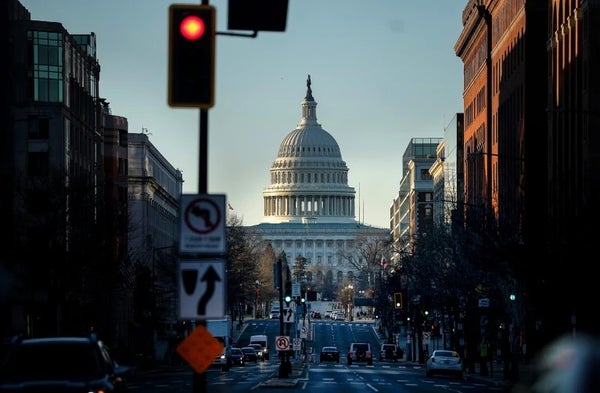
President Trump’s proposal to slash spending at a number of key science agencies was rejected Thursday by a congressional panel.
Kevin Dietsch/Getty Images
Members of the US House of Representatives have indicated they will once again reject US President Donald Trump’s administration’s proposal to slash science spending. But the bill introduced Thursday by a House subcommittee still calls for substantial cuts to science education and spending at agencies such as the National Science Foundation (NSF). The Senate, which also has a say on federal budgets, has yet to schedule a hearing on its own spending bill.
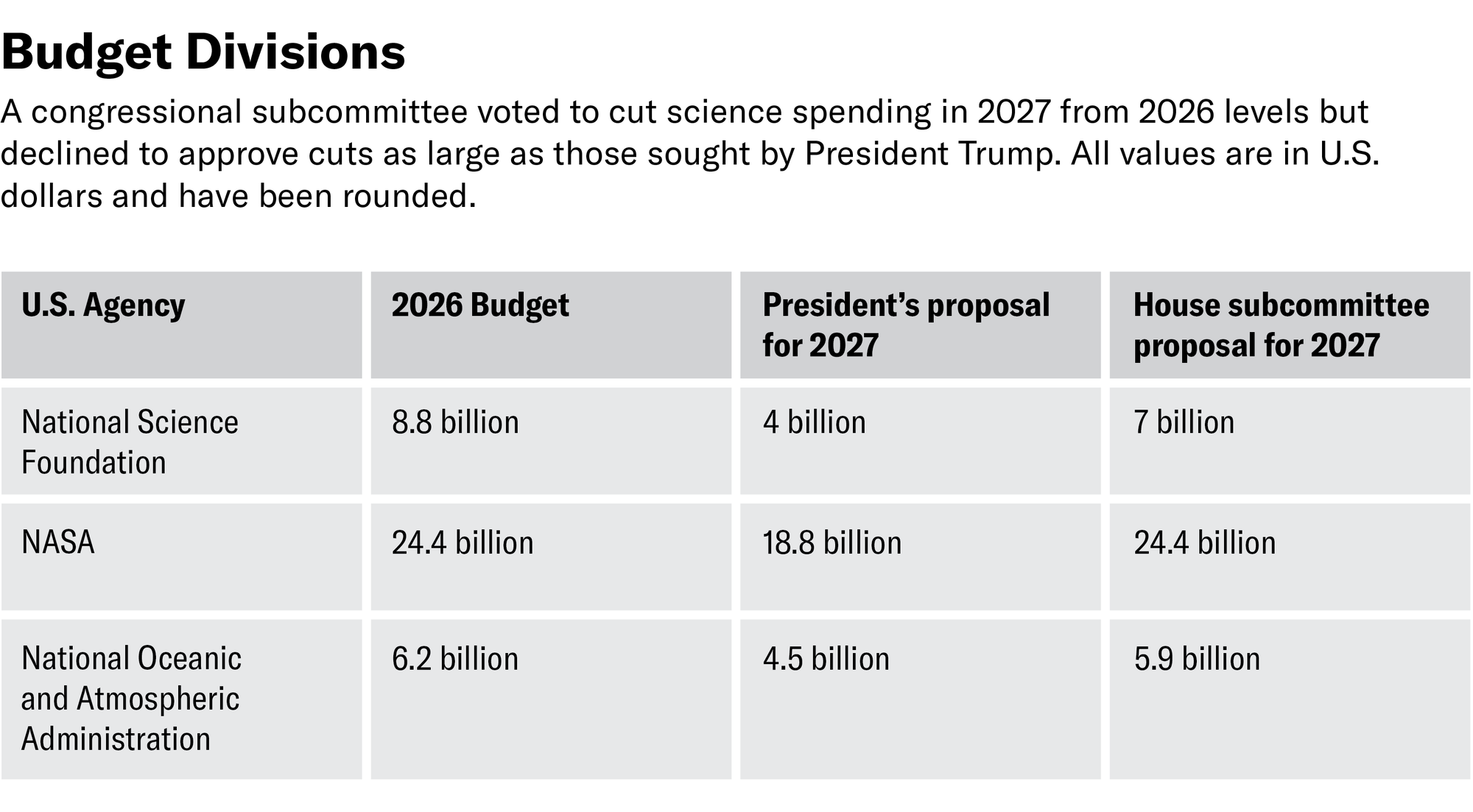
Last year, the Trump administration proposed unprecedented cuts to science agencies in 2026, but Congress rejected those cuts and instead kept science spending relatively stable. In April, the Trump administration tried again, calling for NSF spending in 2027 to decline by 55 percent from 2026 levels and for spending at the U.S. National Oceanic and Atmospheric Administration and NASA to decline by more than 27 percent and 23 percent, respectively. According to the administration’s 2027 budget proposal, “every tool in the executive’s budget toolbox has been used to achieve real savings.”
On Thursday, members of the House Appropriations, Commerce, Justice, Science and Related Agencies Subcommittee voted to cut 2027 NSF spending by 20 percent and NOAA spending by 5 percent (see “Budget Divisions”). Subcommittee members also voted to keep NASA’s total budget — which covers things such as spacecraft development as well as science missions — at roughly its current level. (A separate House subcommittee oversees funding for the National Institutes of Health.)
On supporting science journalism
If you enjoy this article, please consider supporting our award-winning journalism by subscription. By purchasing a subscription, you are helping to ensure the future of impactful stories about the discoveries and ideas shaping our world today.
All eight Republicans voted for the bill, while all six Democrats voted against it, sending it to the Appropriations Committee on May 13.
“I disagree with the approach of this bill,” said Grace Meng, a Democrat representing New York. “We should double our investments in science. »
The bill “right-sizes government while refocusing agencies on their core missions,” said Tom Cole, Oklahoma Republican and chairman of the full House Appropriations Committee.
The U.S. Senate will draft its own version of the spending legislation in the coming months, and then the House and Senate will iron out any differences between their proposals. The final spending bill will then be sent to the White House for Trump to sign.
Last year, the Senate proposed slightly smaller cuts to science agencies than the House. The final spending figures were closer to those of the Senate than those of the House.
A White House spokesperson did not respond to questions from Nature about the House bill.
Invest in the future
Although the House bill would maintain overall spending for NASA, it would reduce the agency’s science funding to $6 billion in 2027, below its current level of $7.2 billion — but well above the Trump administration’s $3.9 billion request. Subcommittee members from both sides praised the recent Artemis II mission to the Moon. “That’s why we continue to support innovation and NASA in this legislation to ensure we continue to make history,” Cole said.
Democrats have expressed concerns about cuts to science education at NASA and the NSF. “These cuts represent a failure, a failure to invest in the future to ensure that the next generation of world-class engineers, inventors, researchers and technicians are trained here in the United States,” said Rosa DeLauro, a Connecticut Democrat and ranking member of the Appropriations Committee.
Some scientists have also opposed these reductions. “If this comes to fruition, no matter how little science we still pay for, NASA won’t be able to tell us about it,” Katie Mack, a theoretical astrophysicist and science communicator at the Perimeter Institute in Waterloo, Canada, said on social media.
The House bill would slightly increase total funding for the National Institute of Standards and Technology (NIST), but $275 million of the budget would go toward specific projects sought by individual members of Congress, rather than funding the agency itself.
The bill would also reduce NOAA’s operations, research and facilities account by about $500 million from its 2026 level.
Whatever funding levels Congress sets, the White House Office of Management and Budget (OMB) could still delay authorizing agencies to spend that money. Such setbacks hit both the NSF and the U.S. National Institutes of Health in 2026, leading to delays in funding new research grants.
One science policy expert expressed concern that Congress is not interested in OMB’s actions. “Even if these [budget] the numbers are bad, they are likely to get worse as OMB tries to exert control over spending,” said Cole Donovan, director of science policy and advocacy for Stand Up for Science, a nonprofit science activism organization in Atlanta, Georgia.
The OMB did not respond to a request for comment.
This article is reproduced with permission and has been published for the first time May 1, 2026.
It’s time to defend science
If you enjoyed this article, I would like to ask for your support. Scientific American has been defending science and industry for 180 years, and we are currently experiencing perhaps the most critical moment in these two centuries of history.
I was a Scientific American subscriber since the age of 12, and it helped shape the way I see the world. SciAm always educates and delights me, and inspires a sense of respect for our vast and magnificent universe. I hope this is the case for you too.
If you subscribe to Scientific Americanyou help ensure our coverage centers on meaningful research and discoveries; that we have the resources to account for decisions that threaten laboratories across the United States; and that we support budding and working scientists at a time when the value of science itself too often goes unrecognized.
In exchange, you receive essential information, captivating podcasts, brilliant infographics, newsletters not to be missed, unmissable videos, stimulating games and the best writings and reports from the scientific world. You can even offer a subscription to someone.
There has never been a more important time for us to stand up and show why science matters. I hope you will support us in this mission.