Violent guerrillas are taking Colombia’s children. Unarmed Indigenous groups are confronting them

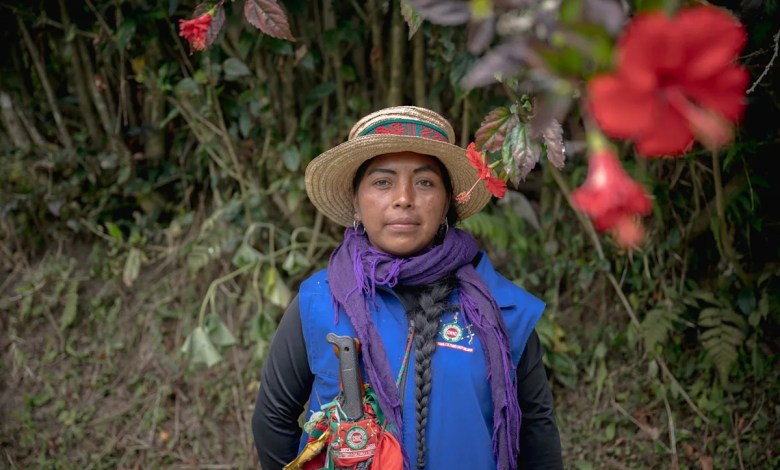
Caldono, Colombia (AP) – When the 13 year old son of Patricia Elago Zetty disappeared in the southwest of Colombia, she did not hesitate. Elago and five colleagues in the Aboriginal Guard traveled a mountainous land to face the guerrillas they suspected of having taken his son and another teenager to strengthen their ranks.
When the members of the unarmed guard reached the Camp of the guerrillas, around 30 fighters arrested them under the threat of a weapon. After a tense wait, a large commander came out of a door, and Elago said she had come for her son. The commander said he would “check” if the boy was there.
After about an hour of negotiations and radio calls, five other guerrillas arrived with his killed son and the other boy. When she saw Triven, said Elago, I felt like her soul returned to her body.
“He hugged me and said to me:” Mom, I never thought you would risk so much “,” she said in an interview with the Associated Press. “It was a victory.”
Rescue missions like CEGLA intensified themselves for the Aboriginal Guard of the NASA people, which formed in 2001 to protect the indigenous territories against armed groups and environmental destruction such as deforestation and illegal exploitation. Since 2020, while armed groups have been tightening their control of the NASA territory to extend illicit cultures such as marijuana and Coca, these guerrillas have increased their recruitment of children in the region by swinging money and protection offers.
More than eight days reporting in the Cauca region, the AP spoke to more than 20 young people affected by recruitment as well as several families struggling with the same threat. Some young people had escaped, others were rescued and some have chosen to stay with the groups.
Guns against a staff his CRED
Colombia has endured more than half a century of internal conflicts fueled by inequalities, litigation and drug trade. Left guerrillas, right -wing paramilitaries and criminal groups fought for control of the territory – with rural, native and Afro -Colombian communities taken in cross -fires. A 2016 peace agreement ended the war with the largest rebellious group in the country, the Revolutionary Armed Forces in Colombia, or Farc, but violence has never stopped entirely.
Since the agreement, the recruitment of children has been mainly motivated by the FARC dissident groups which have rejected the peace process. The ELN, a marxist guerrillas active since the 1960s, and the Del Golfo clan, the largest drug trafficking gang in Colombia, also forcibly recruited minors.
Violence is hung on the region. During the AP visit, two FARC veterans who slept arms under the peace agreement were slaughtered near Caldono. At the same time, families reported the disappearance of several young people – who would have been recruited.
This is the climate in which the guard, known as Kiwe Thegna in the Nasa Yuwe language, works now.
For NASA, Coca has a deep cultural, spiritual and medicinal meaning. Its exploitation to produce cocaine is considered by many as a distortion of a sacred plant – which feeds violence and environmental destruction.
The members of the guard carry “Bastones of Autridad” – the sacred personnel symbolizing moral leadership and collective responsibility. Staff are often decorated with traditional colors of red and green – which represent blood and earth – and emblems. Elago, 39, had a small photo of his son on his.
Impregnated with spirituality, the staff should offer protection against damage, giving members of the guard the courage to confront armed groups. However, more than 40 members of the guard have been killed since the peace agreement, according to the indigenous council of Colombia in Cauca (CIC), a long -standing organization representing NASA and other indigenous communities.
“They wear firearms – we carry staff. The staff represent our life, our courage,” said Elago. “They targeted their rifles on us … hurried to our breasts, at our heads.”
Elago said the rebels that his group had confronted three years ago had expressed their respect for the guard, but said the boys had voluntarily joined, which strengthened it. She said that Stiven had left the house the day he disappeared to perceive wages due to her for agricultural work near a COCA culture area controlled by the FARC dissidents.
She said that she challenged them: “You are talking about respecting the natives, but you kill our youth. What respect is it?”
A rebel told him that he had never seen a mother speak so boldly. But another warned: “Be careful, mom. You already feel formaldehyde ”, a chemical used to preserve corpses.
Not all rescues succeed.
Eduwin Calambas Fernandez, Kiwe Thegna coordinator in Canoas, an indigenous reserve in northern Cauca, described an attempt from 2023 to bring two adolescents recruited via Facebook. They met commanders, only to find that the boys aged 15 and 16 did not want to come back and were considered by the armed groups old enough to decide for themselves. Calambas said the main armed faction of its region said it would no longer make recruits 14 years of age or more in their families.
Children are attracted to promises of liquidity, cosmetic treatments or food for their families, according to the association of native advice from Northern Cauca, or Acin. Once inside the camps, many suffer from physical violence, political indoctrination and sexual violence – especially girls.
“Once, it is very difficult to leave,” said Scott Campbell, United Nations Human Rights Head in Colombia.
ACIN has documented 915 cases of native young people who have been recruited there since 2016, some as young as 9 years. Acin has warned against a sharp increase in recent times, with at least 79 children recruited between January and June.
The Ombudsman office of Colombia confirmed 409 cases of children’s recruitment in 2024, against 342 the previous year, with more than 300 cases only in the Cauca, one of the poorest departments of Colombia.
Campbell described the Colombian government’s response as “ineffective and premature”, noting a lack of presence of the coherent state and not to associate with the Aboriginal authorities on prevention. Acin said the government had left armed groups to fill the void by providing roads, food and other basic services in distant and neglected areas.
Colombia Family Welfare Institute, or ICBF – The main agency protecting children – said Community programs and initiatives led by Aboriginals who contributed to 251 children leaving armed groups at first seme
Armed groups breathe in the neck
From his high class in the mountains, Luz Adriana Diaz looks at the children arriving every morning in the shade of a conflict that they are too young to grasp completely. Its small school in the village of Manuelico – accessible only by a winding road from Caldono – is surrounded by dense forests and coca fields planted and patrolled by armed groups. The banners promoting Dagoberto Ramos in front of the Farc – one of the most violent factions in the Cauca – drag along the side of the road.
“Since 2020, it has been very sad – threats, recruitment, murders … living in the midst of violence,” said Diaz.
Diaz spent 14 years teaching through the municipality of Caldono, but says that in this village, surrounded by Coca, the presence of armed groups felt so constant. The teachers “work with them breathing the neck,” she said.
The Aboriginal Guard has intensified patrols outside the school to discourage recruitment. Diaz says that the members of the armed group came to school to buy food, borrow chairs and interact with casualness with the staff.
“We can’t say no,” she said. “I had to be very careful.”
Several former students, some as young as 11 years old, are now in armed groups, she said. Some left quietly. Others have been taken.
A young woman who recently fled the Farc dissidents, speaking under the guise of anonymity for fear of reprisals, said that she had joined the armed group not because she was forced but to escape family problems.
She said she was cooking mainly, organized supplies and cleaned weapons. She was afraid at first but was not mistreated. She finally fled after a change of commanders left her fearing a harder treatment or that he was transferred to a distant region with an increased combat threat.
Now she works with a local initiative that helps families trying to prevent their children from being recruited. She warns adolescents of the risk of joining armed groups.
As for the parents, she said: “I tell families that they must strengthen confidence with their children.”
A mother, once a recruit herself, fears the same thing for her children
Fernández, a woman in the middle of the thirties who asked to be identified only by her last name for fear of reprisals, was 12 years when armed men came to seek her in her Cauca rural community. Terrified, and without a clear way to say no, she joined the ranks of the Farc. In the years that followed, she said that she endured rape, psychological abuses and famine and saw brutal punishment against those who tried to escape.
His escape, three years after being taken, came by chance. One night, a commander sent him to charge a mobile phone. Instead of coming back, she hid for days in a neighboring house, protected by civilians who risked their lives to house it, before fleeing the region.
Now, raising three children in a village near Caldono, she looks at and worries about her eldest son, now 12 years old.
“Young people are so easily dupled … We show them a little money or a mobile phone, and they think that’s how life works,” she said. “Then they are sent to combat areas where so many children die.”
___
The climate and environmental coverage of the Associated Press receives financial support from multiple private foundations. AP is solely responsible for all content. Find the AP standards to work with philanthropies, a list of supporters and coverage areas financed at AP.ORG.


