
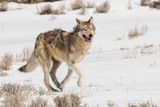
A wolf pup has been caught red-pawed stealing a signpost in Yellowstone National Park.
According to Taylor Rabe, a wolf technician at Yellowstone, who filmed the pup and its daring escapade, the event took place after six young wolves in the Junction Butte pack separated from the adult members of the group.
While that may sound like a cause for concern, these separations aren’t uncommon and often occur when the pups are keen to stay put in a certain area, Rabe explained in an Instagram post, often because they have discovered something smelly. It is during these moments apart from their elders that the pups are spotted being extra mischievous, Rabe added.
In this instance, the young wolf got his paws on a closure sign installed by the park’s Bear Management team to warn visitors of possible grizzly activity, and took off with his prize, much like a dog with a very large stick.
Wolf Pups in Yellowstone National Park and the Benefit of Play
Play is an important part of wolf culture – older wolves in other packs have even been spotted bringing “toys” (read: branches, stones, antlers, and other goodies scavenged from the forest floor) to their dens, according to the National Park Service (NPS).
In research studies, scientists have discovered that very young pups (those aged just 2 to 9 weeks old) display an earlier rate of development when it comes to playing with toys than dog pups. According to a paper published in the International Journal of Play, they even show a preference for certain toys – just like their domesticated relatives.
Play and play fighting continue throughout childhood and into adulthood, a fact that has been linked to their highly social dynamics and their need for cooperation when hunting, breeding, and defending territory. According to a study in Animal Behavior, the activity may also be used to assess social relationships and reduce incidents of aggression within the pack.
Indeed, the researchers found that pairs of wolves who spent more time in a relaxed state of play (as opposed to a competitive state of play) went on to exchange more friendly interactions outside of play.
Meanwhile, although competitive play was associated with lower rates of aggression in mixed-age packs, this was not the case in puppy-only packs. Researchers suggest that this may come down to the fact that a clear hierarchy has not fully established itself among young pack members.
Read More: Rare Footage of Wolf Stealing Bait May Be First Reported Example of Tool Use in Species
The Wolves of Yellowstone National Park
The playful pup that Rabe filmed is a yearling and one of at least 124 individual wolves currently present in the park as of January 2023, according to the NPS, who track and monitor the wolf populations for management and research purposes.
Wolves were only reintroduced to Yellowstone in 1995 after a 70-year hiatus brought about by habitat loss and hunting. Between 1995 and 1997, 41 wild wolves were parachuted in from Canada and northwest Montana to repopulate the park and restore the natural ecosystem.
Initially, many dispersed to nearby regions, but over the last few decades, the wolves have established a permanent presence in Yellowstone alongside cougars, grizzlies, black bears, bison, and elk. There are now 11 packs roaming the park, including the young wolf’s family, Junction Butte.
Read More: Red Fox Caught on Camera Preying on a Wolf Pup in First-Ever Video-Documented Case
Article Sources
Our writers at Discovermagazine.com use peer-reviewed studies and high-quality sources for our articles, and our editors review for scientific accuracy and editorial standards. Review the sources used below for this article:


