Webb and Hubble telescopes combine forces for a new view of Saturn

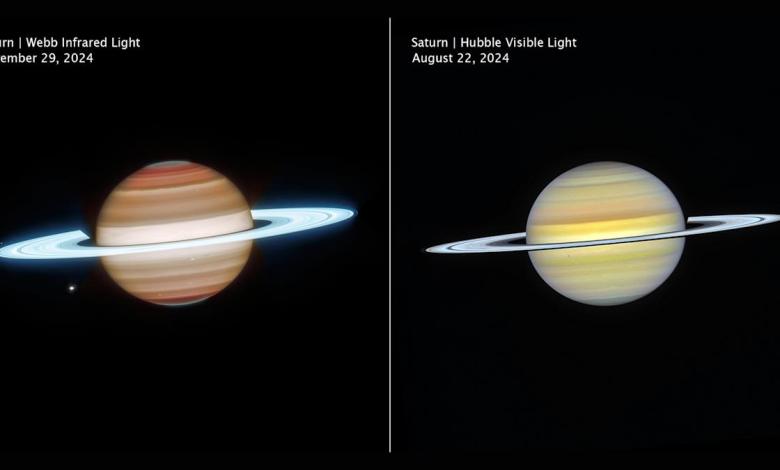
ESA, NASA and CSA have released new images of Saturn captured by the James Webb and Hubble space telescopes that provide an unprecedented view of the gas giant’s atmosphere. In particular, comparing images captured with Hubble with an infrared view from Webb highlights details of the composition and motion of Saturn’s outer layers.
The Hubble images were captured as part of the Outer Planet Atmosphere Legacy program in August 2024, while the Webb images were taken a few months later. “Both detect sunlight reflected from Saturn’s clouds and mists,” NASA explains, “but where Hubble reveals subtle color variations across the planet, Webb’s infrared view detects clouds and chemicals at different depths of the atmosphere, from deep clouds to the thin upper atmosphere.”
Hubble has historically been used to track storms on Saturn, and you can see bands of atmospheric clouds in the new photo from the telescope. The Webb telescope’s infrared sensors are able to highlight even more details, like the highly reflective ice of Saturn’s ring, virtually white in the photo, and the gray-green hues at the planet’s poles. The different coloration in Webb’s photo could be caused by “a high-altitude aerosol layer” scattering light across latitudes, or by “charged molecules interacting with the planet’s magnetic field” and causing “auroral activity.”
The visual information from both telescopes is valuable to scientists and is expected to prove increasingly valuable over time. “These 2024 observations, taken 14 weeks apart, show the planet moving from northern summer toward the 2025 equinox,” NASA explains. “As Saturn transitions into austral spring and then austral summer in the 2030s, Hubble and Webb will gradually have a better view of this hemisphere.”


