Webb Detects Giant Clouds of Helium Leaking from WASP-107b


Using high-precision spectroscopic observations from the Near Infrared Imager and Slitless Spectrograph (NIRISS) aboard the NASA/ESA/CSA James Webb Space Telescope, astronomers have detected helium gas escaping from WASP-107b, a super-Neptune exoplanet located approximately 212 light-years away in the constellation Virgo.
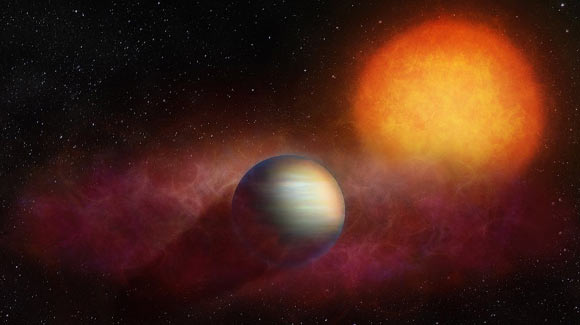
Artist’s impression of the exoplanet WASP-107b. Image credit: University of Geneva / PRN PlanetS / Thibaut Roger.
WASP-107 is a very active K-type main sequence star located approximately 212 light years away in the constellation Virgo.
First discovered in 2017, WASP-107b is one of the least dense exoplanets known – a type that astrophysicists have dubbed “super-puff” or “cotton candy” planets.
The planet orbits very close to the star – more than 16 times closer than Earth is to the Sun – once every 5.7 days.
Its atmosphere is one of the coldest of any discovered exoplanet, although at 500 degrees Celsius (932 degrees Fahrenheit) it is still radically warmer than Earth.
The high temperature is thought to be the result of tidal heating caused by the planet’s slightly non-circular orbit and may explain how WASP-107b can be so inflated without resorting to extreme theories about how it formed.
“Sometimes a planet’s atmosphere escapes into space,” said Yann Carteret, an astronomer at the University of Geneva, and his colleagues.
“This is the case for the Earth, which irreversibly loses a little more than 3 kg of matter (mainly hydrogen) every second. »
“This process, called atmospheric escape, is of particular interest to astronomers for the study of exoplanets located very close to their star, which, heated to extreme temperatures, are precisely subject to this phenomenon.”
Using data from Webb’s NIRISS instrument, astronomers detected a vast flow of helium in WASP-107b’s exosphere.
This cloud partially blocks the star’s light before the planet even passes in front of it.
“Our atmospheric escape models confirm the presence of helium flows, both in front and behind the planet, extending in the direction of its orbital motion up to nearly ten times the planet’s radius,” Carteret said.
In addition to helium, astronomers were able to confirm the presence of water and traces of chemical mixtures (including carbon monoxide, carbon dioxide, and ammonia) in WASP-107b’s atmosphere.
These are valuable clues to reconstruct the history of its formation and migration.
According to the researchers, the planet formed far from its current orbit and then moved closer to its star, which would explain its swollen atmosphere and loss of gas.
“On Earth, atmospheric leakage is too small to drastically influence our planet,” said Vincent Bourrier, an astronomer at the University of Geneva.
“But this would be responsible for the absence of water on our close neighbor, Venus.”
“It is therefore essential to fully understand the mechanisms at work in this phenomenon, which could erode the atmosphere of certain rocky exoplanets. »
The results appear in the journal Natural astronomy.
_____
V.Krishnamurthy and others. Continuous helium uptake by the front and rear tails of WASP-107b. Nat Astron, posted online December 1, 2025; doi: 10.1038/s41550-025-02710-8