Webb Peers into Brilliant Heart of Messier 77


New images from the NASA/ESA/CSA James Webb Space Telescope capture the barred spiral galaxy Messier 77 as a swirl of glowing dust, newborn stars and a brightly active core.
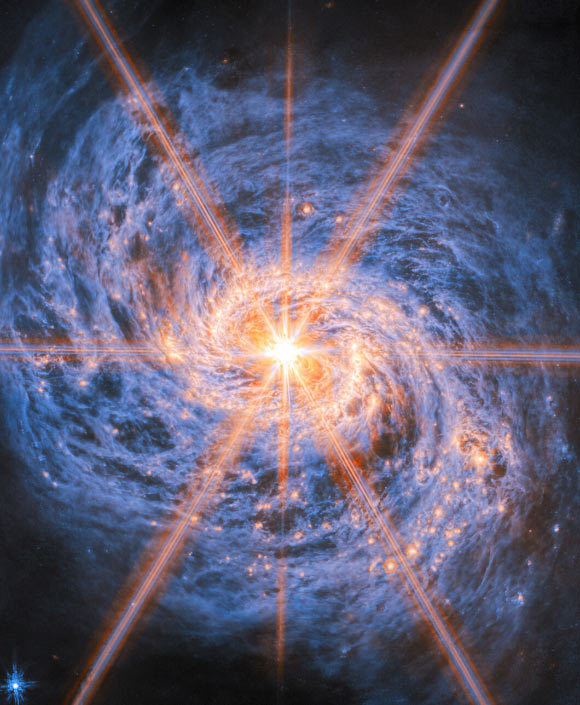
This image of Messier 77 taken by Webb’s MIRI instrument highlights its swirling spiral arms, the dust in its disk, and its core as piercingly bright as never before. The bright orange lines that appear to radiate from the center of the galaxy are not actually a feature of the galaxy: they are a type of distortion resulting from the optical design of the telescope. Called diffraction tips, they are created because intense light from unresolved AGN is very slightly bent (diffracted) around the edges of Webb’s hexagonal mirror panels and around one of the supports that support its secondary mirror. Image credit: NASA/ESA/CSA/Webb/A. Leroy.
Located about 62 million light-years from Earth in the constellation Cetus, Messier 77 is one of the brightest and best-studied galaxies in the night sky.
Also known as the Squid Galaxy, NGC 1068, LEDA 10266, and Cetus A, this galaxy has an apparent magnitude of 9.6.
Messier 77 was discovered by French astronomer Pierre Méchain in 1780, who initially identified it as a nebula. Méchain then communicated the discovery to his colleague, the French astronomer Charles Messier.
Messier believed the very luminous object he saw was a star cluster, but as technology advanced, its true status as a galaxy was revealed.
At 100,000 light years across, Messier 77 is one of the largest galaxies in the Messier catalog – so massive that its gravity causes other nearby galaxies to twist and warp. It is also one of the closest galaxies with an active galactic nucleus (AGN).
Messier 77 is also classified as a Seyfert type II galaxy, characterized by its particularly bright luminosity in infrared wavelengths.
“At the heart of Messier 77 is a compact region filled with hot gas that vastly dwarfs the rest of the galaxy combined, even exceeding the light-gathering capacity of Webb’s cameras,” Webb astronomers said in a statement.
“It is an AGN, powered by the central supermassive black hole of M77, which is eight million times more massive than our Sun.”
“Gas in the central regions of the galaxy is pulled by strong gravity into a tight, fast orbit around the black hole, where it crashes and heats up, releasing enormous amounts of radiation.”
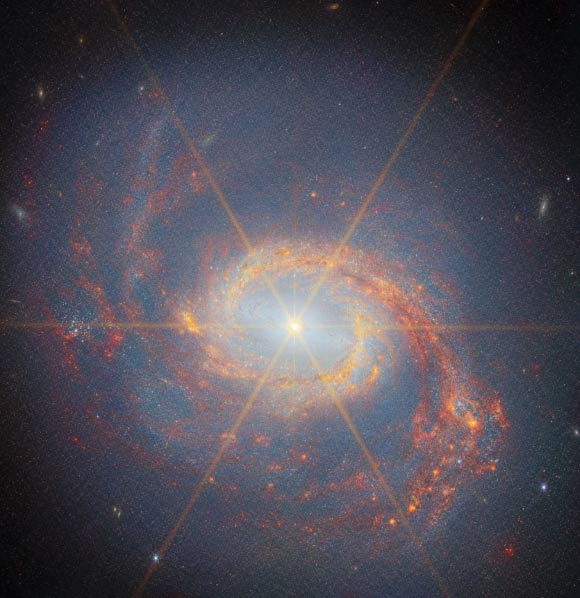
This image of Messier 77 was captured by the Webb Near Infrared Camera (NIRCam). Image credit: NASA/ESA/CSA/Webb/A. Leroy.
“Messier 77 is not only known for its easily visible AGN, but also as a prolific star-forming galaxy,” they added.
“The near-infrared image of Messier 77 reveals a bar extending across the central region, which does not appear in visible-light images of the galaxy.”
“The bar is surrounded by a bright ring, called the star ring, formed by the inner ends of the two spiral arms of Messier 77.”
“Starburst regions in galaxies are characterized by extremely high star formation rates. »
“This ring is more than 6,000 light years across and features intense, widespread stars, visible in this image by the densely concentrated orange bubbles all around the ring.”
“As Messier 77 is relatively close to Earth, this ring of stars is a very well-studied example of the phenomenon.”
“As an active spiral galaxy, Messier 77’s disk is filled with gas and dust that is both a product and fuel for future star formation.”
“Webb’s MIRI complements our view of the galaxy with the glow of interstellar dust grains emitted at longer wavelengths, shown here in blue.”
“The dust forms a huge vortex of smoky, swirling filaments with cavities in between.”
“Bright orange bubbles hollowed out by newly formed star clusters are also clearly visible along the arms of the galaxy.”
“Beyond Webb’s fairly focused view, Messier 77’s arms come together in a faint, extended ring of hydrogen gas several thousand light-years wide, where even more star formation takes place.”
“Vast, tenuous filaments of hydrogen gas extend through this ring and extend into intergalactic space, forming an outermost layer around the galaxy.”
“For the sprawling appearance of these filaments, Messier 77 is also named Squid Galaxy.”


