What comes next in the James Comey and Letitia James cases?


 Reuters
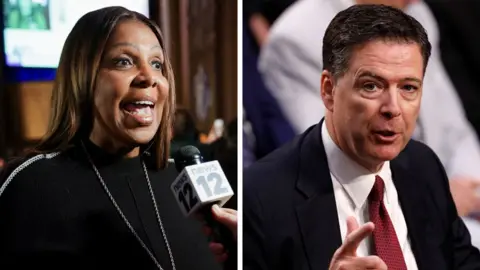
Two of President Trump’s most prominent critics scored legal victories Monday when a federal judge dismissed the government’s charges against them.
For weeks after their indictments, former FBI Director James Comey and New York Attorney General Letitia James furiously claimed they were innocent, saying the president and the Justice Department were only targeting them in retaliation.
U.S. District Judge Cameron Currie dismissed the indictments against them because prosecutor Lindsey Halligan’s appointment as U.S. Attorney was “invalid.” But it also left the door open for the government to try again.
Comey acknowledged that possibility after the ruling, saying he thought Trump would “probably come after me again.”
And White House spokesperson Abigail Jackson seemed to confirm it: “This will not be the final word on this matter.”
But the government faces serious obstacles in pursuing prosecutions after the setback, and experts are hesitant to predict what might happen next because of the unprecedented nature of the cases.
“It seems like uncharted territory to me,” said Kay Levine, a professor at Emory University Law School.
Could justice appeal?
The Justice Department can challenge Judge Currie’s decision to a higher court of appeal. In this case, it would be the Fourth Circuit Court of Appeals.
U.S. Attorney General Pam Bondi has indicated she will take that route, pledging to pursue all available legal action, including an “immediate appeal.”
In other cases, the Trump administration has aggressively appealed unfavorable rulings, appealing to lower courts and sometimes quickly forwarding its requests to the U.S. Supreme Court.
Abbe Lowell, an attorney representing James, vowed to “continue to challenge any new politically motivated charges through every legal means available.”
If appealed, the Justice Department would likely have its own lawyers defend the case, making Halligan’s role in the appeal unclear.
Could there be new accusations?
The government accused Comey of making false statements to Congress and obstructing justice. Federal prosecutors charged James with bank fraud and making false statements to a financial institution.
Both have pleaded not guilty. In addition to claiming Halligan was illegally appointed, both also claimed they were victims of vindictive lawsuits.
Once the initial indictments are dismissed (although, of course, appeals could change that), the government could attempt to convene new grand juries and obtain new indictments.
“From everything I’ve seen, another lawyer could take James’ case to a new grand jury and get a new indictment,” Ms. Levine said.
But John Day, president of the American College of Trial Lawyers, said it could be a complicated path — particularly in Comey’s case.
“I can tell you that the question of whether Mr. Comey’s case can be re-indicted if a legally appointed prosecutor is appointed and is able to obtain an indictment will be very controversial.”
He described the tangle of lawyers, judges and motions involved as a “procedural quagmire” with no simple answers.
It might be more difficult for the government to try to make the exact same accusations against Comey.
One problem is the statute of limitations — the amount of time prosecutors had to charge Comey with these specific allegations — which expired at the end of September. However, dismissal of the indictment would trigger a six-month grace period for the Justice Department to take over the case.
Also in that case, his legal team said it plans to argue that the government is out of time.
“The ruling further states that because the indictment is void, the statute of limitations has expired and there cannot be another indictment,” attorney Patrick Fitzgerald said Monday.
What’s happening to Lindsey Halligan?
In both rulings on the indictments against James and Comey, Judge Currie was blunt: Halligan was wrongly named.
Judge Currie wrote in James that “the Attorney General’s attempt to appoint Ms. Halligan as Acting United States Attorney for the Eastern District of Virginia was invalid.”
Therefore, Halligan “had no legal authority to present the indictment,” she wrote.
U.S. attorneys are appointed by the president and require confirmation by the U.S. Senate. Federal laws govern how people can be appointed on a temporary basis, but Judge Currie found Halligan’s appointment violated those laws.
That leaves, again, Halligan’s role in future cases against James and Comey.
The ruling could also cast a shadow over any other cases Halligan has filed in the Eastern District of Virginia where she serves.
But Bondi said Monday that she had made Halligan “a special American lawyer” and praised her work as “excellent.”
The White House maintained its position that Halligan was legally appointed, press secretary Karoline Leavitt told reporters Monday.


