What does Trump want in the Caribbean as US deploys warships?


Gerardo Lissardy and Caitlin WilsonBBC Mundo and BBC News

 Getty images
First, the United States has deployed several warships in the Caribbean. Then Donald Trump announced a fatal strike on a boat which, according to him, was carrying drugs.
What Washington then planned is not entirely clear, but some analysts tell the BBC that the risk of climbing in the region increases day by day.
Since the return of the American president according to January, the Trump administration has regularly intensified its anti-transformation efforts in Latin America. As part of this, the United States has apparently focused on Venezuela – an effort that has led to the mobilization of the military forces of the two countries in recent weeks.
After the bombing by Tuesday of a small ship in the Caribbean who would occur from Venezuela, officials of the United States clearly indicated that the military action of the region was not finished – alluding to more operations which could target drug trafficking.
On Tuesday, President Trump published images of the military strike in the Caribbean who, according to him, showed the murder of 11 “narcoterrorists” of the Venezuelan gang Tren de Aragua who, according to him, was aboard a small boat.
He said the ship was carrying “massive amounts of drugs” and was heading for the United States. In the oval office, Trump accused the South American country of being “very bad, both in terms of drugs and sending some of the worst criminals in our country”.
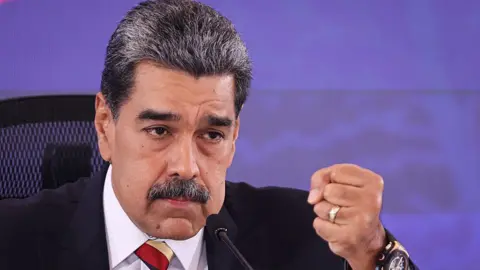
This decision occurred for weeks after the United States announced a reward of $ 50 million (37 million pounds sterling) for any information leading to the arrest of Venezuelan President Nicolás Maduro – whose election to lead the country was largely rejected by the international community – on accusations of drug trafficking.
Analysts who spoke to the BBC suggested that Trump’s last decision could have more than one goal in mind.
“ Trump tries to intimidate the diet ”
Defense secretary Pete Hegseth told Fox News on Wednesday morning that US military activity in the region “will not stop … with just this strike”.
It was a clear attempt to put pressure on Maduro, said a commentator.
The anterior naval accumulation was on a scale not seen in the region since 1965, according to Professor Alan McPherson, who specializes in American American relations at Temple University.
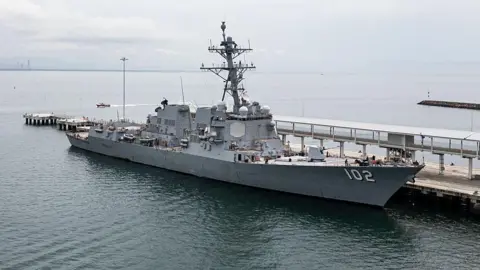
The Pentagon has so far been deployed destroyers of guided missiles, the Amphibian group Iwo Jima and a nuclear propulsion submarine, as well as P-8 intelligence planes and around 4,500 soldiers in the region.
The construction “recalls the days of” diplomacy of channels “over a century ago,” said Professor McPherson.
 Getty images
The Pentagon said deployments aimed at helping to stop drug trafficking and criminals’ actions, and would help the United States put pressure on drug networks in the region.
But the American navy could hope to strike more directly to Maduro or encourage internal revolt in the Venezuelan army, Professor McPherson said – although he recognized that “none of them would require such a flotilla”.
“Anyway, clearly, the Trump administration wants to intimidate the regime (Venezuelan).”
Stephen Donehoo, a former US military intelligence official specializing in Latin America, told the BBC that he had “never seen such a large deployment of naval forces in the Southern South region”.
However, it was “not a force to invade a foreign country,” said Donehoo.
“There could be other missions that they have, much more precise”, such as “armed drone missions overvaining the Venezuelan airspace,” he added.
Maduro has rejected the United States, the claims that he is directly involved in drug trafficking, which he considers a claim to overthrow his government. He also said that he would mobilize 4.5 million members of the country’s militia in response to the American deployment of warships.
But analysts say that the number of maduro is wildly swollen – and that the militia is barely formed and is generally only used to increase figures during political gatherings and parades, it is therefore not a combat force.
Maduro also promised that Venezuela “immediately declared a republic in arms” if it was attacked.
An unusual drug of drugs
US officials presented the strike as an effort to stop the drug flow in the United States – which was a key mission of Trump’s second term.
But it was an unusual operation, according to Rebecca Bill Chavez, chief of the reflection group of the Inter -American dialogue in Washington.
“If that (American movements) is a deployment of counterpins, this is unlike any deployment of countercostles that I have ever seen,” a former US subsecretary of state for the Western hemisphere told the BBC Ms. Chavez.
US maritime anti-drug operations are generally led by the Coast Guard, working with regional partners to intercept suspicious ships.
It is not clear if the United States was in contact with other Caribbean officials about Tuesday’s strike in advance.
“The risk of climbing at sea is real,” said Ms. Chavez.
The president himself told journalists in the oval office that “you see the drug bags all over the boat”, referring to video sequences which, according to him, showed the strike.
Venezuela is often used as a stop for the transport of cocaine – but the drug is mainly transported to the United States via the peaceful ocean rather than in the Caribbean, according to a 2023 United Nations report.
So far, officials have not explained how they determined that people aboard the targeted boat on Tuesday were members of Tren from Aragua, or what type of medication they believe that the ship was carrying.
The military strike has marked the strongest action that the Trump administration has taken against drug trafficking – and is something that, according to legal experts, may have violated international human rights and maritime law.
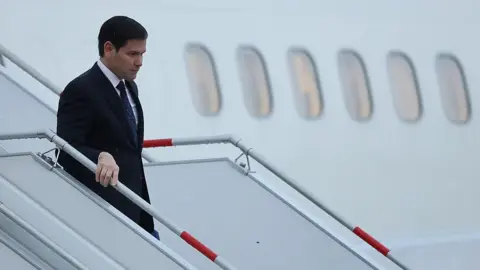
The Secretary of State, Marco Rubio, defended the operation and said that the United States could again take similar measures in the future.
“What will stop them is when you blow (drug traffickers),” he said during a visit to Mexico, deplores that the efforts of the previous United States to stem the profession had not been effective.
 Getty images
“ People are very confused about the real goal ”
Chavez says that the United States probably recognizes that it would be a “serious mistake” to launch any military intervention in Venezuela. It would be welcomed with armed resistance in the country and would also be unpopular return to the house – because it would come up against the non -intervention position professed from Trump.
The state’s under-secretary, Christopher Landau, seemed to refer to military climbing and reasoning behind the movements of an interview for the Podcast by Donald Trump Jr in August.
“I think you will see more actions in the coming days and weeks that will send messages, but ultimately the Venezuelan people must get up and claim their own freedom.”
“We cannot go around the world to change the governments of our whim,” said Landau at the time.
Despite its difficult position against drug trafficking, the Trump administration has always found ways to work with the Maduro government.
Caracas accepted the expenses expelled from the United States and the two countries concluded a prisoner exchange agreement in July. Washington then allowed the American oil company to regain work in Venezuela, a victory for Maduro.
These movements have angry certain Venezuelans and Cubans supported by Trump living in the United States which had hoped that the president could tighten the sanctions against the leftover governments of their country.
With “these three Aegis destroyers moving south (and) … Chevron expeditions moving north”, many observers receive mixed signals from the Trump administration, according to Ms. Chavez.
“People are very confused with regard to what is the real goal behind” the climbing of the American Caribbean, “she said.


