What Is the Sun’s Magnetic Field and Why Is It Important?


Key points to remember about the Sun’s magnetic field
- The Sun’s magnetic field impacts the movement of plasma on the Sun’s surface, but it has no real impact on the amount of heat emitted by the Sun.
- Solar flares, for example, are huge explosions that occur when the Sun’s magnetic fields bind together. The largest of these, called Class X flares, can cause global radio blackouts.
- The Sun’s magnetic field is constantly moving and changing and, in fact, is never the same.
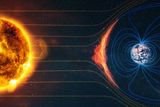
The Sun is a highly magnetic star with lines of magnetic energy rotating in all directions. And unlike Earth, which is surrounded by a much simpler magnetic field in that it can move north and south, the Sun’s magnetic fields are complicated, according to NASA, pulling this way and that and causing everything from sunspots to solar storms to solar flares.
What is the Sun’s magnetic field?
The Sun is a magnetic star with many magnetic fields. Its magnetism is generated by a very hot plasma.
It’s not solid, it’s made of gas and hot plasma, which is part of the reason it and gas planets are so magnetic. This is also why Saturn, Uranus, and Neptune are so magnetized, although less so than the Sun, and their fields come from conductive fluids within.
When these charged particles create movement, they also create a magnetic field. Part of its magnetism comes from the Sun and part returns to the star.
“The ions and electrons move around and create a magnetic field,” explains Holly Gilbert, acting deputy director of the National Center for Atmospheric Research.
Learn more: An increasingly weak point in Earth’s magnetic field could cause more satellites to short circuit
How the Sun’s magnetic fields create solar flares
The Sun’s magnetic field impacts the movement of plasma on the Sun’s surface, but it has no real impact on the amount of heat emitted by the Sun. Yet the Sun’s magnetism shapes solar activity within the solar system in several ways.
Magnetism is so fundamental to the Sun that it not only impacts the Sun; this impacts the solar system in many ways. Solar flares, for example, are huge explosions that occur when the Sun’s magnetic fields bind to each other, according to the ESA. The largest of these, called Class X flares, can cause global radio blackouts. Additionally, sunspots are dark spots on the surface of the Sun, according to NASA.
“Sunspots are really just a collection of very intense magnetic fields coming out of the surface of the Sun,” Gilbert explains.
And although sunspots appear very dark, they are not devoid of light. If you moved a sunspot away from the Sun, it would be about as bright as a full moon, she adds.
The Sun’s magnetic field is constantly moving and changing and, in fact, is never the same. Right now things are active because every 11 years the Sun gets so entangled in magnetism that it reaches what’s called “solar maximum.” Scientists don’t know why this happens every 11 years, but they know it does.
“That’s when we see the most sunspots and the most solar storms, because of the complexity of the magnetic field,” says Gilbert.
But at the other end of the spectrum is the “solar minimum,” when magnetic fields are not as shrouded and become simpler.
The impact of the magnetic field
Auroras on Earth are also caused by solar wind particles that are influenced by the Sun’s magnetism, as solar particles interact with Earth’s magnetic field to cause collisions with gases like oxygen and nitrogen that appear as brightly colored lights, according to NOAA. These cause the northern and southern lights.
Jupiter and Saturn have similar auroras for the same reasons. In 2016, the NASA/ESA Hubble Space Telescope captured stunning images of auroras on Jupiter with the north pole lit in blue and green, after being color-coded.
Ultimately, it’s all about this solar dynamo, a constant churning inside the Sun. When they become entangled, a large amount of magnetism is stored, which can lead to an explosion of solar energy, Gilbert explains.
Learn more: Earth particles travel to the Moon by hitchhiking along Earth’s magnetic field lines
Article sources
Our Discovermagazine.com editors use peer-reviewed research and high-quality sources for our articles, and our editors review the articles for scientific accuracy and editorial standards. See the sources used below for this article: