What Middle East Conflict Could Mean For The World’s Largest Whale Shark Gathering

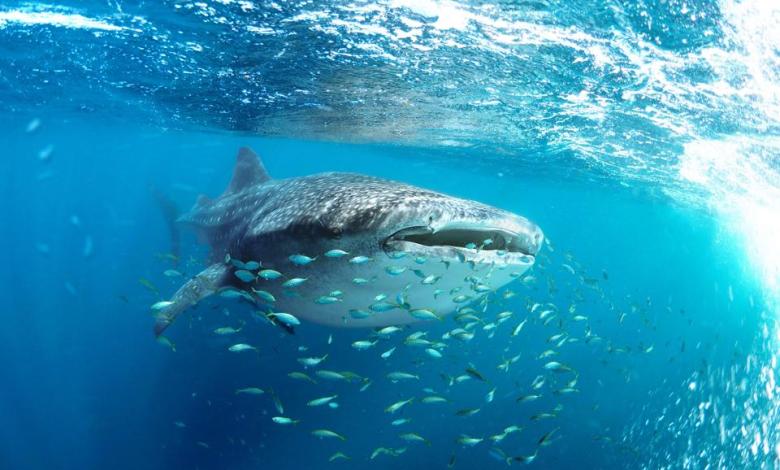
For the most part, the sea off northern Qatar appears ordinary. The azure waters are calm, small waves lapping on the surface breaking the glass facade. Ordinary. Normal. Until it doesn’t. Then the dorsal fins begin to appear. One becomes 10, which then becomes tens. Soon, hundreds of massive spotted bodies are moving just below the surface, mouths open, filtering clouds of fish eggs and other microscopic nutrients from the water.
Every summer, whale sharks arrive here to feed on tuna eggs concentrated by regional ocean currents and cyclonic eddies, which act like invisible funnels that herd microscopic food into dense patches that make the area exceptionally productive. Whale sharks are familiar with this annual buffet, which is why hundreds of individuals gather in the Al Shaheen area from April to September for one of the largest seasonal gatherings of endangered whale sharks on the planet.
The largest fish in the ocean, its distinctive pattern of pale spots and stripes is unique to each individual, much like a fingerprint, allowing scientists to track it over time and across oceans. Despite their size and global distribution in tropical and warm temperate waters, whale sharks are classified as endangered due to threats such as ship strikes, fishing pressure, habitat disruption, and pollution. Because they grow slowly and reproduce later in their lives, protecting key feeding areas where they congregate in large numbers is particularly important for the long-term survival of the species. In 2023, researchers have identified around 600 whale sharks in this region, at peak concentration. Numbers higher than this have not yet been documented anywhere else in the world, making northern Qatar not only one of the most important whale shark feeding grounds known in the world, but also a critical habitat for them.
Many people flock to this place from all over the world to catch a glimpse of these docile predators, or even perhaps swim among them. But that will not happen this year due to the sharp increase in maritime risks in the Strait of Hormuz and the surrounding Gulf region in recent months. With confirmed collisions against commercial vessels, disruptions at ports and increasing interference with shipping, it has created instability in waters that sit uncomfortably close to one of the most important feeding grounds for a species trying to come back from the brink of extinction. Because what else is concentrated in the water shaped by these same currents? Pollution, which can behave a bit like tuna eggs. If an oil spill, industrial discharge, or conflict-related contamination enters these waters, the same oceanographic conditions that gather food for whale sharks could also gather toxins. Instead of a buffet, sharks might encounter an exhibition hotspot. Instead of supporting survival, the environment could amplify risks.
So what happens if tuna roe decreases? Would whale sharks stop coming altogether or move to other feeding grounds that are already overpopulated or degraded? “Whale sharks are exceptionally adept at finding and exploiting food. Their movements are strongly driven by feeding opportunities, whether natural seasonal blooms or, in some cases, human-influenced systems,” says Dr Gonzalo Araujo, founder and director of the Marine Research and Conservation Foundation and research associate at Qatar University. “A decline in tuna spawning in this region would not necessarily mean a complete absence of food, but it could indicate that better feeding opportunities exist elsewhere.”
“In this case, whale sharks would likely change their distribution rather than remaining in a suboptimal environment,” adds Araujo. “This movement could be local – offshore, deeper in the water column, or even at different times of day – or it could involve larger-scale relocation to other concentration sites. If military activity in the Gulf disrupts tuna spawning or the oceanographic conditions that support it, the effects on whale sharks would be indirect but significant. Given their sensitivity to feeding conditions, there is a real possibility that they will leave the area – potentially for periods “However, the biggest concern is not just whether they leave the area, but whether they are driven to feed in degraded or polluted environments.

A whale shark, nearly 6 meters (20 feet) long, swims near the surface of plankton-rich waters.
AFP via Getty Images
There is much we don’t know about how animals respond to conflicts of this magnitude. What we do know is that whale sharks demonstrate high site fidelity in many parts of the world. And when conditions change quickly, animals that rely on predictable feeding events often have difficulty adapting. A single disrupted season may not cause visible collapse, but several consecutive seasons might. “We know from Qatar and other aggregation sites around the world that individuals return to the same feeding areas for many years. So if conditions stabilize and ecological factors – particularly prey availability – remain intact, there is reason to expect whale sharks to return even after a disturbance. If multiple seasons are affected, this could begin to erode the reliability of that aggregation site,” says Araujo. He points out that before the current conflict, the main threats to whale sharks in the region were ship strikes and interactions with fisheries, both targeted and accidental. The Strait of Hormuz, for example, has long been one of the world’s busiest shipping corridors, with many large ships moving at high speeds. Encounters with vessels of this size are very likely to be fatal for whale sharks and other surface-dwelling marine megafauna.
While it’s easy to associate whale shark conservation with snorkeling in clear tropical waters, some of the species’ most important habitats are found alongside shipping lanes, drilling platforms and industrial corridors. The northern Qatar aggregation serves as a reminder that conservation of endangered species does not only occur in isolated marine sanctuaries. This is happening in the middle of our war zones.
“Currently, there are no specific mitigation measures targeting whale sharks in response to the current situation. The most effective action, from an ecological point of view, is de-escalation. It is essential to reduce the risk of further environmental damage,” concludes Araujo. “The Arabian Gulf is home to an extraordinary diversity of marine life, including the world’s largest known aggregation of whale sharks and one of the largest remaining populations of critically endangered dugongs. Protection of these systems ultimately depends on maintaining environmental stability.”


