What should Venezuela do with El Helicoide, the notorious prison? : NPR

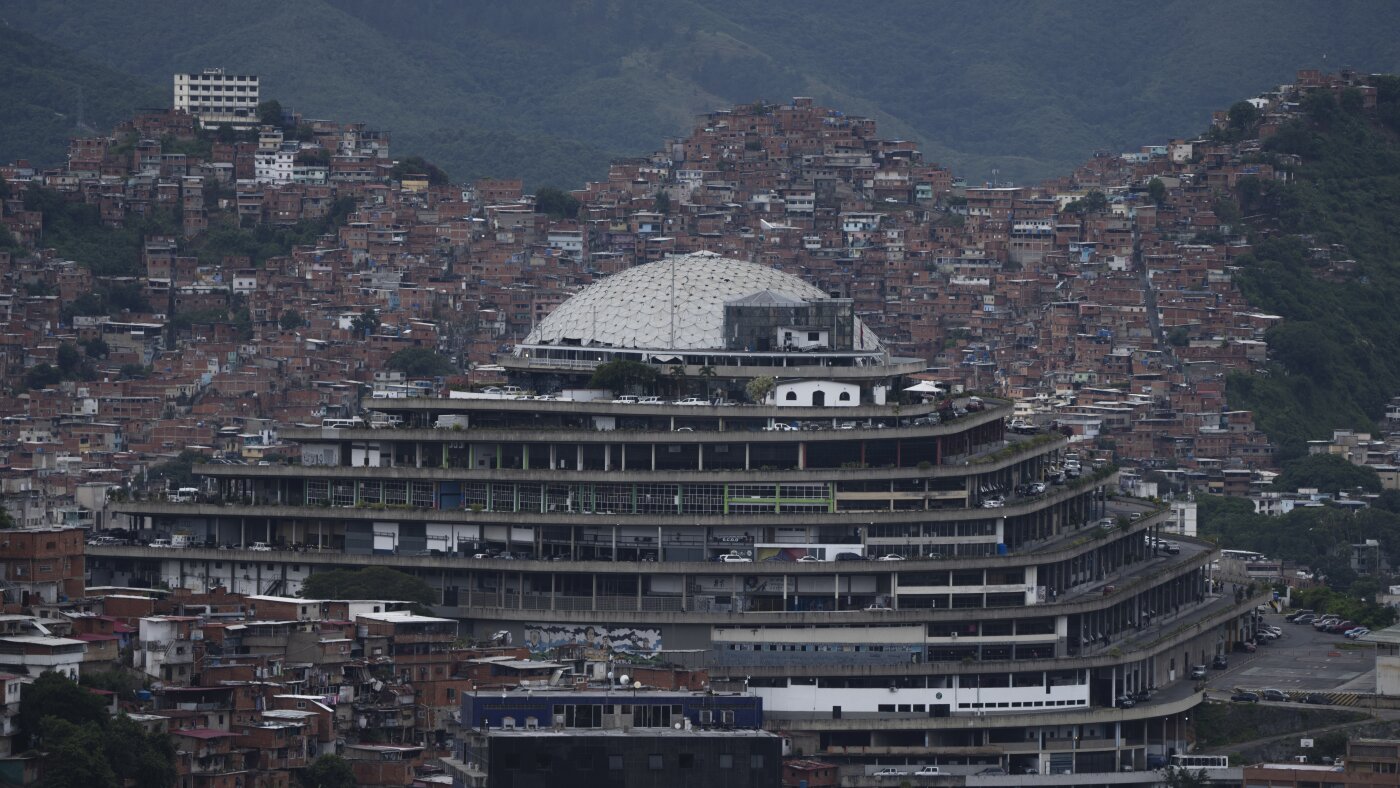

The headquarters of Venezuela’s National Intelligence Service, known as El Helicoide, stands in front of the La Cota 905 neighborhood in Caracas, Venezuela, September 12, 2022.
Ariana Cubillos/AP
hide caption
toggle caption
Ariana Cubillos/AP
CARACAS, Venezuela — Jesús Armas spent 14 months in El Helicoide, a notorious prison built atop a huge rock in the center of the capital Caracas.
One of the things that struck him most about this place was the lack of sunlight and the excess of artificial lighting.
For weeks, the activist was held in a small windowless room, where he had no contact with the outside world. Armas said prison guards never turned off the lights.
“There was always artificial light, always,” Armas said at a rally outside the prison, which has become synonymous with torture. “It makes you really anxious and a little paranoid.”
As Venezuela begins a slow and uncertain transition to democracy, politicians are looking for ways to dismantle a repressive system – which has imprisoned thousands of dissidents on trumped-up charges.
And a debate has erupted over what to do with El Helicoide, an imposing prison in central Caracas that was originally intended to be a futuristic shopping center but remained unfinished.
Venezuela’s interim president, Delcy Rodríguez, has proposed turning the imposing site into a sports complex that could be used by police officers and residents of two nearby slums.
But opposition leaders described the proposal as an effort to erase crimes committed at the prison, where inmates were often isolated for months and tortured by agents seeking information about the activities of opposition activists.

“I think El Helicoide should be a museum,” said Armas, released from prison in January following a U.S. raid on Caracas that led to the arrest of former President Nicolás Maduro.
“We should never forget what happened here.”
While many of Venezuela’s prisons have become sites of torture, El Helicoide stands out for its imposing architecture and unexpected descent into darkness.
The building was built in the 1950s as a shopping center for wealthy Venezuelans, in a country whose economy was booming thanks to its booming oil industry.
It has seven levels built between wide ramps that snake around a massive rock. From a distance, it looks like a flying saucer.
The wide ramps are lined with parking spaces overlooking spaces intended to be offices or stores.
“It’s really the first time driving through a mall,” said Celeste Olalquiaga, a cultural historian who published a book about El Helicoide in 2018.
She said the concrete structure, with its large terraced levels, impressed architects of the time.

“There was an article, I think it was in the Times that said, how is it possible that the United States, the country that develops malls and owns all these roads… never put them together and the Venezuelans did it,” Olalquiaga said.
But the ambitious mall was never finished.
When the dictatorship that ruled Venezuela collapsed in 1958, the project lost political support – and the loans that El Helicoide’s developers depended on. By 1960, construction was at a standstill.
Although the building’s famous ramps are completed, its levels remain incomplete, with no subdivisions for offices or businesses.
“Everything that involves finishing was missing,” Olalquiaga said. “There wasn’t even any plumbing or electricity infrastructure”
The building was abandoned and used briefly to shelter flood victims.
Then, in the 1980s, the government handed El Helicoide over to DISIP, the national intelligence police.
“Prison and torture activities then began,” Olalquiaga said.
Under the rule of Nicolas Maduro, human rights violations in El Helicoide have intensified.
Javier Tarazona, a human rights activist, was taken there.
For months, he was held in a 16-foot-wide cell known as “the Little Tiger” that he shared with two other inmates. He was only released from the room for questioning.
“They tried to suffocate me with a bag,” Tarazona recalled, adding that he was forced to take a psychotropic drug known as scopolamine by agents who wanted him to record confessions that they could use against opposition leaders.

El Helicoide, Venezuela’s intelligence headquarters and detention center, is in Caracas, Venezuela, January 9, after National Assembly President Jorge Rodríguez said the government would release Venezuelan and foreign prisoners.
Ariana Cubillos/AP
hide caption
toggle caption
Ariana Cubillos/AP
Today, the prisoners are leaving El Helicoide, as the Rodríguez government implements an amnesty law that has benefited hundreds of dissidents.
At the end of January, when she announced the amnesty law, Rodríguez said the building would be transformed into a sports complex. And in February, Venezuela’s Communications Ministry posted an edited video online showing drone footage of the building and saying work on El Helicoide had begun after nearby residents were consulted.
Tarazona says the building should become a memorial center – like Robben Island where Nelson Mandela was detained for more than 18 years in South Africa – so that the abuse suffered by prisoners is not forgotten.
“We need to focus on non-repetition and generating a collective memory of what happened here,” he said.
Historian Olalquiaga said the bankrupt mall is so large it could have multiple uses.
Currently, only the lower two levels are used as a prison.
“Prison cells must remain a place of memory,” she said. “But you can’t take the whole building for that, because that would be a disservice to the communities around it, who need all kinds of facilities.”