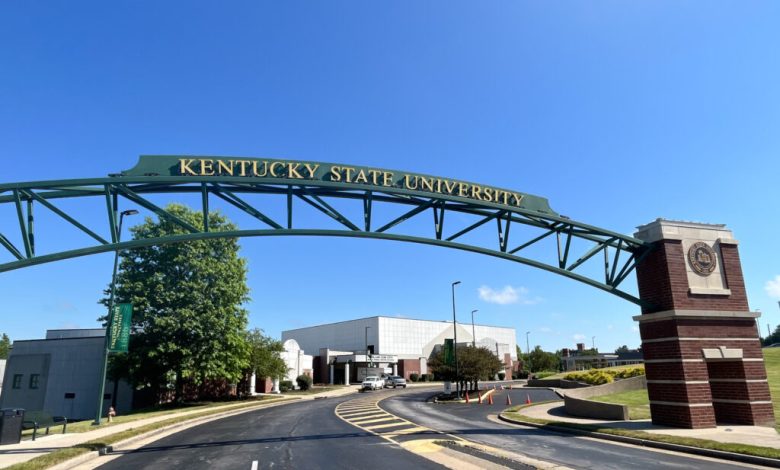
A bill that Kentucky State University leaders hope forges a new path for the state’s historically Black public university has been signed into law by Democratic Gov. Andy Beshear.
Now Kentucky State’s governing board has until June 1 to recommend which academic programs will survive and which will be closed or substantively changed as the university moves into its new role as a polytechnic focused on science and technology.
The legislature’s push to pare down KSU’s academic offerings raised alarm among students who feared their academic major would be abolished before they had time to graduate. In response, lawmakers required KSU to develop a “teach-out plan” allowing students to finish degrees even as their programs are closed to new students and are being phased out.

Tammi Dukes chairs the Kentucky State University Board of Regents. (KSU photo)
“We fully anticipate that all of our students will be able to graduate from Kentucky State University,” Tammi Dukes, chair of the KSU Board of Regents and a KSU alumna, told the Kentucky Lantern in a recent interview. “As we phase out some programs, those students who are currently in a program, we’re going to make sure that they adequately matriculate through the university, so that’s not an issue at all.”
Beshear signed Senate Bill 185 on Monday. It declares a “state of financial exigency” at KSU for the next five years and continues oversight of KSU by the Kentucky Council on Postsecondary Education (CPE).
Dukes said she had initial concerns about the bill, but was “truly ecstatic” with how the plan for KSU was revised as it moved through the legislature.
“Ultimately, this bill strengthens Kentucky State University. It gives us both the financial means as well as the legislative support to help us be successful. And we know that this is going to help us be onward and outward, and I am positive that this is going to be the thing that really takes Kentucky State University to the next level.”
KSU by the numbers
2,838 students, fall 2025
450 faculty and staff
61 degree programs
1,017-acre campus including a 204-acre agricultural research farm and a 306-acre environmental education center
— Source: Kentucky State University
During the five years of the financial exigency, the new law gives KSU’s president the authority to lay off employees, including those who are tenured, with 30 days notice.
Patrese A. Nesbitt, the KSU Faculty Senate president and an assistant professor in the School of Education, said in an email that faculty “did, and still somewhat do, have legitimate concerns” about the legislation.
The law will also impact staff, Nesbitt noted, and the Faculty Senate is “committed to supporting them as we navigate these changes together,” which may include a higher advising case load or mentoring a first-generation student.
Faculty members “are aware that changes are on the horizon” with the new mission, she said, adding that “faculty here firmly prioritize the needs of the students.”
“Faculty not only have questions about academic viability, but we want our students to be holistically successful as goes the same for our fellow staff members,” Nesbitt said. “I am certain we will approach the details outlined in SB 185 eagerly, with the continued goal of preparing students for a growing and evolving workforce for the next 5 years.”
While debating the bill, some lawmakers made clear they had privately had serious dicussions of closing Kentucky State in light of questionable financial practices in recent years. SB 185 was seen as a way to keep KSU going.
Dukes said it would be “devastating” to Frankfort, where the university is located, and to Kentucky if KSU were to close.
“We know that we are a staple within the Commonwealth,” Dukes said. “Broadly, we are in HBCU (historically Black college or university), but for the commonwealth, we have a niche that is not being filled within the commonwealth, and we knew that we have to keep it open in order for us to serve the underserved, which we really, truly believe that we’re doing.”
SB 185 directs the Board of Regents to review the university’s academic programs for “long-term viability, financial stability, alignment with the university’s mission as a polytechnic institution” by June 1 and submit a list of programs to maintain to the Kentucky Council on Postsecondary Education. The board is to submit programs slated for closure or major changes to its accrediting agency.
The law says that beginning in the 2026-27 academic year KSU is to have no more than 10 academic areas of study, excluding online programs, the college of education and those deemed necessary to the polytechnic mission.

Kentucky State University alumni, students and supporters crowded a House Appropriations and Revenue Committee meeting April 1 to hear about changes to Senate Bill 185. (Kentucky Lantern photo by Liam Niemeyer)
When asked about the review, Dukes said KSU has been consistently reviewing programs already, particularly in terms of enrollment and workforce needs. Over the next few weeks, the board will do a “deep dive” on the institution’s enrollment and make sure programs comply with the polytechnic focus.
KSU started annual academic program reviews in 2023 under a previous state law that increased state oversight of the university.
“The board is responsible for the governance, the stewardship and the long term sustainability of the university, and … we want everyone to understand that this legislation is extremely important, and it’s serious for the university, and we want to focus on protecting our students, preserving our accreditation and respecting Kentucky’s identity and our HBCU status,” Dukes said.
SB 185, sponsored by Senate budget committee chair Chris McDaniel, R-Ryland Heights, was publicly unveiled late in the session shortly before the Republican-controlled General Assembly broke for the veto period.
The law initially had opposition from KSU students and alumni, with some protesting on the Capitol grounds. KSU supporters were reassured after a House committee approved changes to the bill to protect the institution’s historical mission and retain liberal arts studies that meet Kentucky’s workforce needs.

Barry Johnson, president of the KSU alumni association, addresses the House Appropriations and Revenue Committee on April 1, 2026. (Kentucky Lantern photo by Liam Niemeyer)
Barry Johnson, the president of the KSU National Alumni Association, gave a passionate speech about the importance of the university during the House committee meeting. In a recent interview, he said that he thinks a lot of alumni had a KSU experience similar to his. He graduated from KSU in 1994 and met his wife while in school. His father was the director of the marching band and a professor, and family members on his mother’s side also worked at the university.
“KSU is a very special place, but I know what it’s meant for so many people, other than just myself,” Johnson said. “You’re talking about, almost 140 years of having its doors open — it’s going to mean a lot to a lot of people, and particularly Black Americans, for whom there was nowhere else to go.”
He said his primary concern after hearing about SB 185 when it became public was that “there was no real debate” about transitioning KSU to a polytechnic mission. The original bill did not have “enough specific language” about KSU’s history.
Founded in 1886, KSU began as a college to educate Black teachers. It’s one of 19 Black institutions that Congress granted land-grant status in 1890 and still operates a cooperative extension program. In the 1983, Kentucky and the U.S. Office for Civil Rights agreed to a desegregation plan for Kentucky higher education that promised an “enhanced” Kentucky State with a redefined mission as “the unique, small, liberal studies university in the Commonwealth.”
“We wanted to just make sure that that mission was protected and stayed consistent on the HBCU, the land grant side … and then also add a little bit more balance on the liberal study side, too,” Johnson said of the alumni. “So, I think that was accomplished.”

KSU President Koffi Akakpo. (KSU photo)
Johnson said that if the legislation is “executed correctly and if it’s fully funded,” then KSU can get “the best of both worlds” with polytechnic and liberal arts offerings that meet Kentucky’s workforce demands.
Lawmakers approved $50 million in bonds for construction of a health sciences building to house KSU’s nursing program. And unlike five of the eight public universities, KSU’s base funding from the state won’t be cut.
Dukes said KSU had already been on a path to a polytechnic mission under the leadership of its current president, Koffi C. Akakpo. She pointed to recent efforts to bolster STEM-related degrees, such as engineering and nursing. The new mission is “another pivot” for the university, Dukes said.
“We believe that this is going to be the thing that puts us at the top of the state when it comes to universities, and we also believe it will help us strengthen our core programs that are needed in the workforce today,” Dukes said. “We know that if we don’t change, something is going to change for us.”
SUBSCRIBE: GET THE MORNING HEADLINES DELIVERED TO YOUR INBOX
SUPPORT: YOU MAKE OUR WORK POSSIBLE


