Who has been swept up in the federal law enforcement surge in D.C. and what charges are they facing? : NPR


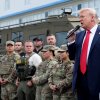
The national guard troops are held outside the Union station on Monday in Washington, DC
Katopodis / Getty Images Tasos
hide
tilting legend
Katopodis / Getty Images Tasos
A little over three weeks ago, President Trump placed the Washington police, DC, under federal control and put the national guard in the streets of the city to crime crime and “clean” the country’s capital.
Although crime in the Columbia district has already been declined after a point during the pandemic, the administration has thrown the operation, which also includes a wave of federal laws on the law, as a major success.
“We had incredible results,” said Trump last month by visiting law enforcement agents in the south-east of DC “is like a different place. It’s like a different city.”

Trump, who is traveling in armored limousine with a huge security detail, also said: “I feel very safe now.”
The White House said on Tuesday that 1,669 people had been arrested since the push of the president of the federal officers in the national capital began on August 7. A considerable part of these arrests concerned immigration offenses.
The administration did not provide the names or cases for any of the people who have been arrested or what they were charged on an individual basis, despite repeated NPR requests for this information.
The NPR has combed by the judicial archives and other data for the first two weeks of the takeover of the DC police by Trump – from August 11 to August 25 – to better understand who was swept away in the sharp increase in non -immigration offenses and the accusations they face.
The situation in the national capital is unique
There is no local district prosecutor’s office in Washington, DC instead, the federal prosecutors of the American prosecutor’s office manage local and federal crimes. The DC prosecutor’s office, on the other hand, continues juvenile crimes as well as certain adult crimes for local crimes.
The proceedings for local crimes go through the Superior Court of the Columbia district, while federal affairs end in the American district court.
The vast majority of those arrested or officially charged from August 11 to August 25 – nearly 1,100 defendants – have seen their belongings go through the Superior Court.
Lawyers working in the courthouse say they are overwhelmed. The courtroom where the defendants are arrested worked a few days after the 1st a.m., which, according to lawyers, is almost unknown.

Of the more than 1,050 accused whose business went to the Superior Court, prosecutors have accused about 20% of crimes: more serious offenses which include drug crimes and firearms.
The remaining 80% of business was crimes, mandates, traffic offenses or prosecutors who abandoned the case.
Lawyers say the prosecutors decide not to continue a case – a decision known as the “papering” – for a series of reasons, including weak evidence, a questionable search or concluding that the alleged offense is too minor to deserve the time and the costs of the prosecution.
The percentage of cases that the office of the American prosecutor decreases at this early stage varies, but in recent months, it is between 10% and 20%, according to the lawyers who work at the courthouse.

During the first week of the federal takeover, the prosecutors abandoned around 17% of the cases, according to the files examined by NPR.
During the second week, this figure fell to less than 1%.
Defense lawyers claim that the quarter of work is striking because the gaps that had previously led the American prosecutor’s office to eliminate certain cases have not suddenly ceased to occur.
Federal affairs
At least 35 cases were tabled and not sealed before the Federal Court during the first two weeks of the takeover. More than half of people involved accusations of firearms or accusations of firearms and drugs, according to an NPR analysis.
In one case, federal agents fired a car after the driver did not use his Tour signal, according to court documents. The police would have found a loaded handgun, 143.5 grams of crack, plastic bags and $ 900 in cash in the car.
The driver, Anthony Grant, had several previous convictions for drugs related to drugs and firearms. A judge ordered him to stay in detention without surety.
The second most common accusation among these cases is the assault, resistance or embarrassment of certain officers. Some of these cases involve violence. In one case, court documents claim that the accused struck a federal agent with his car while fleeing an attempted arrest in a service station.
However, several of these cases involve contact with officers who are not far from that.
An accused, for example, Sean Charles Dunn, launched a sub-Sandwich on a federal agent, hitting the officer on the chest.
In another case, the accused, Scott Pichon, would have spit two troops from the Southern Carolina National Guard while exceeding them on a scooter outside the DC union station.
Exvertable questions
Despite an aggressive thrust of the police and prosecutors, some of the cases collapsed before the federal judges and the great juries.
Take the firearm file against Torez Riley. Police said in the court documents that they had found two firearms in the Riley bag in Crossbody when they arrested him in a JOE grocery store. Riley had already been sentenced to weapons and drug charges, according to court documents.
During a hearing last week, judge American magistrate Zia Faruqui said that Riley seemed to have been distinguished by police because he was a black man carrying a bag that looked heavy.
“This is undoubtedly the most illegal research I have even seen in my life,” said Faruqui from the bench. “I am absolutely stunned by what happened. A high school student would know that it was illegal research.”
The American lawyer’s office then filed documents to reject the case, which the judge granted.
Other cases have had problems with the big juries.
It is extremely rare that the great juries reject the accusations proposed by the prosecutors.
But on several occasions in recent weeks, the great DC juries have done exactly that, especially in the case against the man who launched a sandwich against a federal agent.
In this case, the prosecutors reduced the accusation to an offense after failing to obtain an indictment of the Grand Jury.
Luke Garrett and Carrie Johnson of NPR contributed to this report.


