Why a wildfire chemical toxic to humans lingers longer in clouds


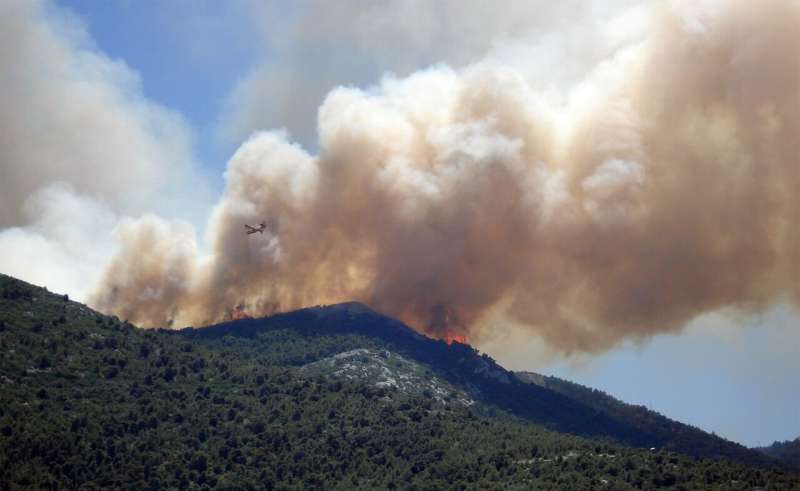
Credit: Public Pixabay / CC0 domain
Researchers from the University of Bristol and the Central Laser Facility (CLF) at Science and Technology Facility Council (STFC) discovered why a toxic compound found in forest smoke resists natural rupture when it is dissolved in atmospheric water droplets.
The discovery explains why the 2.4 -Dinitrophenol (DNP) – a toxic chemical compound for plants, animals and humans – can remain active in the atmosphere for longer than previously included periods.
This persistence can help explain why the brown carbon of forest fires contributes to global warming for long periods. The document is published in the Proceedings of the National Academy of Sciences.
The research team has studied how environmental conditions affect DNP lifespan in the atmosphere. It was found that when the DNP dissolves in tiny droplets of water suspended in the air that make up the mist and the clouds, it becomes more resistant to the natural oxidation process which normally decompose it.
DNP enters the atmosphere through multiple sources, including forest fires. Once in the air in the context of brown carbon particles, the DNP absorbs sunlight and converts it into heat, contributing to climate change. The compound is also toxic to living organisms, making its extent atmospheric duration a double concern for climate and public health.
Brown carbon is a released brownish smoke when biological materials like forests burn. It contains dangerous levels of organic chemicals that cause short and long -term health problems. It is estimated that 1.5 million people are killed each year due to forest smoke exposure.
Research occurs as the frequency of forest fires increases in the world, with four of the five worst years of history, occurring since 2020. Movite locations of forest fire such as the United Kingdom and Sweden highlight the growing impact of climate change.
Beyond forest fires, DNP is also produced by:
- Biofuels and fossil fuels vehicles emissions
- Residential heating fires and joy fire
- Controlled agricultural burn
By understanding the mechanisms that extend the atmospheric lifespan of DNP, researchers can identify methods to reduce the duration of these harmful compounds in the environment. This knowledge could shed light on air quality management and climate modeling efforts.
Dr. Igor Sazanovich, the main scientist of the central laser installation of the STFC, said: “Our advanced laser techniques allowed us to observe exactly how DNP behaves molecular when it meets atmospheric water droplets.
More information:
Orr-Ewing, Andrew J., How a toxic pollutant avoids photodedgradation: relaxation paths of the 2.4-dinitrophenol excited by UV in aqueous solution, Proceedings of the National Academy of Sciences (2025). DOI: 10.1073 / PNAS.2504123122. www.pnas.org/doi/10.1073/pnas.250412312222
Supplied by Science and Technology Facility Council
Quote: Why a chemical of toxic forest fire for humans lingers longer in the clouds (2025, August 7) recovered on August 7, 2025 from https://phys.org/news/2025-08-wildfire-chemical-toxic-humans-blingers.html
This document is subject to copyright. In addition to any fair program for private or research purposes, no part can be reproduced without written authorization. The content is provided only for information purposes.


