Why are resident doctors striking and what do they earn?



 Getty images
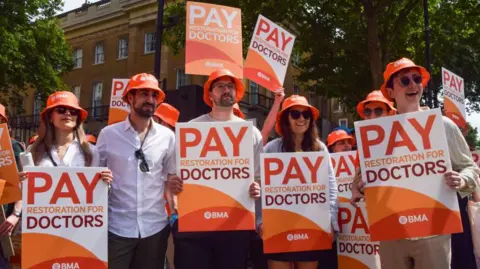
Doctors residents in England return to work after a five -day upgrading on the salary.
They say they have not had a “credible remuneration contract” for 2025-2026, but the health secretary Wes Streting argues that the strike is “unreasonable” after a substantial increase in salary in recent years.
Who are resident doctors?
Resident doctors were known as junior doctors, but the government recently agreed to change the name of their role to better reflect their expertise.
They represent about half of all doctors. As a patient, you could get in touch with a resident doctor in any NHS department, including A&E and during your GP surgery.
Resident doctors are qualified doctors who have obtained a medical diploma.
Many then have specialized training in a particular field of medicine and surgery, or train to become a general practitioner.
Complete training can take a long time, which means that some resident doctors have more than a decade of practical experience and are responsible for many aspects of care.
How were patients affected by the strikes of resident doctors?
Doctors were on strike in England between July 25 and 30.
During the period, GP surgeries were generally open as usual, and the telephone line 111 remained the best option for urgent or unrelated problems. Patients have always been advised to go to A&E or call 999 for emergency care.
Unlike the previous strikes, during the last NHS, the NHS, England, asked hospitals to carry out routine operations as far as possible and to postpone meetings under exceptional circumstances.
But the British Medical Association (BMA), a union for doctors, warned that it could stretch the staff too finely.
Despite the implementation of plans to minimize the disturbances, the NHS chiefs declared that the strikes had wreaked havoc on patients and staff, and that some meetings did not take place.
Prime Minister Sir Keir Starmer said that debraying threatened “to bring the chronometer back to the progress we have made to rebuild the NHS in the past year”.
In the last wave of strikes between July 2023 and February 2024 – which involved certain consultants – government analysis showed that 507,000 appointments and operations were canceled and postponed.
Scotland, Wales and Northern Ireland were not affected by the last industrial action.
What is a salary of a resident doctor?
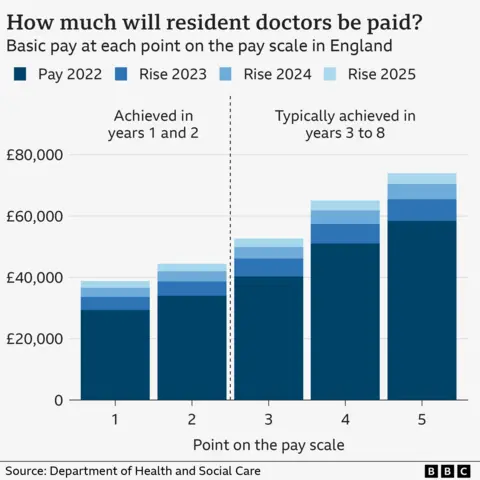
During their first year of foundation after completing their medical diploma, doctors resident in England obtain a basic salary of £ 38,831. During their second year, this reached £ 44,439.
We expect the doctors to operate night quarters, weekends and longer hours for additional payments.
After eight years or more as a resident doctor, wages can increase to around £ 70,000.
Since 2023, resident doctors have participated in 11 separate strikes, pleading for more equitable remuneration and work conditions.
In 2023-24, over two years, they received a 22%salary increase. From August 2025, they will obtain an additional salary increase of 5.4%.
The Secretary of Health, Wes Street, said that resident doctors have received the highest salary increase from all public sector employees in the past three years.
The government says it will no longer offer an increase.
What are the payment requests for resident doctors?
The BMA says that the salary of resident doctors will be 20% lower in real terms in 2008, even after the August increase.
He wants the salary for the group to be brought back online with the level it was 17 years ago, when they say that their value of their salary began to be eroded.
The complaint is based on an inflation measure called retail price index (RPI). This includes housing costs and shows higher price increases than certain other inflation measures.
The BMA stresses that many resident doctors have significant student loans and that interest in this subject is calculated using RPI.
However, the government affirms that RPI is exceeded. Instead, it uses the consumer price index (ICC) to calculate inflation and payment increases. CPI examines the cost of goods and services according to a basket of household items.
Using the measure of the IPC, the government says that the current salary of resident doctors is right.
Analysis of the Nuffield Trust – a health reflection group – suggests that remuneration has dropped by 5% since 2008 if the IPC is used, compared to almost 20% with RPI.
What salary increases have other members of public sector staff?
In May, the government announced that salary increases for a number of public sector workers, including:
- A 4% increase for other doctors, dentists and teachers in England, as well as prison agents in England and Wales
- An increase of 3.25% for civil servants
- An increase of 3.6% for certain members of NHS staff in England, including nurses and midwives
- An increase of 4.5% for members of the United Kingdom Armed Forces, with 3.75% for higher military personnel
However, because a medical diploma can take five or six years to finish – longer than most other diploma courses – BMA maintains that resident doctors may have accumulated more debts than other graduates.
Resident doctors also say they have little control over where and when they are asked to work. And that it can be difficult to put the roots, due to the need to do internships in different parts of the country.


