Why so few children attend school and what could be done to change that


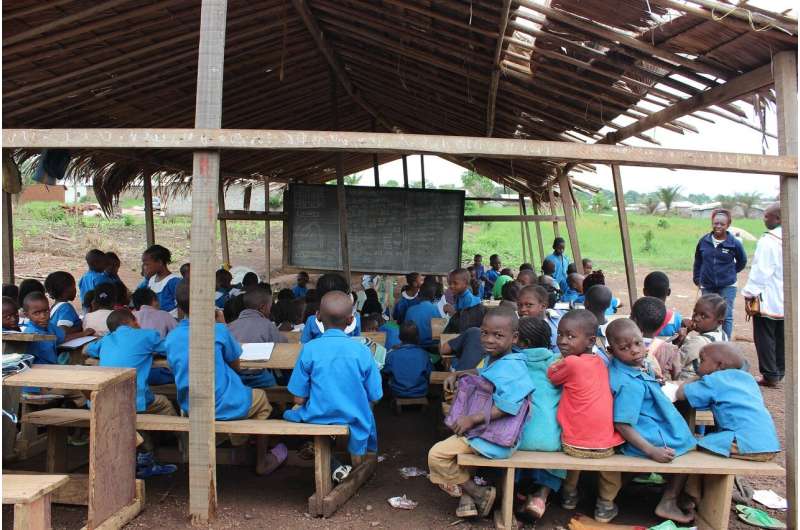
Credit: Public Pixabay / CC0 domain
About 98 million children and young people in sub -Saharan Africa are outside school, representing almost 40% of the world’s population excluding schooling. This is disproportionately high, since the region represents approximately 15% of the world’s population. In simple terms, “outside children” are defined as those of the age group for primary education or lower secondary which are not inscribed in both levels.
One of the main obstacles to access is conflict. This is particularly obvious in Somalia, which has endured violence and upheavals since the collapse of his central government in 1991. Various armed groups, including clan activists and Al-Shabaab activists, have made it possible to control the capital, with devastating consequences.
Currently, nearly 3 million children and young people are without school in Somalia on approximately 7.6 million inhabitants of the school age. As a epicentre of conflicts and trips, Mogadishu is undergoing deep disruption of access to education. Less than 23% of children eligible for primary education are registered, according to statistics from the 2020 government. Only 17% increased to secondary education.
I am a scholar of urban geography with research on urban policy and governance. My co-researcher and I sought to examine the historical, social and economic factors beyond conflicts contributing to the high number of children outside the school in Mogadishu.
We have found that public education is both limited and unevenly distributed. Schools managed by the government represent only 4% of the total number of schools in the city. These few public schools are disproportionately located in areas dominated by the main clans, leaving the minority communities and the populations displaced by conflict with limited access to formal education.
A key obstacle is the prohibitive cost of schooling. It is just as important that the cultural dynamics rooted in the fields populated by minority clans, where formal education, in particular for girls, is often undervalued in favor of technical skills or small-scale entrepreneurial training transmitted during generations. Like the historical resistance of Somali society to colonial education through Islamic education, many minority communities are now counting on professional skills as a strategies of autonomy of the dominant clans which control political and economic power and often restrict their access to opportunities.
By narrowing our Mogadiscio objective, our study offers a more detailed and localized understanding of educational obstacles within the city. It highlights daily choices, institutional fragmentation and socio-religious imperatives which reproduce exclusion in a way that other studies have neglected. It contributes to a more nuanced analysis of the educational challenges of Somalia, supporting the development of more targeted and more effective political recommendations and political interventions.
The results
Our qualitative study was carried out in two stages. We started with a review of academic literature, government and non -governmental reports and education policy documents. The objective was to retrace the historical and structural causes of exclusion. This was followed by 21 semi-structured interviews with families of children, teachers, education officials and decision-makers with regard to education at the regional and federal level.
Our results suggest that the reasons why children are not at school in Mogadishu are complex and deeply structural. At a certain level, we have found that formal education is largely inaccessible. Public education funded by the government is limited by the small number of schools and its uneven distribution. Official private tuition fees, however, vary from US $ 120 to US $ 300 per year. It is far beyond the scope of most households, whose average monthly income amounts to US $ 350.
Although no official statistical statistical exists, anecdotal evidence suggests that hundreds of thousands of children are registered in Koranic schools, also known as Madrassas. Indeed, Madrassa’s instruction is culturally integrated and largely reliable. Many families also count on Madrassas because the costs are lower or negotiable and they offer flexible arrangements, such as reduced costs or derogations.
However, these institutions generally exclude academic subjects such as science, mathematics and language.
Families must choose between two parallel systems – formal and Islamic – which are neither harmonized nor reinforced mutually. In many cases, children complete Madrassa’s instruction without acquiring basic literacy or numeral skills, blocking their educational progression.
This two -track education system dates back to the colonial era. There was resistance to Western style schools introduced in the 1930s which were considered a foreign influence and a religious dilution.
Spatial inequality and social identity also exclude people. Districts and peripheral districts where minorities are concentrated suffer from underinvestment in educational infrastructure. These areas can be absent from national and municipal development plans. Some existing schools lack adequate sanitation facilities, libraries and trained teaching staff.
For people displaced internally, insecurity permanently and legal ambiguity further limit access to public services, including education.
What must happen
This situation is not unique to Somalia, but the extent of exclusion in Mogadishu is alarming. Education is more than academic education – it offers security, structure and hope. When children cannot go to school, the consequences are deep: increased poverty, higher crime and weakened social cohesion.
The solution requires more than the construction of classrooms. Based on our research and our analysis of policies, we offer some recommendations.
With a federal budget of only 1 billion US dollars, the options are limited. To start, the government should authorize Madrassas to provide 6th year education and reuse primary schools in secondary establishments.
Flexible madrassas and mobile classrooms have shown notable resilience in times of crisis. In the Hodan district in Mogadiscio, Koranic schools adapted to the influx of the displaced internally by extending the hours and reducing the costs. These locally integrated systems must be officially recognized. They also deserve direct national support to ensure quality and alignment with strategic education objectives.
Many schools managed by the community are currently operating outside of public planning and budgeting executives, but they provide critical services. In Somaliland, some schools were funded by Zakat (charity) and the contributions of the diaspora. Mogadishu should adapt this model.
While Islamic education enjoys large legitimacy, its program of narrow studies limits the prospects of students. This requires a hybrid program mixing Koranic education with basic academic materials: literacy, numeral and science. This has proven itself in the pilot schools of the State of Puntland.
Finally, the efforts to build and rehabilitation of schools should first go to the districts historically in poor service.
Children outside Mogadishu are not invisible. They are the future of the city. Including them requires more than programs led by donors or technical solutions. This requires political commitment to equity. This means officially recognizing community efforts, filling religious and secular traditions and investing where it is most necessary.
Supplied by the conversation
This article is republished from the conversation under a Creative Commons license. Read the original article.
Quote: Somalia education crisis: why so few children frequent school and what could be done to change this (2025, August 6) recovered on August 6, 2025 from https://phys.org/News/2025-08-somalia-crisis-children-school.html
This document is subject to copyright. In addition to any fair program for private or research purposes, no part can be reproduced without written authorization. The content is provided only for information purposes.


