Why some human GII.4 noroviruses are better than others at infecting cells


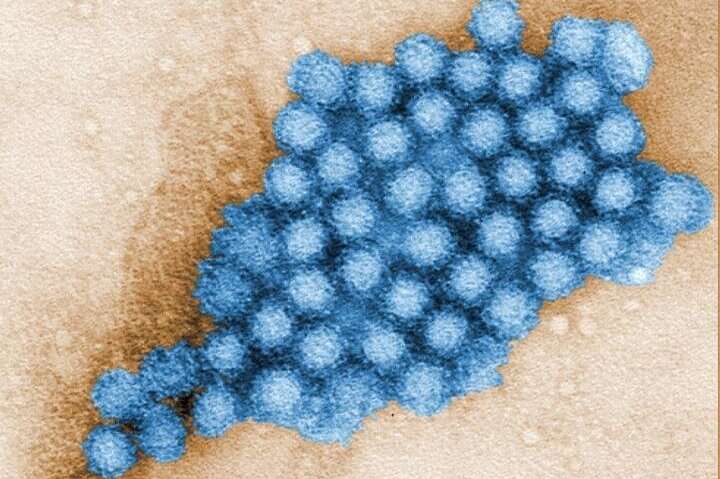
Norovirus virions cluster. Credit: CDC
Human noroviruses, GII.4 strains in particular, are the main engines of acute viral gastroenteritis in the world, a condition for which there are no vaccines or antivirals. Understanding how these viruses enter cells into the intestine, a first step towards the development of an infection, can lead to effective therapy.
With this objective in mind, researchers from the Baylor College of Medicine and collaboration establishments have studied the entry mechanism of GII.4 Human Norovirus, comparing the dominant strain GII.4 Sydney with other GII.4 variants.
The study, published in the Proceedings of the National Academy of Sciencesreveals that the Noroviruses GII Humans.4 have evolved a single powerful input mechanism with clear differences specific to deformation. The results open up new possibilities to identify the elusive receptor of human norovirus as well as to develop vaccines and treatments.
“To study the entry mechanism of the human norovirus GII.4, we compared the bond and the entry of several GII variants.4 using human intestinal interroids,” said the first author of the work Dr. B. Vijayalakshmi Ayyar, senior status S then of molecular virology and microbiology in Baylor.
VLPs are non -infectious protein structures that imitate the shape and size of viruses but do not have the viral genetic material, which makes them incapable of reproducing or causing a disease. Human intestinal intenroids are a human gastrointestinal tract model that summarizes its cell complexity, diversity and physiology. Human enteroides imitate the models of infection of the specific host of the stump, which makes it an ideal system to dissect the infection through human norovirus, identify the growth requirements specific to deformation and develop and test the treatments and vaccines.
“In a previous study, we discovered that the link of the Human Norovirus GII.4 VLPS to the enteroid cells injured cell membranes, which in turn triggers a membrane repair mechanism at the injury site, activating another cellular route known as the way of the clique,” said Ayyar. “We have observed the diaphony between the internalization mediated by click viral particles and the repair mechanisms of the host.”
In this study, the researchers studied the input mechanism in more detail. “We have found that after the viral particles are linked to human enteroides, they form clusters on the cell surface triggering a series of events that result in viral entrance and infection,” said the co-author, Dr. Bv Venkataram Prasad, professor of molecular virology and microbiology and president of Alvin Romansky in Baylor. “Above all, our study has revealed that structural changes in viral particles are necessary to assemble the dynamic clusters on the surface of the cells, resulting in a way of entry into several stages.”
Interestingly, researchers have discovered that not all GII variants. 4 do not form distinct clusters on the cell surface. The strains of clustering, which include GII.4 Sydney, cause much more injuries by membrane and enter and reply in enteroids more than non-clustering strains.
“When we studied the differences between the regrouping and the non-clustering GIIs. 4 we have identified two amino acids on the salient domain of the particles of Norovirus, named V333 and R339, which were critical mediators of clustering and entry,” said Ayyar. “Mutatize or block these amino acids disturbed the grouping and viral entrance.”
“We know that there are many differences between the different strains of human norovirus. Some of them relate to the immunology of the virus and to some in the way the virus enters the cell,” said the co-author, Dr. Robert L. Atmar, professor of clinical research by John S. Dunn in Baylor. “Find out more about what distinguishes individual strains so that we can better understand why some viruses predominate more than others are exciting. This study on GII.4 Human Norovirus is an important step towards this objective.”
“By increasing our understanding of the way in which human norovirus enters sensitive cells, these results bring us closer to the identification and characterization of the elusive host receptor of the human norovirus,” said the corresponding author, Dr. Mary K. Estes, a distinguished service professor and president of molecular virology of the Cullen Foundation.
“This work also contributes to important information that advances the development of targeted preventive treatments and therapies which, we hope, will one day help to relieve the charge that these viruses represent to the human population.”
The other contributors to this work include Carmen V. Apostol, Janam Jitetra Dave, Soni Kaundal, Joseph A. Kendra, Frederick H. Neill, Khalil Ettayebi, Sarah Maher, Ramakrishnan Anish, Gabriel I. Parra, Göran Larson and Sue E. Crawford. The authors are affiliated with Baylor College of Medicine, Food and Drug Administration or the University of Göteborg in Sweden.
More information:
B. Vijayalakshmi Ayyar et al, Functional diversity in GII.4 Norovirus entrance: HBGA and Dynamics of Capsid Clustering, Proceedings of the National Academy of Sciences (2025). DOI: 10.1073 / PNAS. 2517493122
Supplied by Baylor College of Medicine
Quote: Why some human GIIs. 4 Norovirus are better than others in cell infection (2025, October 3) Extract on October 4, 2025 from https://phys.org/news/2025-10-human-gii4-noroviruss-fecting-cells.html
This document is subject to copyright. In addition to any fair program for private or research purposes, no part can be reproduced without written authorization. The content is provided only for information purposes.


