Why some mathematicians think we should abandon pi


May 5, 2026
4 min reading
 Add us on GoogleAdd SciAm
Why some mathematicians think we should abandon pi
A growing minority thinks it is a mistake to link so many mathematical formulas to the famous value 3.14…. Another value, tau, might be better
Antonio Iacobelli/Getty Images
This article is from Positive proofour friendly newsletter that explores the joys and quirks of mathematics. Register today for a weekly math essay and brainteaser delivered to your email inbox.
“I know some will call this blasphemy, but I believe π is wrong.” With that bold opening statement in a 2001 Mathematical Intelligencer In this article, mathematician Robert Palais launched a debate that continues to this day.
On supporting science journalism
If you enjoy this article, please consider supporting our award-winning journalism by subscription. By purchasing a subscription, you are helping to ensure the future of impactful stories about the discoveries and ideas shaping our world today.
For many, an attack on pi is equivalent to an attack on all of mathematics! Almost no other symbol is so strongly associated with the subject. Songs, poems, books and films have been dedicated to him. The date of International Mathematics Day, March 14, is based on the first digits of pi. It is therefore all the more surprising that Palais has won over many supporters.
Anyone who thinks this is a circle of people who despise mathematics is completely wrong. On the contrary, their passion for the subject pushes them to such upheavals.
Let’s make one thing clear from the outset: no one in this debate doubts the correct calculation of pi. But Palais maintains that it was a mistake to choose the value 3.14159… as the fundamental constant of a circle. He believes it would be much more appropriate to use double this value, now known as tau (τ).
Nine years after the publication of Palais’ article, physicist Michael Hartl posted “The Tau Manifesto” online. In this document, he develops and develops Palais’s arguments. “π is a confusing and unnatural choice for the circle constant,” Hartl wrote.
Why Tau is greater than Pi
The Tau Manifesto lists several reasons why constant tau is more appropriate than pi:
-
In mathematics, it is the radius, not the diameter, that defines a circle. Therefore, the mathematical constant pi must be defined in terms of radius, and tau allows you to do this quickly. With it, the circumference of a circle is calculated as follows: C = τ × r.
-
In trigonometry, we work with radians instead of degrees. A full rotation, or 360 degrees, corresponds to 2π, which is not very intuitive. It would be much simpler if 360 degrees was just constant tau. Half a rotation, or 180 degrees, would then be τ⁄2.
-
A factor 2π appears in many mathematical and physical formulas (such as when calculating the period of a simple pendulum or that of a mass on a spring). These equations would all be simpler if we could use tau.
“What really worries me is that the first thing we broadcast into the cosmos to demonstrate our ‘intelligence’ is 3:14…” Palais wrote in his 2001 article. “I’m a little worried about what the life forms that receive it will do after they stop making fun of the creatures who should rarely question orthodoxy.” In the years following the publication of Palais’ article and Hartl’s manifesto, the topic attracted increasing media attention. Internet forums led to heated debates over which constant was better, and in classrooms, some teachers and students began using tau instead of pi. Programmers, too, are increasingly defining the tau constant as 2π in their code. “I hope that one day we will all be tauists,” Hartl said in an interview with Spektrum der Wissenschaftwhat is Scientific Americanthe German-language sister publication.
Why Pi is greater than Tau
The arguments of the “Tau Manifesto”, however, do not convince everyone. Many experts remain convinced that pi is a constant. Shortly after Hartl’s proposal, “The Pi Manifesto” appeared (as one would expect). According to this manifesto, written by mathematician Michael Cavers, Hartl’s arguments were “full of selective biases in order to convince readers of the advantages of τ over π.” In many cases, tau protein would bring more harm than benefit, says Cavers. The Pi Manifesto lists several reasons why replacing Pi makes no sense:
-
Thousands of years ago, the mathematical constant pi was defined as the ratio of circumference to diameter. This is mainly because the diameter of a circle is much easier to determine than its radius. We must therefore retain the formula C = 2πr.
-
The area of a circle can be described by the simple formula A = πr². When this formula is used, a circle of radius 1 has an area of π and a semicircle has an area of π⁄2.
-
Particularly in the fields of probability theory and statistics, many formulas depend solely on pi. Replacing it with tau would introduce factors of 1⁄2 in these cases.
Of course, the math itself doesn’t change one way or the other. So one might wonder why the experts are making such a fuss. After all, it’s just about scoring. This may not seem particularly important, but scoring doesn’t just determine whether a result can be represented in a simple or complicated way. Notation is also crucial for intuitive understanding. For example, the tau camp has argued that angles can be expressed more intuitively using tau than pi. Here is an illustration:

But consider the contrast in notation when we look at the area of a circle or various parts of a circle:
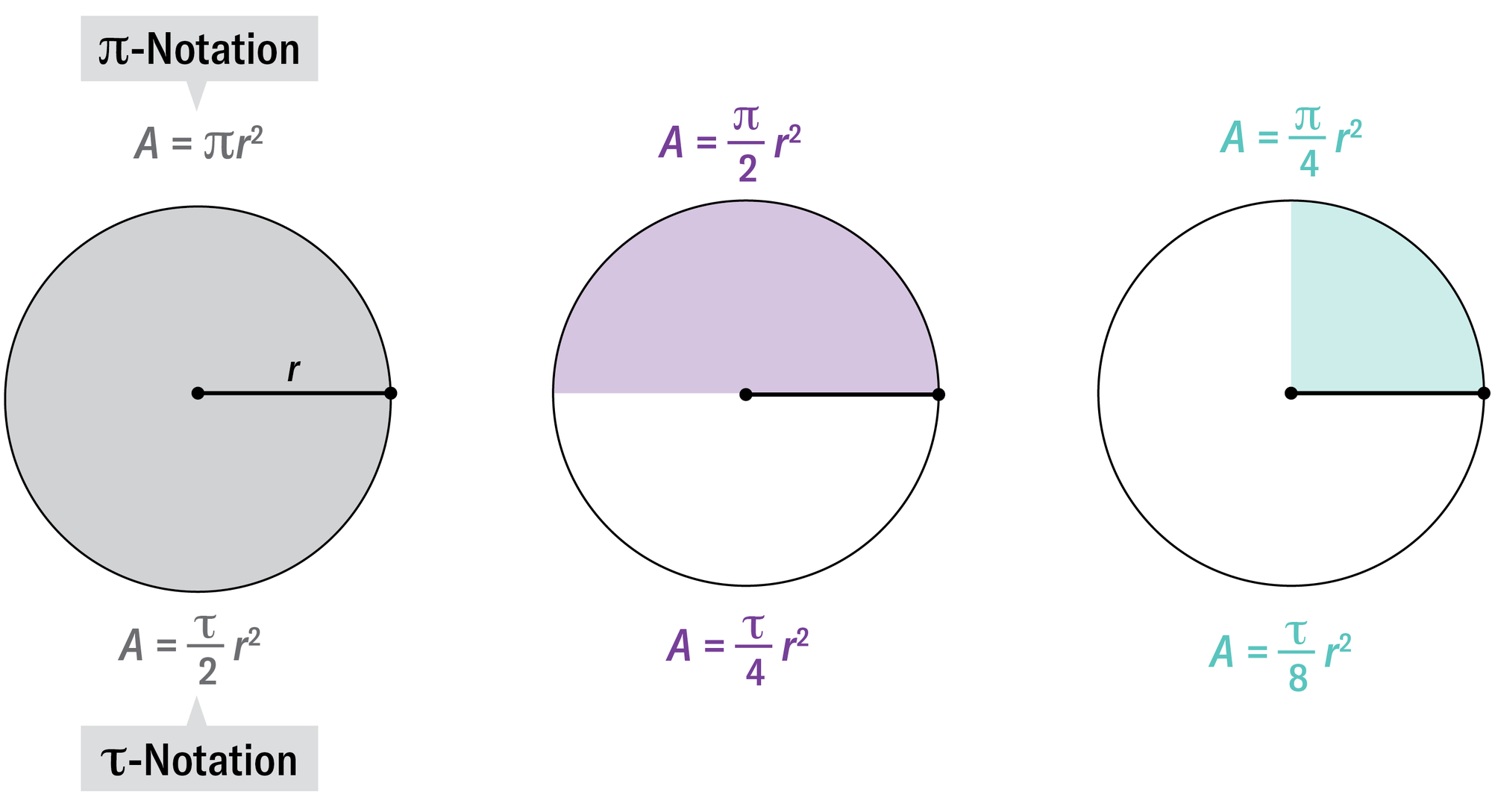
It’s not so easy to say whether pi or tau is better suited here. Both tauists and pi supporters recognize that the opposing side has an advantage in certain contexts and make valid arguments. The fact is that pi has been deeply rooted not only in mathematics but also in popular culture for centuries. Abandoning this constant and introducing a new one would be anything but simple. And dealing with two different circle numbers would just create confusion.
Some parties therefore advocate a compromise. “The Proper Pi Manifesto” (not to be confused with The Pi Manifesto) proposes to keep pi but to introduce a completely new unit, “darians”, instead of radians to measure angles.
Or maybe even better, the idea mentioned in the xkcd webcomic: a constant called “pau” that has a value of 1.5π. Then everyone would be equally confused.
This article was originally published in Spektrum der Wissenschaft and has been reproduced with permission. It was translated from the original German version with the help of artificial intelligence and reviewed by our editors..
It’s time to defend science
If you enjoyed this article, I would like to ask for your support. Scientific American has been defending science and industry for 180 years, and we are currently experiencing perhaps the most critical moment in these two centuries of history.
I was a Scientific American subscriber since the age of 12, and it helped shape the way I see the world. SciAm always educates and delights me, and inspires a sense of respect for our vast and beautiful universe. I hope this is the case for you too.
If you subscribe to Scientific Americanyou help ensure our coverage centers on meaningful research and discoveries; that we have the resources to account for decisions that threaten laboratories across the United States; and that we support budding and working scientists at a time when the value of science itself too often goes unrecognized.
In exchange, you receive essential information, captivating podcasts, brilliant infographics, newsletters not to be missed, unmissable videos, stimulating games and the best writings and reports from the scientific world. You can even offer a subscription to someone.
There has never been a more important time for us to stand up and show why science matters. I hope you will support us in this mission.


