Wildlife trade ups the risk of diseases spilling over to … us : NPR

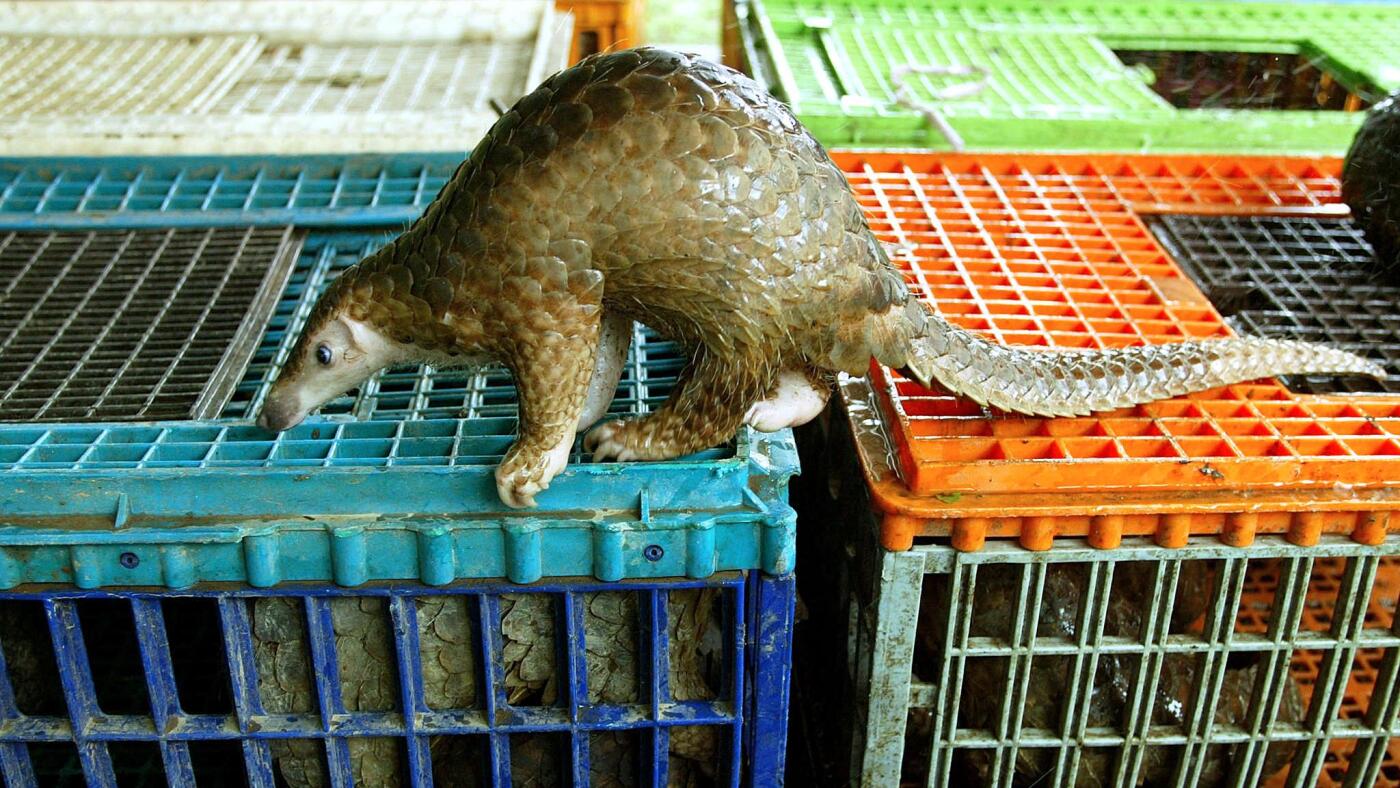

This pangolin was confiscated from a smuggling ring that sold endangered animals to restaurants in China. Animals involved in the wildlife trade are at high risk of spreading disease.
Jimin Lai/AFP/via Getty Images
hide caption
toggle caption
Jimin Lai/AFP/via Getty Images
In 2003, a shipment of exotic African rodents to an Illinois pet store sparked a political backlash in the United States. first mpox epidemic. Giant Gambian rats and other rodents infected prairie dogs, which in turn infected nearly 100 people handling the animals.
Ebola outbreaks are often triggered after contact with bats, which are sometimes eaten or used in traditional medicine.
And more famously, a chain of scientific articles suggest that the COVID-19 pandemic originated at the Huanan Seafood Wholesale Market, where dozens of live wild animals – raccoon dogs, civets, Himalayan marmots – were housed in cramped quarters.
Anecdotes like these are examples of how the wildlife trade – from buying wild animals for food to trapping them for pets – can open the door for pathogens to jump from animals to humans. A single fateful encounter can result in hundreds, thousands, or even millions of deaths.
“There has long been consensus that wildlife trade poses a risk to human health,” says Colin Carlsondisease ecologist at Yale University. “But much of what we know comes from anecdotes.”
This uneven view makes it difficult to understand how risky the wildlife trade is compared to other causes of surging infectious diseases, Carlson says, like climate change or deforestation. While it makes sense that traded species infect humans more often than non-traded species, scientists couldn’t definitively answer the question without more data.
Carlson and his colleagues now offer an answer. The mammals traded are approximately 1.5 times more likely be sources of human disease than non-traded animals, researchers report in Science. Basically, the longer humans have interacted with a species, the more viruses we have in common, especially when it comes to illegal animals and live markets.
“It’s a very solid document that reinforces what we already knew,” says Kevin Olivala disease ecologist at the University of Hawaii who was not involved in the study. “The wildlife trade indeed constitutes a risk of zoonotic diseases. It is behind past outbreaks, likely including COVID-19, and if we want to prevent the next one, we need to think about it on a global scale.
An atlas of pathogens
Five years ago, a study like this wasn’t really possible, Carlson says.
“The data we have here, on animals and their viruses [and other pathogens] “didn’t exist,” he says, at least not in a way that researchers could easily analyze. Carlson and his colleagues changed that.
They have built databases into which they can add all newly discovered viruses. By aligning this pathogen atlas with wildlife trade data – which mammals are traded and how long a species has been involved – the team was able to see which mammals share the most pathogens with humans.
The results, while not entirely surprising, were striking. Of more than 2,000 traded species, 41% shared at least one pathogen with humans, compared to only 6.4% of non-traded species.
Showing that pathogens are shared says nothing about who did the sharing, but it’s likely that the vast majority of these cases come from pathogens jumping from animals to humans, not the other way around, Carlson says. “Humans are omnipresent. We are in contact with everything and we capture many more things than we deposit.”
Some aspects of the wildlife trade that researchers already consider risky appear particularly conducive to virus transmission, the researchers found.
“Live animal markets are a major risk factor,” says Carlson.
“We’re talking about unhealthy animals, overcrowded conditions, strange combinations of species,” he says. “We know that viruses evolve in real time in these markets as they move between species.” People who work in these markets often don’t have the type of protective equipment that can stop pathogens.
Illegal wildlife trade, which includes threatened or protected animals like pangolins and squirrel monkeys, was also associated with a high risk of spillover. This could be because these species harbor more viruses or because illegal markets could be even more lax about hygiene, Carlson says.
Ultimately, the team found that time was of the essence. According to the study, every ten years that a species spends in the wildlife trade, another new pathogen spreads to humans. “It’s important,” Olival says, and it makes sense, although he wonders whether the trend might be driven by better detection of pathogens.
In total, hundreds of species have been traded for decades or hunted for millennia. “It’s a one-way ticket. In many ways, the toothpaste is out of the tube here,” he says, and these animal viruses are here to stay.
Risk reduction
The findings also highlight that acting now can reduce risks, says Sagan Frianta disease ecologist at Penn State who was not involved in the study. “This document attracts our attention [toward] a way to block the main routes of disease transmission from animals to humans. If you can block these routes, then you will block many pathogens. »
Globally, this could involve governments tackling the illegal wildlife trade, for example by increasing surveillance at airports.
But Carlson notes that this could ultimately push the trade further underground, making it harder to detect spillovers. “We must choose between criminalizing and driving the trade underground, or finding a way to ensure public health in [these] parameters.”
Another option is to meet the demand for these exotic species, which generates billions of dollars per year.
“Even though it seems like I’m not involved in the wildlife trade, as a normal citizen, you actually are,” Olival says. The 2003 mpox outbreaks in the Midwest “were caused by people buying animals. [exotic] animal in your pet store, think twice.”