World’s longest suspension bridge may finally link Sicily to mainland Italy


Italy has taken a giant step towards achieving a goal envisaged for the first time thousands of years ago. Earlier this month, the country’s government and the Webuild architectural firm announced final approval measures to start building the longest suspension bridge in the world. More than two miles long, the Ponte Stretto Messina will extend through the Strait of Messina by two miles, finally offering a direct transport link between the island of Sicily and continental Italy. Although the monumental project, $ 15.6 billion is currently planned for the completion around 2033, local opponents and the region’s environment can complicate things.
It is not a huge distance from most standards. But for millennia, generations of travelers need a boat to cross the Strait of Messina separating Sicily and the continent. Historical files indicate the desire to build a bridge connecting the dates of terrestrial mass as far as ancient Rome, but an end result has never materialized. Today, the simplest and fastest way to move between the locations is on one of the daily climbs of ferry at 30 minutes through the Strait.
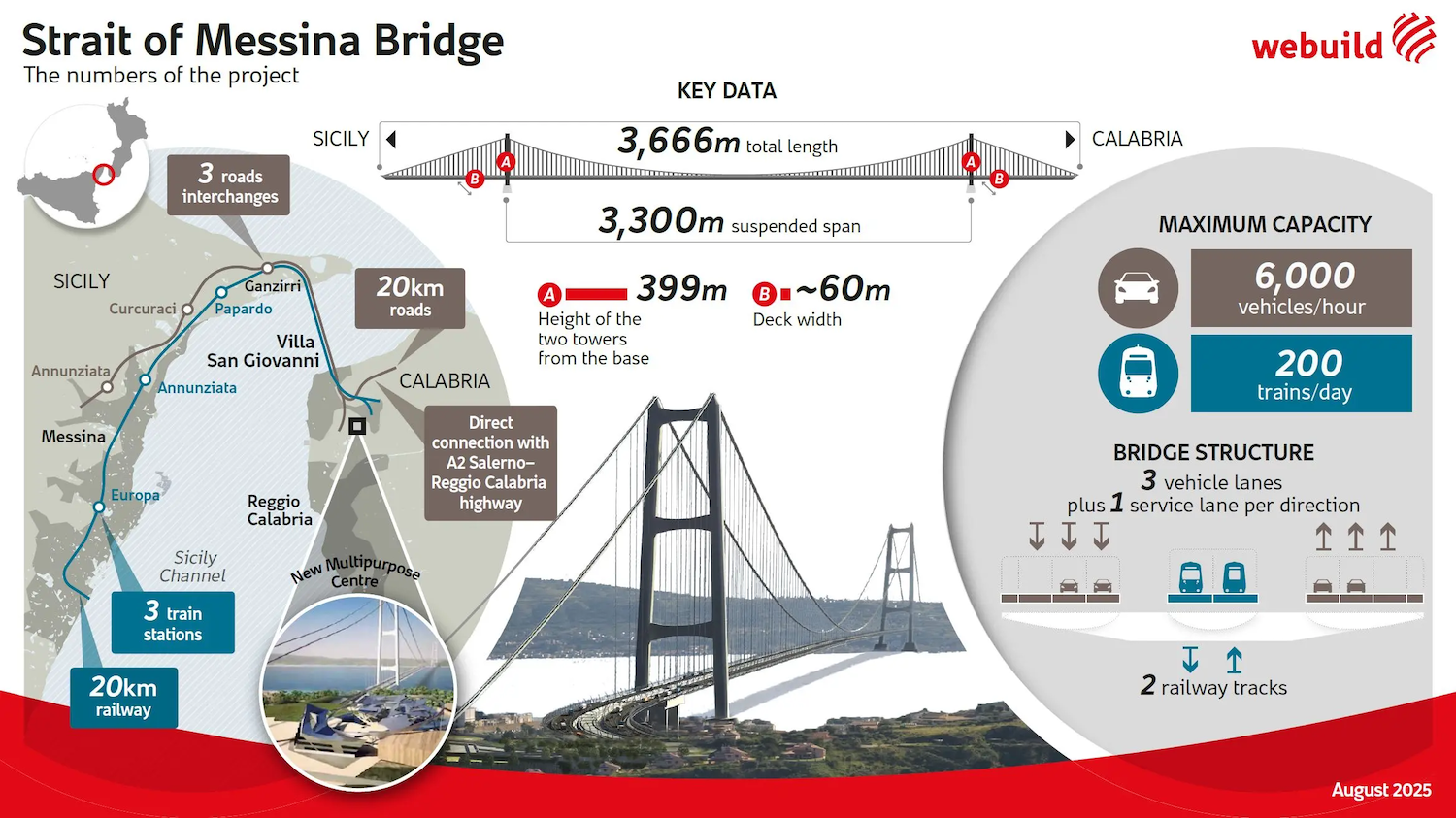
The Streetto Messina Endeavor Ponte 2.24 miles wide seeks not only to considerably reduce this journey time, but also to offer several transport options. Webuild’s current design includes three car tracks as well as a service track on each side, with a two -lane train road zipping on the bridge almost 200 feet wide. Support for the suspension itself will come in the form of a pair of laps on the ground of 1,309 feet high – each on the height of the State Building Empire. Two four -feet wide cables will link the towers and extend in the use of 44,323 steel wires. Once finished, its designers estimate that the bridge on average 6,000 vehicles per hour and 200 train journeys per day.
In a press release, Webuild CEO, Pietro Salini, said that the bridge would be “one of the most difficult projects in the world”. Salini may be right on several levels. The conceptions of Ponte Stretto Messina date on 50 years, each attempt to put aside for various political and economic reasons. They included concerns of rampant corruption due to the continuous influence and presence of Sicilian and Calabrian mafias in local affairs.

Like the Bbc Explain, local politicians express concerns about the large -scale consequences in the surrounding communities. The senator of the Democratic Party, Nicola Irto, described it as a “controversial and division” project which will eliminate money from critical resources, in particular local transits, infrastructure improvements, school security and health care, opposition groups such as the basis of Calabria at the base of the Messina bridge have argued that plans need additional technical assessments and Messina’s Water Besoind. They believe that the construction of the bridge will use millions of water gallons per day in an area which is frequently subject to drought.

Then there are environmental and logistical obstacles to consider. A central reason why Italy has never built a bridge through the Strait of Messina is the seismic activity of the region, which ranks the highest in the Mediterranean. The strait also frequently experiences gusts of wind and is a major hub for the transport of shipping ships. However, Webuild does not seem particularly concerned about these problems.
“Suspended bridges are the most reliable seismic structures because they have a low sensitivity to earthquakes,” said the firm on its website. “In fact, a large number of this type of structure is built in areas of greater seismic risk compared to the Strait of Messina, such as California, Turkey or Japan.”

More offers, reviews and purchasing guides