World’s Largest Spider Web Discovered in Bizarre Sulfur Cave


November 7, 2025
2 min reading
This cave is home to a spiderweb “megacity” the size of half a tennis court
This discovery is the first documented case of colonial behavior between two solitary species of spiders.
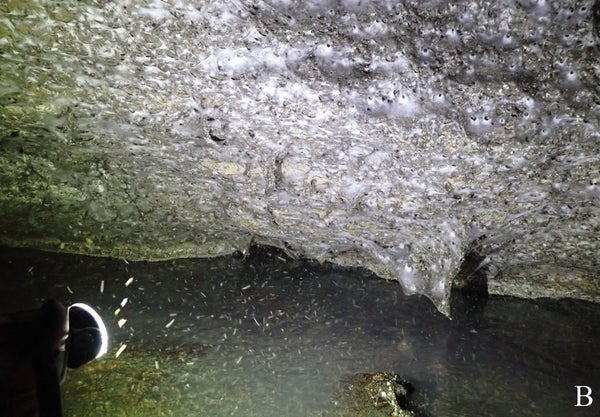
Lights illuminate a huge spider web found in a cave on the border of Greece and Albania.
“An extraordinary colonial spider community in the Sulfur Cave (Albania/Greece) supported by chemotrophy,” by István Urák et al., in Underground biologyn° 53. Published online October 17, 2025 (CC BY 4.0)
While exploring a sulfur cave on the border between Albania and Greece, scientists from the Czech Speleological Society discovered the largest spider web ever recorded. The vast “megacity,” which spans more than 1,040 square feet – almost half the size of a tennis court – is home to an estimated 111,000 spiders of the species. Domestic tegenaria And Prinerigone vagans, according to a study conducted by a separate group of researchers. This is the first documented case of either of these two species building webs together, the study authors recently reported in Underground biology.
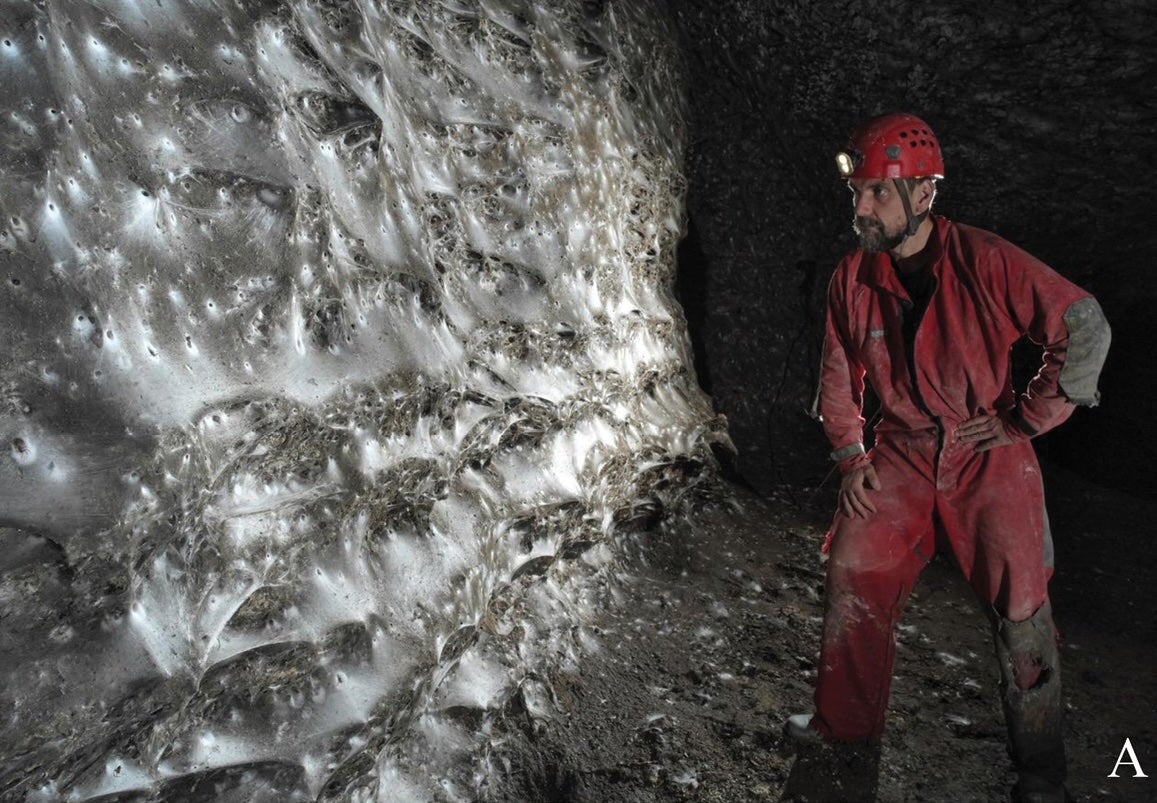
A caver observes the immense colonial spider’s web.
Sulfur caves are some of the most extreme habitats on the planet. They are completely dark and filled with hydrogen sulfide, toxic to most life forms. Inside, species survival depends on chemical reactions powered by microbes that oxidize sulfur. These microorganisms form the basis of a unique food chain that supports a community of cave-dwelling organisms.
On supporting science journalism
If you enjoy this article, please consider supporting our award-winning journalism by subscription. By purchasing a subscription, you are helping to ensure the future of impactful stories about the discoveries and ideas shaping our world today.
To understand how the spiders survive in this environment, the team analyzed the chemical signatures of their tissues, which revealed that the arachnids feed on tiny midges that hatch from cave pools. These flies themselves rely on sulfur-oxidizing microbes as their primary food source.

Domestic tegenaria on the spider web.
“An extraordinary colonial spider community in the Sulfur Cave (Albania/Greece) supported by chemoautotrophy,” by István Urák et al., in Underground biologyn° 53. Published online October 17, 2025 (CC BY 4.0)
A genetic analysis showed that cave spiders are distinct from populations of the same species that live outdoors, suggesting that they are adapted to the underground environment, the researchers wrote. They believe that this genetic isolation, combined with a stable and abundant food supply, may have caused these species – which have never been reported to form colonies – to adopt colonial behavior.
This new discovery “shows that nature still has many surprises in store for us,” says study co-author Urák István of Hungary’s Sapientia University of Transylvania in Romania.
It’s time to defend science
If you enjoyed this article, I would like to ask for your support. Scientific American has been defending science and industry for 180 years, and we are currently experiencing perhaps the most critical moment in these two centuries of history.
I was a Scientific American subscriber since the age of 12, and it helped shape the way I see the world. SciAm always educates and delights me, and inspires a sense of respect for our vast and beautiful universe. I hope this is the case for you too.
If you subscribe to Scientific Americanyou help ensure our coverage centers on meaningful research and discoveries; that we have the resources to account for decisions that threaten laboratories across the United States; and that we support budding and working scientists at a time when the value of science itself too often goes unrecognized.
In exchange, you receive essential information, captivating podcasts, brilliant infographics, newsletters not to be missed, unmissable videos, stimulating games and the best writings and reports from the scientific world. You can even offer a subscription to someone.
There has never been a more important time for us to stand up and show why science matters. I hope you will support us in this mission.


