Yale’s Summer Storage Wars | The Nation


Company
/
Student Nation
/
April 10, 2026
Yale just cut summer storage reimbursements for first-generation and low-income students. The university has a $44 billion endowment. What he chooses to budget for speaks volumes.
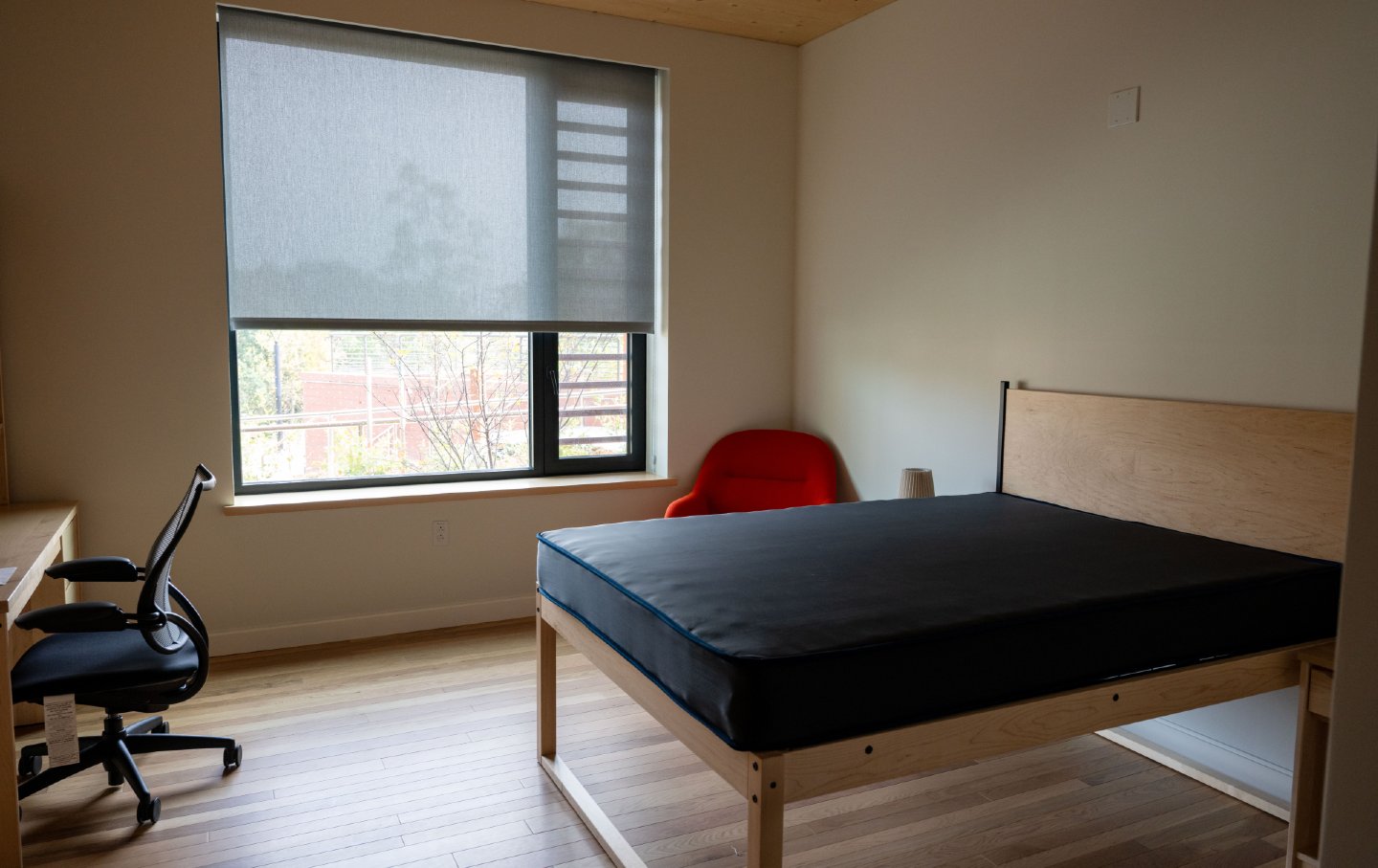
An unfurnished dorm room at Yale in New Haven.
(Ayannah Brown/Connecticut Public via Getty Images)
Early Monday morning, someone from the Yale College dean’s office sent me a message on WhatsApp. A link led to a letter from Professor Glenda Elizabeth Gilmore published in the Yale Daily News. It was a letter written about a word. The word was “stuff.”
In 1967, Gilmore finished his freshman year at Wake Forest. When school let out, she had nowhere to go, so she found a friend with a room on campus where she could stay for a few weeks. She also found a place in the basement of the dorm where her belongings – presumably a suitcase and her freshman year’s accumulations – could wait for her sophomore year.
A dean eventually found her and what she had hidden in the basement. He told her to leave it exactly where it was.
Gilmore is now the Peter V. and C. Vann Woodward Distinguished Professor at Yale, where she holds appointments in history, black studies, and American studies. But she didn’t write her letter to Yale Daily News on any scholarship or expertise in the many fields for which she is considered an authority. She wrote it to describe the dorm basement at Wake Forest. And she wrote it because Yale College Dean Pericles Lewis, defending his administration’s decision to eliminate its summer storage reimbursement program for first-generation and low-income students, suggested that these students “just shouldn’t buy too much stuff.” Dean Lewis had used “stuff,” so Gilmore had done it too. She put quotes around it. After working in universities for 60 years, she was precise.
A week before the publication of his letter, the Yale Daily News published an article about cuts to the summer storage reimbursement program. When the News posted the story on Instagram, it received nearly a thousand likes and over a hundred comments from current students and alumni. Jake Thrasher, a doctoral student at Yale, wrote the most popular comment: “If I made $450,000 a year (according to public information), I personally think it would be really corny to tell the poorest students here ‘not to buy too many things,’ but what do I know? Lizzie Conklin, who graduated last year, commented, “This is truly absurd. » Elizabeth Shvarts, who graduates next month, wrote: “Let’s just keep him in his mansion. » Another commenter compared Dean Lewis to Marie Antoinette. Several others called the situation absurd.
Alex William Chen was not among those who commented on the Instagram post. But Chen is the president of the Yale College Council and helped allocate the council’s remaining budget — nearly $13,000 — to support students who need financial assistance to cover summer storage costs.
Current number

Chen sent me a message he would like to send to Yale administrators: “Please come down from your desks and meet with students on campus. Explain to us how the utility of financial support for Yale’s most financially vulnerable students is somehow less than the utility of preserving an exponentially bloated administrative apparatus.”
Chen told me he knew several Yale students from New Haven who were offering their own homes to store boxes for friends who would lose summer storage reimbursement. He asked, “Would these Yale administrators be willing to do the same?”
The reimbursement program had covered summer storage costs for low-income, first-generation college students and provided relief to eligible students whose socioeconomic background does not make it a financially feasible option for summer storage. His elimination disrupted the expected relief.
A week after the announcement and a day after Gilmore’s letter, a new announcement came: this one from a student who, like Chen, wanted to find a way for students to solve this problem on their own.
Topher Allen, student equity coordinator at Dwight Hall, a public service center at Yale, held emergency meetings with storage vendors, container brokers and colleagues on the student executive committee. Between meetings, he was in communication with alumni and leaders of the Yale College Council. Within a week, they had reallocated their entire spring budget to community development, social justice and outreach. Everything that was allocated to these programs went into creating solutions for students who still needed summer storage reimbursement.
What they built: A flat rate of $50 for storage throughout the summer, available to any full Pell Grant-eligible student living on campus with a home address more than 150 miles away.
In an email to students, they compared their price to that offered by local vendors, between $400 and $700. Allen, however, called the solution a band-aid. He said it was born out of necessity, not abundance. He also noted that some students, before Dwight Hall’s intervention, had planned to hide their belongings on campus or throw away items and try to replace them in the fall.
Gilmore’s letter, about halfway through, ends her story about the dean who let her keep her “stuff” in a dorm basement all those years ago. When she finishes this story, she begins another, in which Yale holds a $44 billion endowment. In the article, she argues that the administration could be more helpful by eliminating two administrator positions rather than ending a summer storage reimbursement program that benefited thousands of students.
Popular
“Swipe left below to see more authors”Swipe →
Gilmore’s second story, alluding to what Chen called a bloated administrative apparatus, did not arrive at its conclusion arbitrarily.
In 2025, more than a hundred Yale professors from dozens of academic departments in nearly every discipline, including Yale Law School and the Yale School of Medicine, signed a letter calling for a freeze on new administrative hires. Faculty saw their own salary increases slowly as the ratio of administrators to undergraduates approached parity.
The endowment that pays these administrators was accumulated, at least in part, through generations of alumni who wanted to give back to the school that had given them so much. Among what Yale offered them were programs like summer storage. It seems, based on Chen’s text messages and numerous angry comments on Instagram, that such programs give Yale an opportunity to show students that it values them as more than their good grades, SAT scores, and ISEF awards.
That’s the argument Gilmore made in her letter, which began, she told us, in the basement of a dorm room in Winston-Salem in 1967. She remembers it 60 years later. She put the word in quotation marks. She took a word that a dean had used carelessly and delineated it precisely in the oldest college daily newspaper in the United States. But Gilmore didn’t call any of this absurd. “Yale College Dean Pericles Lewis may have been trying to be humorous… when he suggested that low-income students should simply not “buy too many things,” Gilmore wrote, “instead it seemed arrogant.” »
More than The nation
What the battle over a mixed-use development in a historic city reveals about liberal America.
Sophie Mann-Shafir

Too often we narrow our scope to remote communication. We must integrate into communities to make a real difference.
Gregg Gonsalves

The city is at the forefront of fighting the use of big tech to surveil residents. But AI poses new threats.
Functionality
/
Sasha Abramski

A manifesto for an AI revolution that benefits as many people as possible, not just billionaires.
Functionality
/
Representative Ro Khanna

More and more students are being indoctrinated into a cold cult of “efficiency,” where training workers for corporate employment is seen as the ultimate priority.
Jonathan Kozol