
Your immune system has one job: to protect you. And most of the time, it does that job like a pro.
But occasionally it gets a bit overzealous, even paranoid. It mistakes harmless, even wonderful things—flowers, peanuts, cats—for threats, and attacks them (and you—mostly you) with a senseless, chaotic vengeance.
For most allergy sufferers, this might mean giving up a few tasty foods, staying inside during high pollen counts, or rehoming the cat—or, more realistically, the person allergic to the cat. But for a tiny number of people, the immune system decides to take aim at one of the most essential substances on earth: water.
Yes, it is possible to be allergic to water. And the condition is even stranger than it sounds.
“Imagine not being able to go into the pool, or the lake, or the ocean,” says dermatologist Dr. Amir Bajoghli, who has treated a patient with this rare condition. “My patient also has to take much faster showers, as you might imagine. It definitely interferes with quality of life.”
Yes, you can be allergic to water
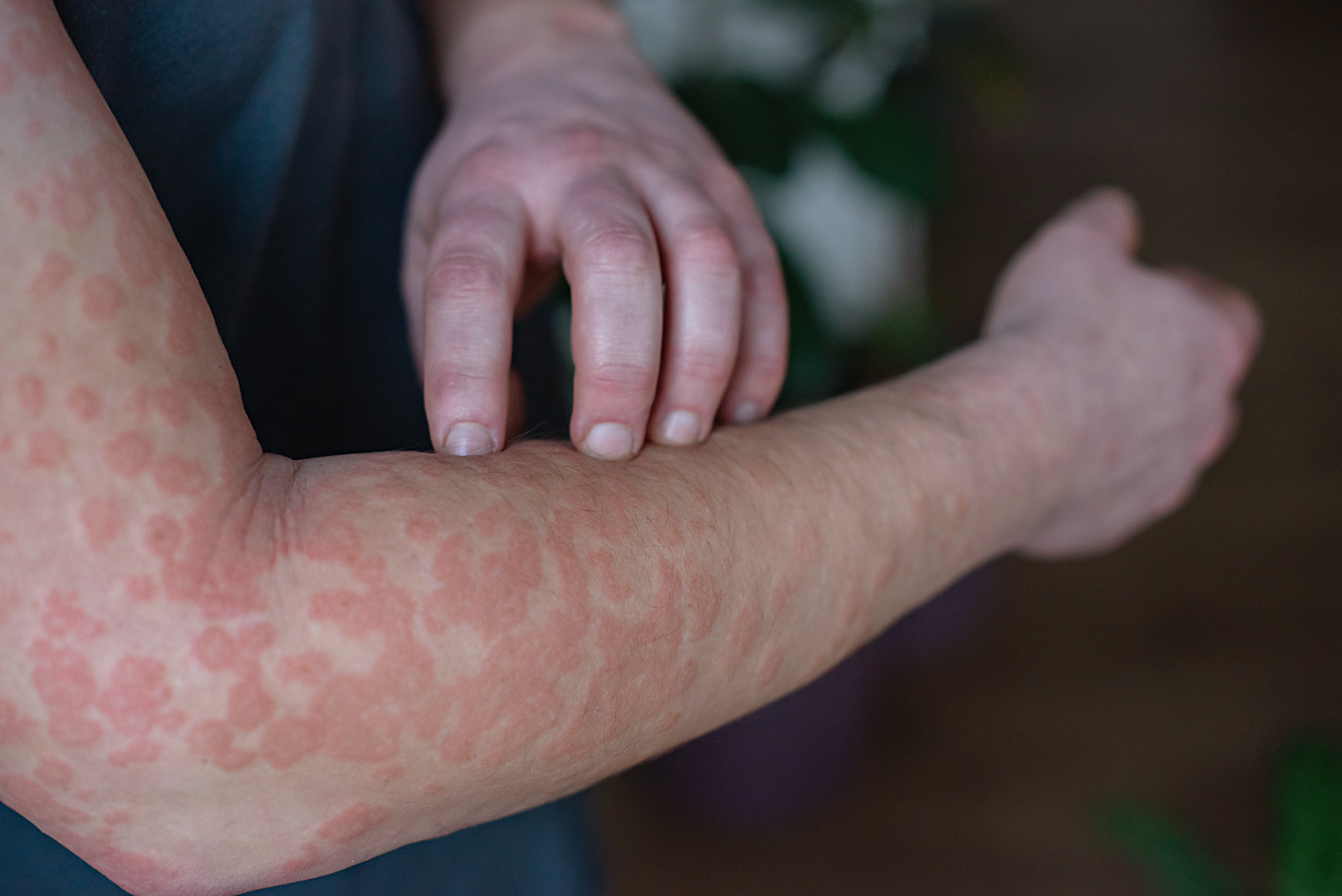
The medical term for an allergy to water is aquagenic urticaria, a form of hives. The condition is so rare that only an estimated 100 to 150 cases have ever been reported. However, researchers believe many more cases go undiagnosed: When a patient comes in complaining of hives, “it could be water” is probably not the first thing that leaps to mind.
“Honestly, a lot of general physicians aren’t even aware of it,” says Bajohgli, an adjunct professor at Georgetown University School of Medicine. “It’s rare, and it’s not on their radar.”
Although scientists don’t fully understand exactly how aquagenic urticaria works, they believe water itself isn’t the culprit. Rather, it appears that certain people’s skin responds differently to water contact, setting off a reaction in the skin’s outermost layer. This triggers the body’s mast cells (immune cells that sound the alarm during allergic reactions), which releases histamine, the troublemaking chemical responsible for allergic responses.
Within minutes of water touching the skin, a person with aquagenic urticaria will develop raised, intensely itchy welts. The reaction typically lasts anywhere from 30 minutes to an hour, and the longer the exposure, the more severe the symptoms.
You can still drink water, but sweating can be a problem
Interestingly, and luckily, aquagenic urticaria does not interfere with the body’s need for life-sustaining hydration. In other words, drinking water is fine. When water is swallowed and processed by the gut rather than absorbed through the skin, it doesn’t trigger the same immune response, Bajoghli says.
“The gut, just like the skin and the lungs, is one of the first forms of defense,” he says, “but in this case, somehow, it’s not eliciting the response in the gut the way it does in the skin.”
Bajoghli notes that some patients with aquagenic urticaria do react to their own sweat, although his patient does not. Sweat, he explains, involves an entirely different biological process than external water making contact with the skin.
Scientists believe an unidentified substance in the skin may be triggering this reaction, although much remains unknown.
“It’s still, medically, for us, a mystery,” he says.
How to test if you’re allergic to water
For better or worse (mostly better), water is inescapable. Because of its ubiquity, and also because aquagenic urticaria is something of a medical unicorn, it often takes a while for patients or doctors to connect the dots.
Related ‘Ask Us Anything’ Stories
Once it occurs to the patient and provider that water could be the culprit, diagnostic testing is fairly straightforward. It typically involves applying water-soaked compresses to the skin and waiting. In most positive cases, symptoms appear within five minutes, although the test can take up to 30.
“We wait 30 minutes before we call it negative,” Bajoghli says.
The importance of very quick showers
So, what is life like for a person whose body treats H₂O as a sworn enemy? For Bajoghli’s patient, an active teenager involved in sports, the condition reshapes even the most basic daily routines. Among other things, this means really fast showers.
“When he showers for about two minutes, the symptoms are more subdued and milder in nature,” Bajoghli says. “If he takes a longer shower, they’re more severe and they persist longer.”
The good news is that aquagenic urticaria is unlikely to cause a major allergic reaction. It is, however, chronic; patients should not expect it to resolve on its own.
Treatment options do exist, however. Bajoghli’s patient takes an antihistamine called cyproheptadine, which reduces symptoms enough to make that two-minute shower manageable. Timing is important: taking the antihistamine about an hour before water exposure helps maximize its effectiveness.
For patients who need more relief, Bajoghli says a newer drug called omalizumab has shown promise.
For now, the mechanisms behind aquagenic urticaria, including the identity of the substance—or antigen—that triggers it, remain poorly understood, and that knowledge gap makes it difficult to develop more targeted treatments.
“We’re really looking forward to finding out what that antigen is,” Bajoghli says, “and hopefully one day solving this.”
In Ask Us Anything, Popular Science answers your most outlandish, mind-burning questions, from the everyday things you’ve always wondered to the bizarre things you never thought to ask. Have something you’ve always wanted to know? Ask us.

2025 PopSci Best of What’s New


