2 displaced Lebanese grandmothers reflect on successive Israeli invasions : NPR

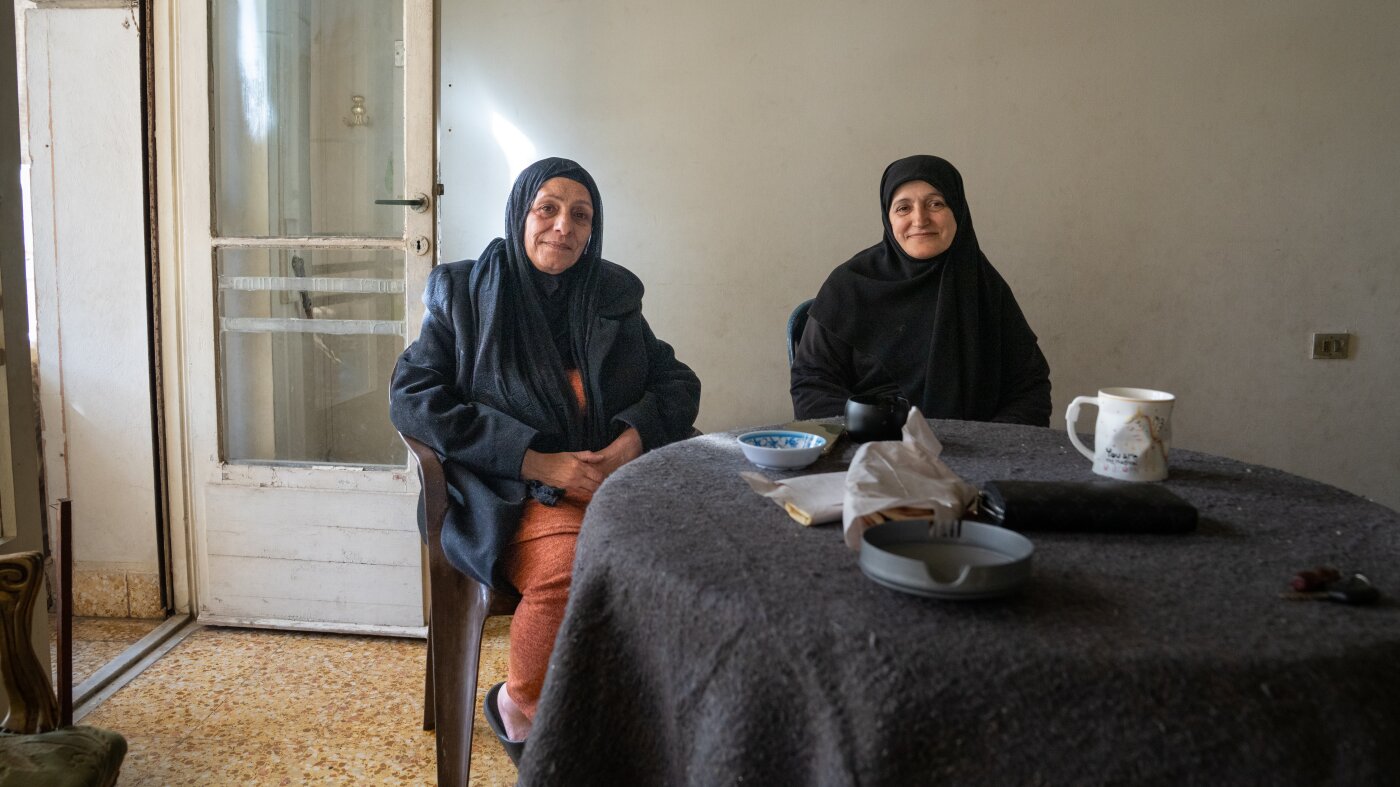

Mariam Allawiya, 60 (left), and Kafa Wehbe, 67, sit together in a vacant building in central Beirut after being displaced from southern Lebanon by Israel’s ongoing invasion. They both grew up in southern Lebanon and Alawiya’s son married Wehbe’s daughter.
Claire Harbage/NPR
hide caption
toggle caption
Claire Harbage/NPR
BEIRUT, Lebanon — Mariam Allawiya and Kafa Wehbe sit on a sun-drenched balcony and smoke.
They both grew up among the olive groves of southern Lebanon. Allawiya’s son married Wehbe’s daughter. They are grandmothers now.
But this is not how they hoped to age: squatting in a vacant building in the center of Beirut, displaced several times.
Yet they conjure up hospitality for visiting journalists, grab a donated plastic chair and tell the stories of their lives – which also tell the history of southern Lebanon.
“What can I say? It’s all anxiety and war,” says Alawiya, 60.

A building in central Beirut housing families displaced by Israeli attacks. More than a million people have been displaced in Lebanon since the beginning of March, according to the Lebanese government.
Claire Harbage/NPR
hide caption
toggle caption
Claire Harbage/NPR
She and Wehbe, 67, are among more than a million people the Lebanese government says have been displaced by the current Israeli invasion, which began last month after Lebanese Hezbollah militants fired rockets into Israel. They said they were responding to U.S. and Israeli attacks on their benefactor, Iran, and 15 months of Israeli attacks on Lebanon that continued after a previous ceasefire in November 2024.
Now, with a new ceasefire, Israel and Hezbollah are warning displaced people not to return to the south. And Allawiya and Wehbe say they will stay put – it’s too dangerous.
This is not the first time these grandmothers have had to flee Israeli attacks.
Born in the south, moved to Beirut, on the run again
Allawiya was born in the Lebanese village of Maroun al-Ras, near the Israeli border. Israeli troops invaded him in 1982, destroyed his family’s home and then occupied southern Lebanon for 18 years. The Allawiya family fled north to Beirut and settled in the southern suburbs of the capital with other displaced Shiite Muslims.
But they drove home every summer and rebuilt their home — a labor of love during the occupation, she said.
“Our village, our land, our houses, our trees, our olives, our apples – our soil,” Allawiya says wistfully.

Allawiya shows a photo of his house in Maroun al-Ras, destroyed just over a year ago. The house was destroyed and rebuilt after successive Israeli invasions in 2006 and 2024.
Claire Harbage/NPR
hide caption
toggle caption
Claire Harbage/NPR
“And also checkpoints and Israeli soldiers!” his friend Wehbe interrupts him. “At the time, you needed a permit to travel, like in the Palestinian territories. We don’t want that anymore!”
“This is why we support the resistance,” she says.
By this she means Hezbollah.
Why these grandmothers support Hezbollah
Hezbollah was founded during that 1982 invasion. At the time, Israel was targeting Palestinian militants. But Hezbollah said it was fighting for the Lebanese, against foreign occupation, and endeared itself to people like Allawiya and Wehbe. He financed the reconstruction of thousands of homes, often with Iranian money. And she celebrated victory when Israeli forces finally withdrew from southern Lebanon in 2000.

Lebanese people walk near the border fence with Israel in Kfar Kela on May 28, 2000, after the withdrawal of Israeli forces from southern Lebanon a few days earlier.
Ramzi Haidar/AFP via Getty Images
hide caption
toggle caption
Ramzi Haidar/AFP via Getty Images
“Oh, how beautiful that moment was,” Alawiya recalls. “It was perfect.”
But it was fleeting.
The Allawiya family never managed to move permanently. Israeli troops invaded again, in 2006 and 2024, in pursuit of Hezbollah militants, each time destroying the Allawiya home.
They rebuilt after 2006, but did not have the chance to rebuild again, a third time, before last month’s invasion displaced them again – this time from their apartment in Beirut’s southern suburbs to this vacant building in a central part of the city, which the owner offered to the displaced. They moved from one temporary home to another.
Not everyone in Lebanon supports Hezbollah. Many blame the group for these successive wars. Wehbe says he fears that some of his fellow citizens will abandon the south – accepting a new era of Israeli occupation – in exchange for a ceasefire.
Despite the current ceasefire, Israel says its troops will continue to hold Lebanese territory south of the Litani River, which flows between 16 and 32 kilometers north of the current border, to create what it calls a buffer zone from which Hezbollah can no longer fire rockets.
“How could the south not be part of Lebanon? It’s on our map!” said Wehbe. “If we could all stand united against Israel, then Israel would leave us alone.”
She believes that Hezbollah is her country’s best hope for obtaining the withdrawal of Israeli troops, since it already did so in 2000.
Accommodation with 35 family members, including a pregnant woman and children

Mohammad Atwi, 4, jumps on a chair in the apartment where his family lives with dozens of relatives, including his grandmother Kafa Wehbe (right), all displaced by Israeli attacks.
Claire Harbage/NPR
hide caption
toggle caption
Claire Harbage/NPR
Allawiya, Wehbe and 35 of their relatives are all squatting together in this vacant building. On April 7, they stayed up all night, waiting for the announcement of a ceasefire between the United States and Iran. They trusted early accounts from Pakistani mediators that the deal would include Lebanon, and assumed that this would mean an end to Israeli attacks and that they would be allowed to return home.
“We were happy! We started cleaning, preparing to leave this place,” Alawiya recalls.
But his hopes were dashed the next morning, April 8, when Israel struck Lebanon 100 times in 10 minutes, killing more than 350 people, according to Lebanese authorities. Numerous strikes hit the center of Beirut, shaking the building where the Allawiya and Wehbe families were gathered.
Allawiya says this experience makes her wary of trusting a ceasefire between Israel and Lebanon, announced by President Trump on April 16. As long as this ceasefire is described as temporary – for 10 days rather than permanent – she says it still seems too dangerous to return home.
“To be honest, we don’t feel safe going back,” she says. “The Israelis could break their promise.”
Former neighbors, displaced like them, keep calling. They are trying to find out if their houses in the suburbs of Beirut are still standing. The area is home to some Hezbollah offices and Israeli airstrikes have hit several times.
But this is not the apartment Alawiya dreams of. This is his family’s former home in the south, in Maroun al-Ras, which is now back under Israeli control. This is part of the “buffer zone” that Israel says it can maintain for months or even years.
I dream of rebuilding again
One of Allawiya’s tech-savvy children made a video of their ancestral home, with a carousel of photos from when it was still standing, set to a ballad written by an Egyptian singer, Sherine, about Israel’s invasion of Lebanon in 2006. It’s called “Lebanon at the Heart.”
In this sterile, borrowed, barely furnished apartment, Allawiya leans into his cell phone and replays this video over and over again.

Baby clothes hang on washing lines on the balcony of the apartment where the family lives.
Claire Harbage/NPR
hide caption
toggle caption
Claire Harbage/NPR
“Wake up, oh South! The sun is going down,” she mumbles the lyrics over the music. “Lebanon is in the heart.”
The chorus continues: “There is no one but us to protect our homeland.”
This new war interrupted the treatment Allawiya was receiving for cancer. One of her daughters-in-law is seven months pregnant. Grandkids bouncing off the walls, no school.
They can’t stay in this free apartment forever. But even with a ceasefire, they don’t know when it will be safe for them to return home.


