A bizarre ‘decapitated’ asteroid likely made the moon’s largest impact crater. NASA’s Artemis astronauts may land near the proof

When you purchase through links on our articles, Future and its syndication partners may earn a commission.
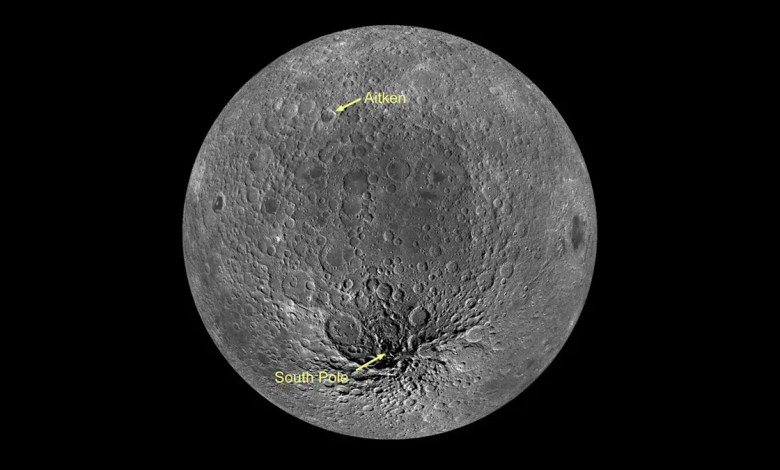
A violent impact that carved out the Moon’s largest impact basin may have scattered deep lunar material near the lunar south pole, where NASA plans to send Artemis astronauts.
A new study suggests that the South Pole-Aitken Basin (SPA), an impact crater more than 2,000 kilometers wide on the planet moonon the other hand, was probably created by a differentiated system asteroid. The results could answer some of the biggest scientific questions surrounding the creation of the SPA – and could have major implications for future exploration of the Moon.
The SPA basin is one of the most scientifically valuable lunar impact structures because it can expose materials mined from deep within the lunar mantle. Scientists have long debated exactly how the basin formed, including the size, speed and direction of the impactor.
Using high-resolution 3D simulations, a team of researchers led by Shigeru Wakita of Purdue University found that the distinctive shape of SPA’s tapering ellipse is best explained by a 160-mile-wide (260-kilometer-wide) differentiated impactor—a large asteroid which had already separated into a dense iron core and a rocky outer layer, much like a small planet. It hit the Moon moving north to south at about 13 kilometers per second (8 miles per second) at a low angle of 30 degrees, researchers said.
This shallow angle is key. At this trajectory, the impactor is essentially “decapitated”. Its upper layers shear as the dense iron core continues to plow forward. “The impactor core is responsible for the tapered shape of the SPA,” the authors wrote in the study. On the other hand, a simpler, undifferentiated asteroid would have produced a rounder basin.
Above all, the team discovered that the impact would have projected ejecta from the mantle towards the lunar south pole. According to the paper, Artemis astronauts landing near the pole could encounter deposits containing materials mined from depths greater than 90 km.
“Our work suggests that NASA Artemis III Mission“, which will send astronauts to the Moon, will likely sample SPA ejecta, if it lands as planned in the south polar region of the Moon,” the researchers write in the study. (NASA has since revised THE Artemis Program and announced that its first crewed moon landing would take place on the Artemis 4 mission no earlier than 2028.)
If the simulation is correct, the recovered samples could help scientists determine the age of the SPA basin and reveal the composition of the Moon’s deep interior, offering clues about how the Moon evolved shortly after its formation more than 4 billion years ago.
The study was published May 7 in the journal Science Advances.


