
In the minds of people like me, who were raised on nature documentaries, it’s as if Sir David Attenborough were the voice of nature itself. His inimitable near-whisper narrated much of my childhood, as the splendors of the natural world danced across my screen. And today, Attenborough celebrates his 100th birthday.
But what do you get for the naturalist, conservation advocate, and broadcaster nonpareil who has everything?
Why, an eponymous, newly discovered species, of course. This time, it’s a Chilean parasitic wasp that was recently determined to belong to a new genus and species after researchers at London’s Natural History Museum studied a 40-year-old specimen more closely. Attenboroughnculus tau has physical traits, noticed by a sharp-eyed volunteer, that separate it from three other genera in subfamily Claseinae, which contains other small, parasitic wasp species from southern South America.
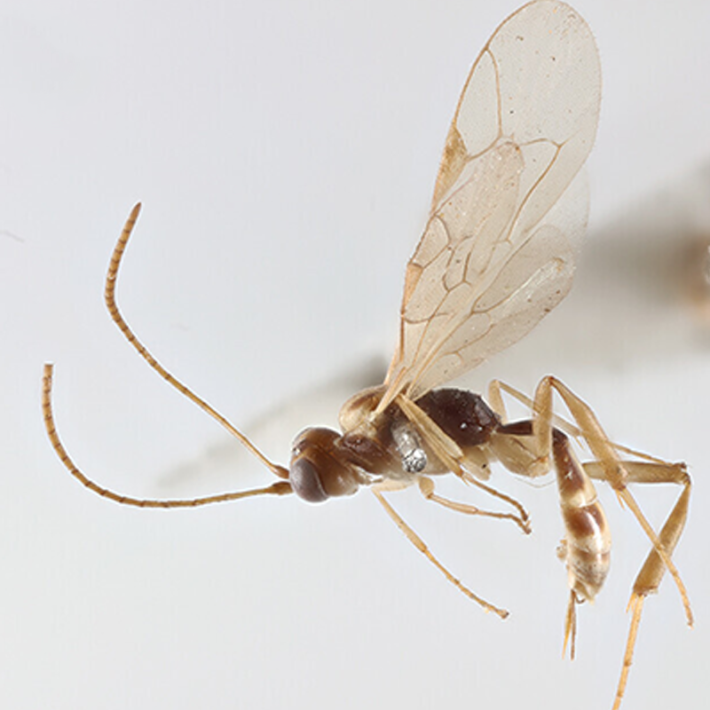
The researchers published their intricate examination of the new species in the Journal of Natural History to coincide with Attenborough’s centennial birthday. They cited the broadcaster’s work in Chile and specifically with parasitic wasps as the inspiration to name the wasp after him. “David Attenborough has featured Chile’s diverse, extreme landscapes in several documentaries, emphasising the unique environmental challenges and ecological resilience of species within the country,” they wrote in the paper. “Sir David has also filmed several scenes with parasitoid wasps, famously termed the ‘bodysnatcher wasp’ by the broadcaster in the Trials of Life, first broadcast in 1990. He has used his work to reveal the intimate, unseen or overlooked within nature. This resonates in the discovery of this species in an unsorted drawer within the collections of the Natural History Museum, London.”
Read more: “David Attenborough’s Life in Color”
This isn’t the first time that scientists have honored Attenborough’s contributions to natural history and science communication by naming new species after him. More than 50 taxa have been named after him and his documentary series, including reptiles (extant and extinct), insects, mammals, fish, plants, arachnids, birds, crustaceans, worms, amphibians, protists, mollusks, and fungi. For good measure, a museum on the campus of his alma mater, Cambridge University, and a polar research ship also bear Attenborough’s name.
From his iconic voicing of nature’s hidden worlds to his work in anthropology to his championing of sustainable living and conservation, Attenborough has wracked up more honors than there is space to mention here. Generations of researchers, science communicators, and naturalists count him as their formative inspiration. And his view of the natural world shaped the perspectives of innumerable viewers, yours truly included.
Enjoying Nautilus? Subscribe to our free newsletter.
Lead image: Wikimedia Commons


