Hubble Space Telescope Captures New Image of NGC 2775


The large central bulge of NGC 2775 is filled with old stars, surrounded by narrowly rolled spiral arms decorated with dark dust and clusters of young blue stars.
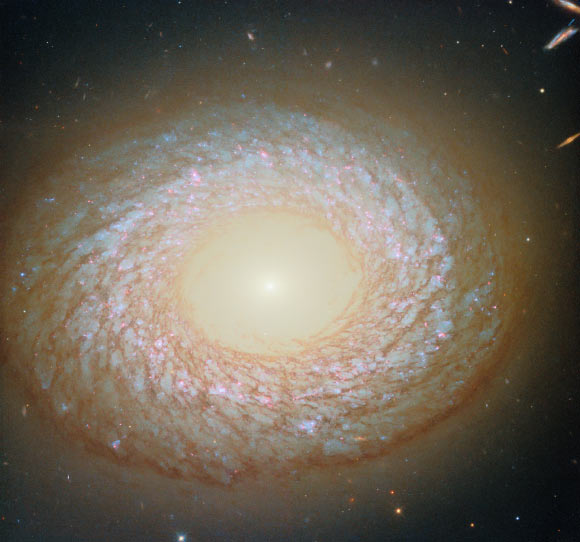
This Hubble image shows NGC 2775, a galaxy at around 67 million light years in the Constellation of Cancer. Image credit: NASA / ESA / HUBBLE / F. Belfiore / J. Lee / Phangs-HST Team.
NGC 2775 is located at around 67 million light years in the northern cancer constellation.
The galaxy was discovered on December 19, 1783 by the British astronomer of German origin William Herschel.
It belongs to the anti-Hydra galaxies cloud and is the main member of a small group of galaxies called the NGC 2775 group.
Also known as Caldwell 48, LEDA 25861 or UGC 4820, NGC 2275 has a diameter of 80,000 light years.
“NGC 2775 has a smooth and without business center which is devoid of gas, resembling an elliptical galaxy,” said Hubble astronomers in a press release.
“He also has a dusty ring with uneven stars bunches, such as a spiral galaxy. Which one is it, then: spiral or elliptical – or not? ”
“Because we can only see NGC 2775 from an angle, it is difficult to say it with certainty.”
“Some researchers have classified NGC 2775 as a spiral galaxy due to its feather and dust ring, while others have classified it as a lenticular galaxy.”
“Lenticular galaxies have characteristics common to spiral and elliptical galaxies.”
“We do not yet know exactly how lenticular galaxies arrive, and they could form in various ways.”
“Lenticular galaxies could be spiral galaxies which have merged with other galaxies, or which mainly failed in gas forming stars and lost their arms in a prominent spiral.”
“They could also have started more similar to elliptical galaxies, then collected gas in a disc around them.”
According to astronomers, NGC 2775 has probably merged with other galaxies in the past.
“Invisible in this Hubble image, NGC 2775 has a gas hydrogen tail which extends nearly 100,000 light years around the galaxy,” said the researchers.
“This slight tail could be the rest of one or more galaxies that wandered too close to NGC 2775 before being stretched and absorbed.”
“If NGC 2775 has merged with other galaxies in the past, it could explain the strange appearance of the galaxy today.”
“An NGC 2775 hubble image has already been published in 2020,” they said.
“The new version adds observations of a specific red wavelength of red light which is emitted by clouds of gas hydrogen surrounding young massive stars.”


