Ebola outbreak triggers U.S. ban on travelers from three African nations


May 18, 2026
2 min reading
 Add us on GoogleAdd SciAm
US bans travel from three African countries as Ebola outbreak spreads
At least six Americans are believed to have been exposed to Ebola, and one person who appears to have contracted the virus has been evacuated to Germany.
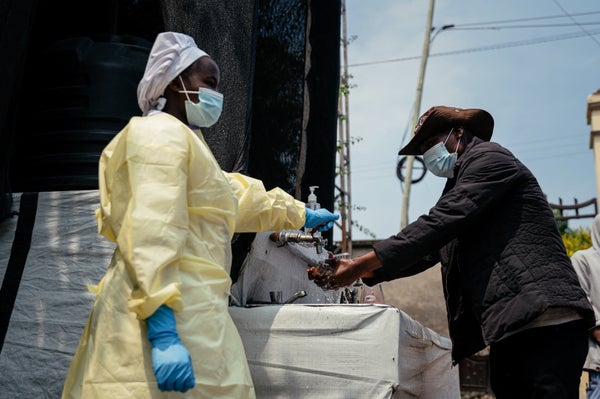
Photo by Jospin Mwisha / AFP via Getty Images
The United States on Monday announced new travel restrictions for visitors from three African countries: Uganda, South Sudan and the Democratic Republic of Congo (DRC), which are at the center of an ongoing outbreak of the Ebola virus that has reportedly killed at least 100 people. The ban, which does not apply to U.S. citizens or permanent residents, will remain in effect for 30 days. At least six Americans reportedly exposed to virus in DRC; one of those people developed symptoms and was evacuated to Germany, according to U.S. officials.
In an order signed by Jay Bhattacharya, acting director of the Centers for Disease Control and Prevention (CDC), the agency says the ban aims to minimize the potential for spread in the United States and to give authorities time to assess the threat of the outbreak, which the World Health Organization (WHO) declared a global health emergency on Sunday. Although there have only been a dozen confirmed infections, hundreds more are suspected.
The United States will also step up medical screenings and the CDC will attempt to trace anyone who may have entered the country in recent weeks and who may have been exposed to the Ebola virus. The risk to the general public remains low, the agency said Monday during a press conference.
On supporting science journalism
If you enjoy this article, please consider supporting our award-winning journalism by subscription. By purchasing a subscription, you are helping to ensure the future of impactful stories about the discoveries and ideas shaping our world today.
The outbreak appears to be caused by the Bundibugyo virus, one of several viruses that can cause Ebola disease. The most notable symptom is viral hemorrhagic fever, which can cause life-threatening internal bleeding. This type of Ebola is similar, but not identical, to the Zaire strain of the virus, which caused the 2013 to 2016 Ebola outbreak in West Africa that killed at least 11,325 people. The mortality rate in Bundibugyo is 25 to 50 percent, according to the CDC, and there is no vaccine or specific treatment for the disease.
It’s time to defend science
If you enjoyed this article, I would like to ask for your support. Scientific American has been defending science and industry for 180 years, and we are currently experiencing perhaps the most critical moment in these two centuries of history.
I was a Scientific American subscriber since the age of 12, and it helped shape the way I see the world. SciAm always educates and delights me, and inspires a sense of respect for our vast and beautiful universe. I hope this is the case for you too.
If you subscribe to Scientific Americanyou help ensure our coverage centers on meaningful research and discoveries; that we have the resources to account for decisions that threaten laboratories across the United States; and that we support budding and working scientists at a time when the value of science itself too often goes unrecognized.
In exchange, you receive essential information, captivating podcasts, brilliant infographics, newsletters not to be missed, unmissable videos, stimulating games and the best writings and reports from the scientific world. You can even offer a subscription to someone.
There has never been a more important time for us to stand up and show why science matters. I hope you will support us in this mission.


