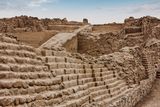
Each storm leaves a new wound: channels carved by water, layers of mud washed away, and reliefs slowly eroded. The increasingly intense rains associated with El Niño are wearing down the adobe pyramids — made from a mixture of clay, sand, water, and straw — built more than a thousand years ago on Peru’s northern coast.
A new study published in Archeological Prospection reveals how extreme storms, wind, and solar radiation are deteriorating one of the country’s most important earthen archaeological complexes. And the threat is not unique to Peru: thousands of earthen archaeological sites around the world face similar risks in an increasingly extreme climate.
“On a global scale, we underestimate the speed of the dismantling processes at earthen sites,” Guido Ventura, senior researcher at the National Institute of Geophysics and Volcanology in Italy, told Discover.
Why the Chotuna and Chornancap Pyramids Were Built
The Chotuna-Chornancap Archaeological Complex lies about five miles from the city of Lambayeque and less than three miles from Peru’s northern coast. Amid dunes and sea breezes, the huacas — sacred sites — linked to the story of Ñaimlap, one of the most important oral traditions of the Lambayeque culture, still stand.
“The story recounts the voyage and arrival of this emblematic figure together with his wife, Ceterni, his concubines, retinue, and officials,” archaeologist Carlos Wester La Torre, director of the Brüning National Archaeological Museum, told Discover. According to legend, Ñaimlap came from the sea and founded a lineage that ruled the region until the Inca conquest.
After landing, Ñaimlap and his entourage settled half a league inland, where they built palaces and a temple called Chot, believed to correspond to what is now the Chotuna huaca.
“We are in a place that functioned as a major ceremonial, administrative, and residential center, as well as a mausoleum,” Wester La Torre said.
Excavations carried out over the past few decades have revealed the political and symbolic significance of the site. It was there that researchers discovered the tomb of the ruler-priestess of Chornancap, considered one of the most powerful female authorities of her time. Her burial included prestige objects, as well as the remains of eight young women and a camelid.
The entire complex was built more than 1,200 years ago using millions of sun-dried mud bricks. The Chornancap huaca — the largest truncated pyramid at the site — stands about 60 feet high and measures between 260 and 295 feet on each side. Engineers constructed it with earth and sand used not only for adobe bricks, but also for floors, reliefs, and polychrome paintings.
“During their period of use, these monuments received constant maintenance,” Wester La Torre said. “But after their abandonment — around the 14th century — they were gradually covered by dense layers of sand carried by the wind. This natural burial helped preserve many architectural elements for centuries. The problem is that, when we excavate them, we expose them abruptly to current environmental conditions, and that produces changes and deterioration.”
Read More: The Race to Protect Atacama’s Ancient Geoglyphs
The Weather’s Great Impact on Ancient Pyramids
Ventura puts it plainly: what neither looting nor the Spanish conquest could accomplish, the weather does patiently over time.
“The water associated with intense rains dismantles and destroys the architectural structure of the huacas,” he explained to Discover. Meanwhile, wind erodes the most exposed areas and deposits sand and clay in the lower sections. Similar phenomena have been observed at other nearby sites, such as El Mirador and Apurlec, as well as at the Pachacamac Archaeological Complex on Peru’s central coast.
The onslaught of the elements offers no respite. Between May and January-February, winds associated with the Humboldt Current dominate the region; between February and April, rains linked to the El Niño–Southern Oscillation (ENSO) arrive. In 2023, Cyclone Yaku caused massive flooding that affected both nearby communities and the preservation of the archaeological heritage, according to the Peruvian Ministry of the Environment. Researchers warn that these types of extreme events could intensify in the coming decades.
Another factor threatening the site’s preservation is the expansion of rice cultivation in surrounding areas, where irrigation has increased humidity in some sectors of the archaeological complex.
“We are dealing with monuments built of earth, whose fragility and vulnerability to rainfall are extremely high,” Ventura said.
How El Niño is Eroding Huacas
Today, the slopes of the Chornancap huaca are scarred by runoff channels. Cavities have formed at its summit due to water accumulation, and its structure is slowly degrading under the combined effects of rain, wind, and solar exposure.
Research led by Ventura quantifies this damage with unprecedented precision. Using drone photogrammetry, scientists have created centimeter-scale 3D models of the site, allowing them to measure how extreme rainfall erodes the adobe architecture.
To calculate the rate of deterioration, the researchers began with a hypothesis: while the complex was still in use, its structures received constant maintenance, meaning the surfaces of the huacas would have remained relatively smooth and free of large erosion grooves. Based on the current depth of the channels carved by water on the western slopes of Chornancap, the team estimated a maximum erosion rate of about 1 foot (0.33 meters) per century, driven solely by El Niño-related rainfall.
The figure surprised researchers because it is comparable to the natural erosion produced by rivers over periods ranging from 1 to 100 years, and even exceeds the estimated rate for the nearby Chotuna huaca: about 8 inches (0.2 meters) per century.
Publishing their findings in Remote Sensing, the team also analyzed the nearby El Mirador Archaeological Complex, whose main truncated pyramid stands about 26 feet (8 meters) high and today exhibits deep gullies, channels, and ravines carved by erosion. In some areas, rain has partially dissolved the adobe bricks, forming clay deposits that cover older structures.
According to Ventura, although Chornancap and El Mirador are exposed to similar climatic conditions, the degree of deterioration differs.
“El Mirador is less well preserved,” Ventura explained.
One possible reason may be the presence of ancient drainage pipes at Chornancap that helped partially control water flow during heavy rains. Ventura’s warning, however, is broader.
“Without adequate intervention and protection, it could be completely destroyed within just a few decades,” he said.
Mitigating Destruction of the Huacas
Around 10 percent of UNESCO World Heritage sites are earthen archaeological sites distributed across all continents, according to UNESCO. They are complemented by modern, still-inhabited structures — primarily in Africa — built with adobe, a mixture of clay, sand, water, and straw. Whether ancient or contemporary, all are exposed to the vagaries of the weather. For this reason, Ventura argues that his photogrammetry-based methodology — faster and less expensive than Light Detection and Ranging (LiDAR) — could be applied to these types of structures worldwide.
“Currently, there are no other techniques capable of obtaining data at such high resolution,” said Ventura. “The solutions to mitigate the effects of climatic factors are relatively simple and do not require large investments. It is more a cultural problem than an economic one.”
In the case of Peruvian huacas, it would be enough to protect them with shed-style or pitched wooden roofs, complemented by curtains or windbreaks. The construction of “false” floors could also help.
“None of these solutions alters the architectural structure because they do not come into direct contact with the building,” Ventura said.
Paradoxically, one of the approaches adopted at the site has been to rebury some structures to ensure their preservation.
“It’s the most effective form of protection,” Wester La Torre said.
For the archaeologist, what is at stake is not only the survival of the monuments, but also the evidence that could still rewrite the history of the Lambayeque culture.
Read More: The Earliest-Known Astronomical Observatory in the Americas May Offer New Insights
Article Sources
Our writers at Discovermagazine.com use peer-reviewed studies and high-quality sources for our articles, and our editors review for scientific accuracy and editorial standards. Review the sources used below for this article: