
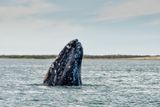
It was April 2026, and for days, locals had reported a very strange sight in the Willapa River in Washington state. A young male gray whale was swimming about 20 miles upriver in freshwater — strange behavior for an oceanic creature, and unsustainable in the long run. After only a few days, officials reported the whale dead.
The death was just part of a wave of recent deaths of gray whales that researchers are working to better understand. The details of what drove this individual so far from its oceanic home aren’t completely clear, but some biologists suspect the answer has to do with widespread changes in oceanic patterns thousands of miles away that left the Willapa River juvenile and others incapable of completing their annual migration.
“We think that was just a reflection of a combination of desperation and maybe animals getting to a debilitated state where they’re losing their faculties,” John Calambokidis, a research biologist and cofounder of the Cascadia Research Collective, a nonprofit organization focused on biology that studies gray whales, told Discover.
Record Numbers of Gray Whale Deaths
By the end of April 2019, 11 gray whales had washed up dead onshore in the Pacific Northwest. By the end of the year, eastern North Pacific gray whales had experienced record deaths. The National Oceanic and Atmospheric Administration (NOAA) responded by declaring an “unusual mortality event,” which supposedly ended in 2023, when deaths abated slightly. Some 690 gray whales were stranded in that period along the coast of Canada, the U.S., and Mexico.
But at the end of April 2026 and in early May, 17 gray whales had become stranded on beaches in Washington state, with others washing up dead on beaches along the Pacific Coast — a new record for the first four months of a year. The mortality event, apparently, wasn’t over yet.
Some of these whales were washing up dead on beaches, while others were stranded in shallow water alive before dying. One juvenile swam up the Willapa River and died, while another was trapped in a lagoon. While these numbers were high, Calambokidis said they represent just the tip of the iceberg — likely many more whales are dying at sea without humans observing their carcasses before they sink to the ocean floor.
Read More: Gray Whales Went Extinct for 200 Years in the Atlantic, Until This Recent Spotting
Why Are Gray Whales Dying?
Gray whales typically feed on tiny shrimp and other creatures that live near the seafloor. They migrate northwards to the Arctic to bulk up in the summer every year before swimming down to the waters off Mexico’s Baja California to breed.
Since people are spotting most of the dead whales in the first few months of the year as they migrate northwards to their Arctic feeding grounds, Calambokidis believes that the whales just don’t have enough gas in their tanks left to complete the return trip.
In some cases, hungry whales are losing their normal capacity for navigation, swimming far up rivers or into lagoons.
“We see these very thin gray whales searching for alternate areas to feed,” Calambokidis said. “If an animal [is in a] desperate state and in the throes of dying, it may not navigate correctly.”
Biologists are still unclear about all the factors that might cause this hunger and confusion. But they suspect that the loss of ice cover in the whales’ summer feeding grounds is driving the problem. The animals don’t eat as much at the southern end of their migration during the breeding season — they rely mostly on the food they ate in the Arctic to power their return trip.
To some extent, ice cover seems to drive the number of crustaceans and amphipods in the Arctic. Decades ago, drops in average ice cover initially seemed to benefit gray whales, Calambokidis said. This is likely since it opened up new feeding areas earlier than usual. Mothers gave birth to more calves, and whale numbers increased.
But the ice cover has now changed so dramatically that the underwater ecosystem has changed in a larger sense, eclipsing earlier gains with “disastrous consequences,” Calambokidis added. Researchers still aren’t sure about how this may drive crustacean productivity, but the loss of ice and changes to temperature may affect sediment transport and currents as well — all things that could change the amount of food in the typical feeding grounds of gray whales.
Why Do Whales Swim Up Rivers?
Whales that swim up rivers are usually just examples of this larger trend of hungry animals desperate for a bite to eat.
“They are often going through the motions of feeding as if they were trying to feed, but when they die, we can see that they didn’t succeed,” Calambokidis told Discover.
The recent whale found up the Willapa River isn’t the only one. Over the years, Calambokidis has known of half a dozen in Washington state alone that have ended up outside their normal habitats, sometimes up rivers. Others have ended up in lagoons or other shallow waters. He’s seen some of them swim right up and bump into his boat.
“They don’t seem to have all their faculties working,” he said.
In other cases, whales end up in places like Puget Sound near Seattle. A few individuals may find temporary food in these areas, Calambokidis said. But feeding grounds, such as those in heavily trafficked areas, can leave them vulnerable to ship strike danger.
What Can Be Done To Help Whales Lost In Rivers?
Unfortunately, whales that find themselves upriver are often in a very bad state by the time they are there. Otherwise, they likely wouldn’t have gotten there in the first place.
Calambokidis added that he’s seen a couple of cases where the whale is still alive in unusual areas or on a beach. In those cases, they evaluate the condition of the stranded whale. If they otherwise appear healthy, they will make a huge effort to get the whale into deeper water.
Otherwise, if a whale is nearly dead or in terrible condition, attaching ropes and attempting to pull it to deeper water would only add to its stress without changing the outcome, he said.
Read More: Humpback Whales Show Strange “Gaping” Behavior — and Social Media Helped Us Understand It
Article Sources
Our writers at Discovermagazine.com use peer-reviewed studies and high-quality sources for our articles, and our editors review for scientific accuracy and editorial standards. Review the sources used below for this article:


