How does a 3D printer work?


Since the debut of 3D printers in the 1980s, these devices have been used to make meat, chocolate, human organs, clothing, cars and homes. It’s more common than ever and you can buy a machine for less than $200.
Also called additive manufacturing or rapid prototyping, 3D printing has many advantages over more traditional subtractive manufacturing methods, in which you start with a piece of metal or wood and remove material using milling cutters, drills, and other tools. The two main advantages are that 3D printers produce much less waste and can better create objects with complex shapes. Instead of a complex assembly process, everything can be manufactured in one place.
“Mass manufacturing methods are almost all quite fixed,” says Diana Haidar, associate professor of mechanical engineering at Carnegie Mellon University. “You can only make the same parts over and over again. But people also want custom parts. That’s where 3D printing has a niche.”
So how exactly does a 3D printer work?
What is 3D printing?
Consider the type of printing that most people are very familiar with: ink printing on paper. This is a 2D print, because there is an area with an x-axis and a y-axis, so there are two degrees of freedom. With 3D printing, there is a third dimension: height. The files you feed into 3D printers are 3D images that software then cuts into horizontal layers.
“The idea is that I have a 3D object and I’m going to cut it into several individual layers. We use cutting software for that,” explains Haidar. “Then there is usually a two-axis head that will move around and build a singular layer. Then either the head goes up or the bed [that the object is being built on] will fall. But there is a change on the z axis so we can create one layer at a time.
Popular methods for 3D printing
One of the most common types of 3D printing is fused deposition modeling, or FDM. “It’s the cleanest in terms of space,” says Haidar.
With this method, a spool of wound filament (usually plastic or polymer) is fed into the machine head. Inside the head is a heating unit that melts the polymer. Polylactic acid (a type of plastic) is one of the most commonly printed 3D materials because it is cheap and has a fairly low melting point of around 180 degrees Celsius (350 degrees Fahrenheit). When used as a feed material, engineers typically set the 3D printer to around 200 Celsius (390 Fahrenheit) to ensure that the material will melt when extruded from a small nozzle, but can then harden back into shape. The smaller the nozzle, the higher the resolution of the printed object.
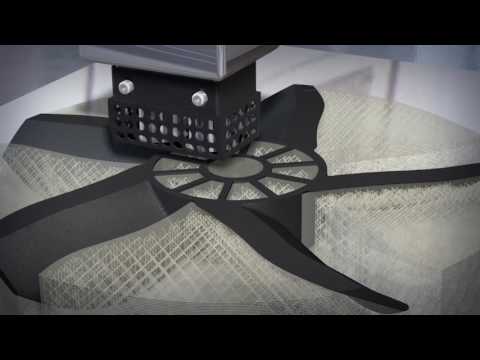
The second most popular 3D printing method is an older technique called stereolithography, or SLA. In this case, photocurable resin is the printing material instead of a solid spool. This technique involves a bath of sticky, viscous resin placed in an uncured glass tank; a UV laser beam and multiple mirrors cure one layer at a time. Each time a layer is cured, it becomes solid, is sheared off the bottom glass of the tank, and then lifted from the bath. Eventually, a solid, cohesive structure emerges.
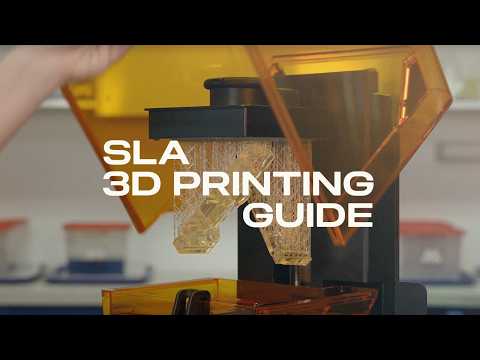
The third most popular method of 3D printing is called laser powder bed fusion. This technique works well for printing or compressing metals. To begin, there is a large flat bed of metal powder and a laser sculpts a shape, melting the desired shapes together. Once the layer is finished, the bed lowers and a roller distributes a new thin layer of powder onto the surface.
Another common 3D printing method is polyjet printing, which allows engineers to work with a wide range of nozzles and materials (from hard to soft) in a single print.
What types of materials can be 3D printed?
Although 3D printers most commonly print with plastic, they can also be modified to print metal-inlaid materials, ceramic-inlaid materials, and wood-inlaid materials. Different types of fibers or particles can be mixed with polymer binders to give objects varied properties.
When specialized machines print organs (like a heart), multiple nozzles can be pre-filled with syringes to inject different types of cells. Instead of a coil, the machine injects in a hydrogel.
How much do 3D printers cost?
The cheapest 3D printer on the market costs around $200, and these machines are the ones used by engineering students to make quick models. But spending less money on a machine like this comes with compromises. Cheap models tend to be more temperamental and break down more often. They are also not as consistent in producing the same object repeatedly. For example, the polymer, or plastic building material, can warp if there is too drastic a change in temperature between the inside of the nozzle and the outside environment. “You don’t see this as much in larger machines because they have clearly enclosed, temperature-controlled environments, and they may even have a cooling cycle,” Haidar says.
A mid-range desktop machine for FDM printing will typically cost $3,000, and that price includes software packages. A more high-end machine, capable of making larger objects with more durable starting material, can cost $200,000. Spending all that money leads to big benefits down the line. “Your maintenance costs are much lower. It’s easier to print materials that smaller machines would struggle with,” says Haidar. “These machines give you the closest thing to a professionally manufactured part.”
The most sophisticated machines print with metal, such as aluminum. Metal 3D printers can cost up to $1 million because they must be used in a very well-controlled room that is ventilated and capable of suppressing explosions (if they occur).

Holiday Gift Guide 2025


