Hubble Space Telescope Spots Sparkling Spiral Galaxy: NGC 6000


The Hubble team published a beautiful photo taken by the Hubble Spatial Telescope of NASA / ESA half of the Galaxy Spiral Bard NGC 6000.
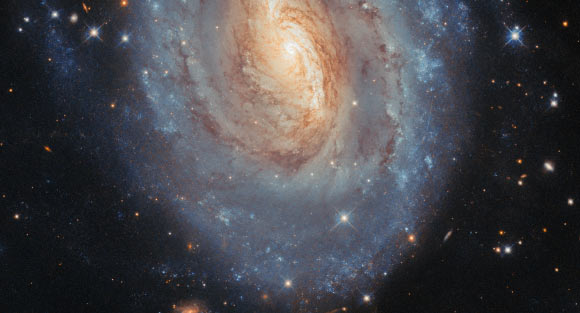
This Hubble image shows NGC 6000, a spiral galaxy barred at around 102 million light years in the Constellation of Scorpius. Image credit: NASA / ESA / HUBBLE / A. Filippenko / MH Özsaraç.
NGC 6000 is located at around 102 million light years in the Constellation of Scorpius.
Otherwise known as ESO 450-20, IRAS 15467-2914 or LEDA 56145, this spiral galaxy has nearly 67,000 light years.
It was discovered by British astronomer John Herschel on May 8, 1834.
Also classified as Seyfert II Galaxy, NGC 6000 is the brightest of all the galaxies in the Constellation Scorpius.
“NGC 6000 has a brilliant yellow center and a sparkling blue periphery,” said Hubble astronomers in a press release.
“The colors reflect the differences in the ages, masses and average temperatures of the stars of the galaxy.”
“At the heart of the galaxy, the stars tend to be older and smaller.”
“The less massive stars are cooler than the more massive stars, and cooler stars a little cooler are reder, while the warmer stars are more blue.”
“Further along the spiral arms of NGC 6000, clusters of shiny stars host young massive stars which appear clearly blue.”
Hubble’s instruments collected data from the new image of NGC 6000 when surveying recent supernova explosions in neighboring galaxies.
“NGC 6000 welcomed two recent supernovae: SN 2007ch in 2007 and SN 2010s in 2010,” said astronomers.
“We were able to discern the low glow of the supernovae for years after the initial explosion.”
“These observations help to force the masses of supernova progenitor stars and can indicate whether they had stellar companions.”
“Zooming on the right side of the galaxy disc in this image, you can see something yellow and blue: a set of four thin lines.”
“It is an asteroid in our solar system, which was dried through the field of vision of Hubble by looking at NGC 6000.”
“The four sequences are due to different exhibitions which were recorded one after the other with slight breaks between the two. These were combined to create this final image.”
“The colors appear in this way because each exposure has used a filter to collect only very specific light wavelengths, in this case around red and blue.”
“Having these distinct exhibitions is important to study and compare the stars by their colors – but this also makes the intruders of asteroids very obvious.”


