Ice Volcanoes Across the Solar System Distort Surfaces with Boiling and Freezing Water


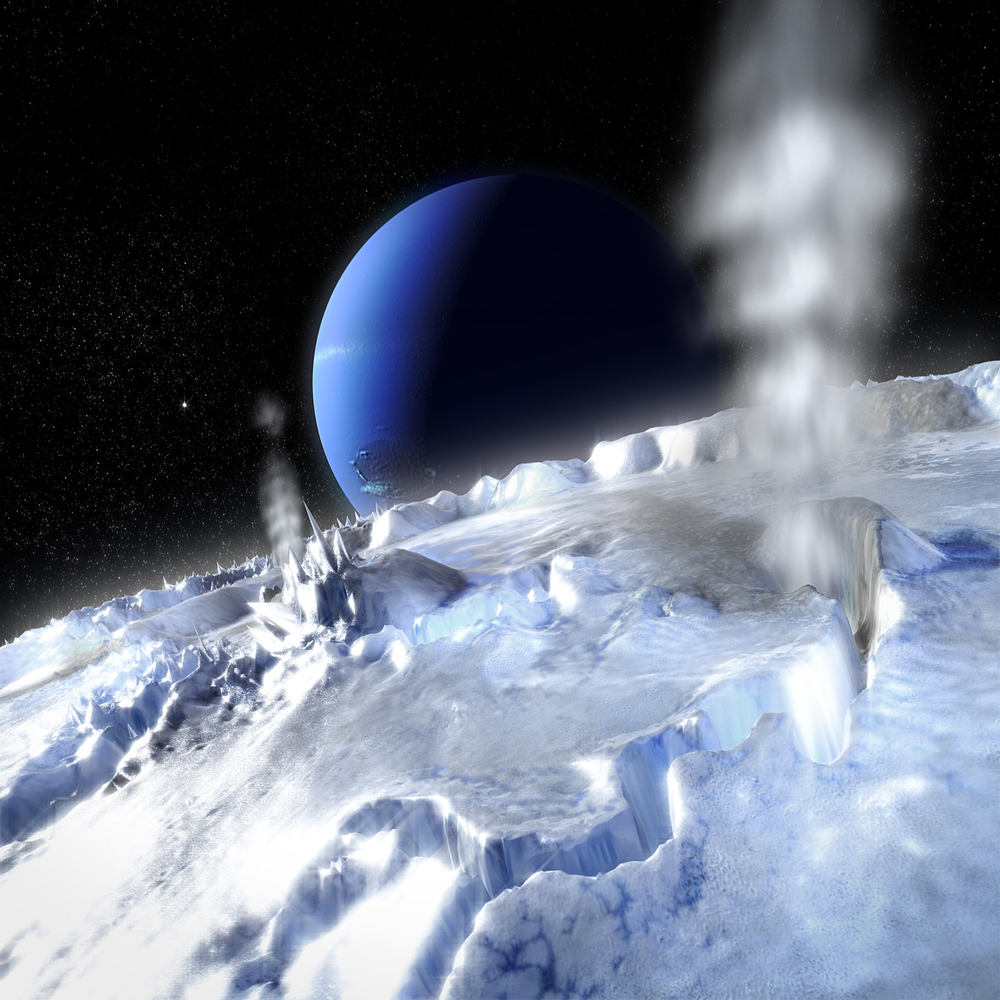
While volcanoes light all kinds of chaos on earth, ice volcanoes in space lead to a geological change in an entirely different way. The landscapes of glazed moons in our solar system are shaped not by flowing lava flows, but by water that bubbles and freezes simultaneously due to extremely low pressure in space.
A new study published in Earth and planetary science letters Recreated the almost zero pressure environment to determine how water flows have an impact on the surface of the ice moons. The experiments carried out in a low pressure chamber revealed that, on these moons, the steam bubbles increase in the water and fracture the upper layer of ice, creating a surface with a variety of geological characteristics.
Aqueous eruptions on frozen moons
Ice volcanoes, known more formally under the name of Cryovolcanoes, were observed on several moons in the external solar system, like Europa (A moon of Jupiter), Enladus (a moon of Saturn) and Triton (a Moon of Neptune).
These moons are wrapped in an outer surface made of ice, but many have also underground oceans hidden under their crust. On some of the moons, jets of water vapor and water particles have been observed in eruption in space in a process called “explosive cryovolcanism”.
Scientists do not know the exact mechanisms that trigger the eruptionsBut the new study has shed light on a way that the groundwater is capable of going through the icy crust of the moons, another process called “effusive cryovolcanism”. This process occurs when liquid water well on the surface, similar to the way the lava flows from cracks on earth.
Find out more: Spatial volcanoes tell the explosive story of Mars, Venus and several moons
Bubble on the surface
To understand how cryovolcanism would take place on a moon like Europa or Enceladus, the researchers involved in the new study turned to a low pressure chamber located at the University open in the United Kingdom, they filled the Grande Chambre de Mars Dirty (or “George”, as it is nicknamed) with large volumes of water to manage their experiences.
When the pressure was lowered, the water began to boil and boil despite the remaining cold. Indeed, when the pressure decreases, the boiling point of the water also does so. When the water has reached its freezing point, floating pieces of ice have formed and develop until a thin sheet covers most of the water.
But even after the formation of the ice cap, liquid water continued to boil. While the bubbles rose in the water, they found themselves trapped under the ice, causing pressure accumulation and creates cracks in the ice through which water could escape.
“We have found that the water freezing process under very low pressure is much more complex than we thought before,” said the main author Petr Broz, researcher at the Czech Academy of Sciences, in a statement. “In such conditions, water ends quickly even at low temperature, because it is not stable under low pressure. At the same time, it evaporates and begins to freeze, driven by the intense cooling effect caused by evaporation itself. The crust of ice that forms is considerably disturbed, complicating and extending the libris process.
Explore cryovolcanoes in the solar system
Experiences imitating the conditions of the quasi-vacuum of Europa and Enlade showed how these moons are transformed by water flows, which shape the uneven icy crust with bumps and depressions.
The researchers say that these geological characteristics could end up being a key target for future missions to analyze and that they can occur not only on the icy moons but also on other planetary bodies of the solar system.
“These topographic irregularities – caused by a steam trapped under the ice – can leave distinct signatures which could be detectable by spacecrafts in orbit, for example by those equipped with radars, offering a new potential way of identifying the old cryovolcanic activity”, declared the author Manish Patel, a planetary scientist at the open university. “This could provide precious clues to plan future missions on these distant worlds – and help us better understand the still mysterious process of cryovolcanism.”
Learn more:: With frozen volcanoes, the Europa moon is obscure, as well as these other 3 moons
Article Sources
Our writers at Discovermagazine.com Use studies evaluated by high -quality peers and sources for our articles, and our publishers examine scientific precision and editorial standards. Review the sources used below for this article:
Jack Knudson is a deputy editor -in -chief to discover with a strong interest in environmental sciences and history. Before joining Discover in 2023, he studied journalism at the Ohio University Scripps College of Communication and previously interned at recycling Today Magazine


