If the Supreme Court ends birthright citizenship, what will it mean for newborns? : NPR

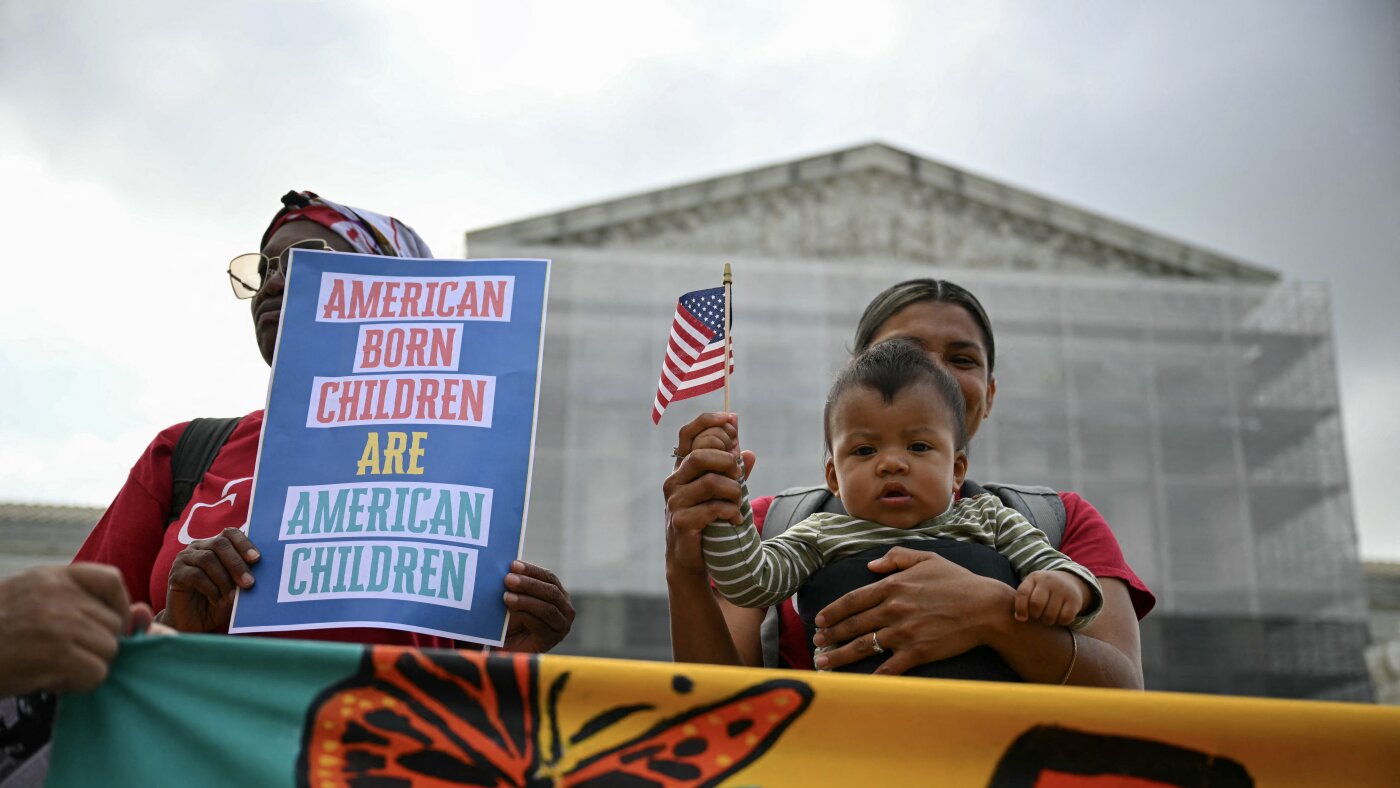

Olga Urbina holds her 9-month-old son, Ares Webster, during a protest outside the United States Supreme Court in Washington, DC, in May 2025.
Drew Angerer/AFP via Getty Images
hide caption
toggle caption
Drew Angerer/AFP via Getty Images
Bruce Lesley is furious about a dimension of the debate over birthright citizenship that he says is being completely overlooked. “It’s in the words: the right to citizenship at ‘birth’ – it’s about babies.”
Lesley is president of First Focus on Children, a bipartisan advocacy group for children and families, which submitted an amicus brief for the case. Trump vs. Barbara will be debated on Wednesday April 1 before the Supreme Court.

During the debate over the potential end of birthright at recent congressional hearings, Lesley heard about administrative challenges, historical context and political allegiance. “The word ‘child’ doesn’t come off their lips,” he said of lawmakers and witnesses.
This is a serious oversight, he says. “It affects every baby born in America,” he says.
What Birthright Citizenship Means for Birth
Currently, when a baby is born in a U.S. hospital or birth center, that baby automatically becomes a citizen with immediate access to a range of supports and services.
Pregnant women are eligible for Medicaid coverage in all states, regardless of immigration status. This means that prenatal, birth and postnatal visits are covered. In the United States, Medicaid currently funds 40% of all births. Health coverage during pregnancy means the baby has the best possible chance for a healthy start, including automatic Medicaid eligibility for the first year of life. Despite this safety net, the United States has significantly higher maternal and infant mortality rates than peer countries.
An estimated 300,000 babies will be born to parents without legal status in 2023. A shift to birthright citizenship, however, would affect all children, not just those born to immigrant families. All parents would have to prove their own citizenship status in a bureaucratic process that does not yet exist. Federal data shows that about 3.6 million babies are born in the United States each year.
The first few weeks of a newborn’s life are busy, even when the baby is born full-term and healthy. “You have well-child visits and vaccinations and lots of appointments to make sure the child is thriving and developing properly and getting the services and care they need,” Lesley says.

For babies born with serious health problems, the consequences of not having health coverage could be disastrous. Under the current system, parents and hospitals can be assured that medical treatment will be covered.
Additionally, hospital staff help families complete the necessary paperwork for the baby to obtain a Social Security number, since almost all babies born in the United States are citizens and can obtain one. “They put that together and submit it to Social Security on your behalf,” Lesley says. This Social Security number is required for the baby to be officially enrolled in health insurance, food benefits, and any other support services he or she may need.
The American Hospital Association declined to comment on the case about to be argued before the Supreme Court. The American Medical Association and the American Academy of Pediatrics also declined to comment. Hospitals and doctors would have to change their practices and policies if the birthright was overturned.
A potential burden of proof
Without birthright citizenship, the parents of every baby born in the United States would have to establish their citizenship status to access these supports. This would mean a break in the continuity of care that currently exists, says Lesley. “If you say, ‘Well, we don’t know if the baby is a citizen,’ it’s very doubtful that babies will then qualify for Medicaid, SNAP, WIC. [food benefits]all access to these essential programs at the most vulnerable time of our lives,” he explains.
The process of establishing a baby as a citizen can be difficult and expensive in many cases.
“I think in about 10 percent of birth records the father is listed as unknown,” Hannah Steinberg, an attorney with the ACLU Immigrant Rights Project, said at a press briefing last week. “Children in this situation, where the [unnamed] “The father is a green card holder or a U.S. citizen — the child will not get citizenship,” even if he is eligible, she says.
She adds that there are also cases where babies are found in the United States and the identities of both parents are unknown.
“The law actually says these children are U.S. citizens, but this executive order completely removes that and says, ‘No, who your parents are is important,'” Steinberg says. “Our entire legal system was set up around this guarantee of birthright citizenship – all of our administrative procedures, state laws, local laws.”

President Trump issued an executive order on his first day in office to limit the birthright to the right of citizenship. So far, that decision has been blocked in lower courts. The Supreme Court will hear the case on April 1, 2026.
Alex Wong/Getty Images
hide caption
toggle caption
Alex Wong/Getty Images
Lesley adds that babies born to same-sex couples, surrogates, or couples who used assisted reproductive technologies could also have difficulty establishing their babies’ citizenship, as could married, heterosexual, U.S. citizen parents whose documents were lost in a house fire or other disaster.
“That the government [would be] asking for paternity tests, surrogacy documents, etc. is just crazy,” Lesley says.
Births and babies are already affected
Arturo Vargas Bustamante, research director at UCLA’s Latino Policy and Politics Institute, says maternal and child health is already being affected by the debate over citizenship rights and other immigration policies of the Trump administration.

“When you are afraid and you stop going to the doctor, in the future you will have significant consequences” if you lack prenatal care, Bustamante says. “Your children are more likely to suffer from, for example, low birth weight, and this will have long-term consequences.”
He points out that this has particular implications for the Latino population, since “75% of children of non-citizen parents are Latino,” he says. This statistic was included in a recent policy brief he authored on the health and social consequences of ending birthright citizenship.


