I’ve been testing macOS Tahoe for weeks, and these are the five features I can’t live without


The public beta MacOS Tahoe is there, which means that you can get hold of the latest macOS update and all its new exciting features without the need for a developer account. And if you choose to follow this path, there are a lot of good things that await you.
I have been using the Tahoe Beta macOS for a few weeks now, and there are a lot of things I love. From the redesign of the liquid glass to the fully altered projectors, I found that it was a significant upgrade on MacOS Sequoia. Here are five of my favorite macOS features that you want to try as soon as you download the public beta.
If you want more information on the next major macOS upgrade, see our superguid macos Tahoe.
Liquid glass
The redesign of liquid glass has been on everyone’s lips since Apple raised the lid at the global conference of business developers in June. It is a complete reimagination of the appearance and the feeling of macOS – the flat design is flat design, replaced by a multitude of transparent elements which bear more than a hint of skeuomorphism.
Liquid Glass has been quite conflicting so far, and it is easy to find people who judge it is the best or the worst thing that Apple has ever done. But most of the controversy seems to come from its implementation in iOS 26, where the elements that overlap can often make it difficult to read text and pimples. In MacOS, however, it’s much less a problem.
I used the beta of iOS 26, Watchos 26 and MacOS Tahoe, and I found that MacOS is by far the most natural house for liquid glass. With a larger display, there are fewer elements that ride that ruin the experience. Instead, you get all attractive glasses – with light applications through applications and refraction elements wherever you look – in a much more comfortable setting.
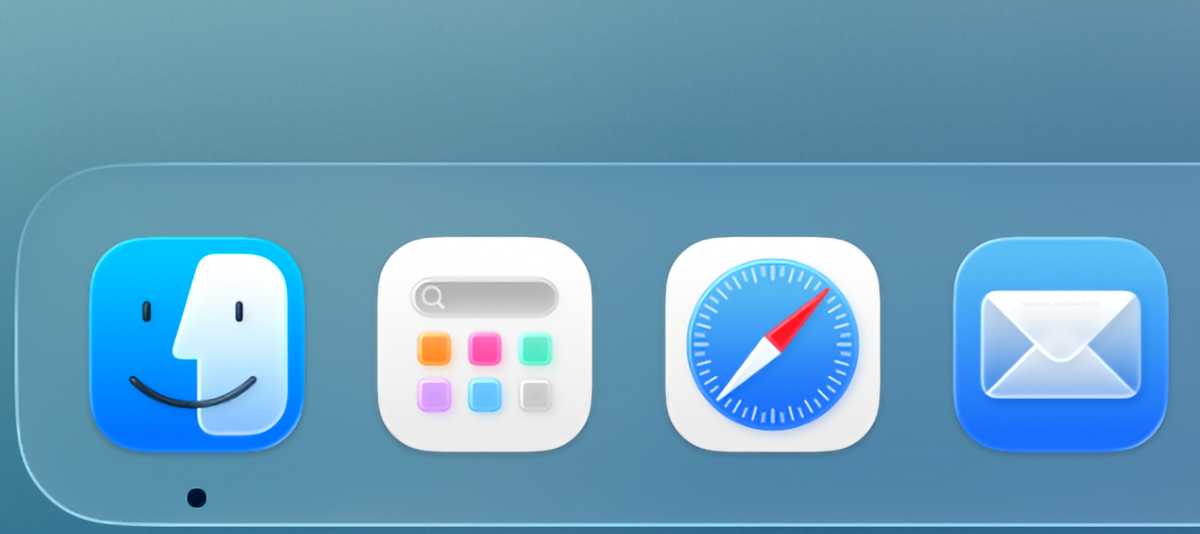
With MacOS Tahoe, you can adjust the transparency of icons to your liking.
Foundry
One of my favorite aspects of liquid glass is the platform. I chose to keep my platform icons in their regular solid colors because the transparent option gives the impression that it pushes the glass a little too far. This gives me a range of colored icons based on a giver glass sheet, and the effect is magnificent. It is a subtle difference compared to MacOS Sequoia, but my Mac feels better for that.
Subtlety is perhaps what makes liquid glass feels much better on macOS than iOS. On my iPhone, it is difficult to ignore the glass elements. They are everywhere. On the Mac, however, they are much more selected. You see them when you move a cursor, or when the control center is opened, but this is not the case in your face only with iOS. It makes much easier to appreciate.
By default, the MacOS Tahoe menu bar is transparent. Honestly, I love this little change at the Mac interface. Looking at the old versions of macOS, a solid menu bar is now a little clumsy compared to that clear. But if you like a menu bar with a background, you can bring it back to the System Settings application. The choice belongs to you.
There are other menu bar options in MacOS Tahoe that you want to try. You can now decide which third -party applications can appear in the menu bar on an individual basis, giving you more control over how this area is stacked.
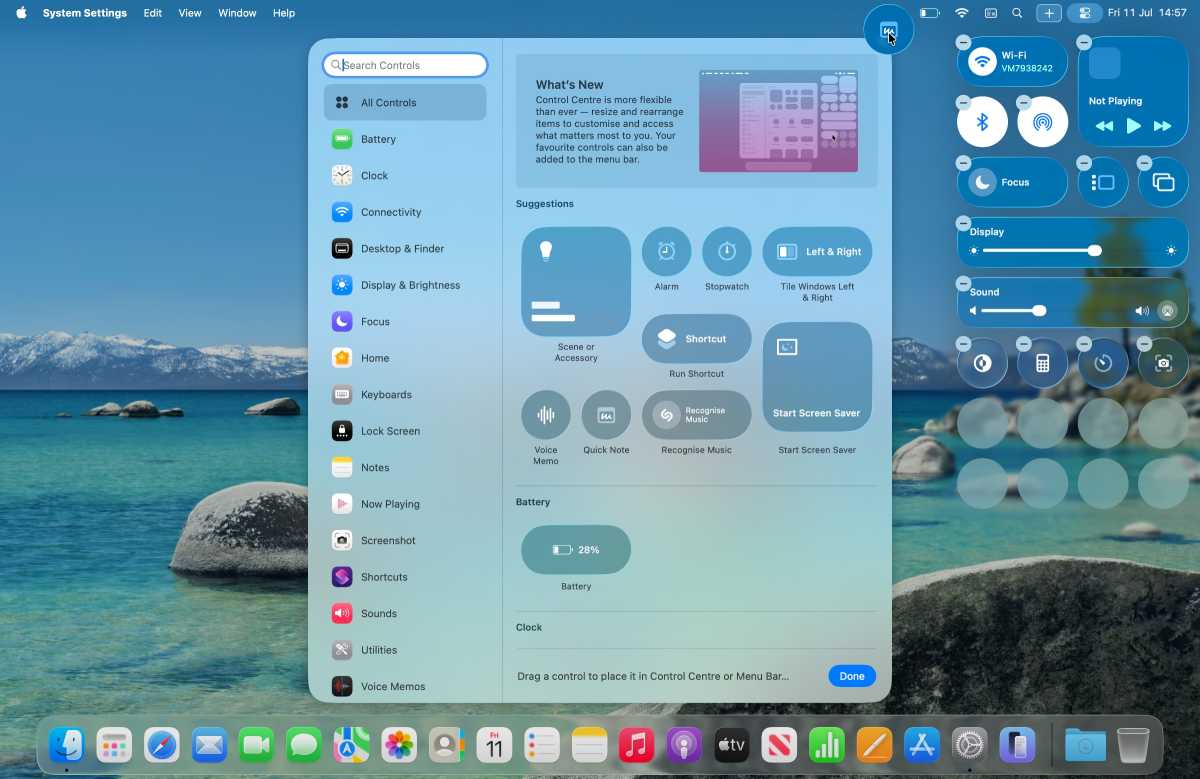
In MacOS Tahoe, the elements of the control center can now appear as icons in the menu bar.
Foundry
But maybe the best change is linked to the control center. Instead of leaving widgets and buttons only in the control center, you can also drag them into your menu bar. Everything, from a button to start your screen saver to a quick control at tile windows can now live at the top of your screen, putting them at a click.
Smarter shortcuts
The application of shortcuts has long been one of the most underestimated aspects of macOS. With MacOS Tahoe, he had a much necessary love with the addition of Apple Intelligence features.
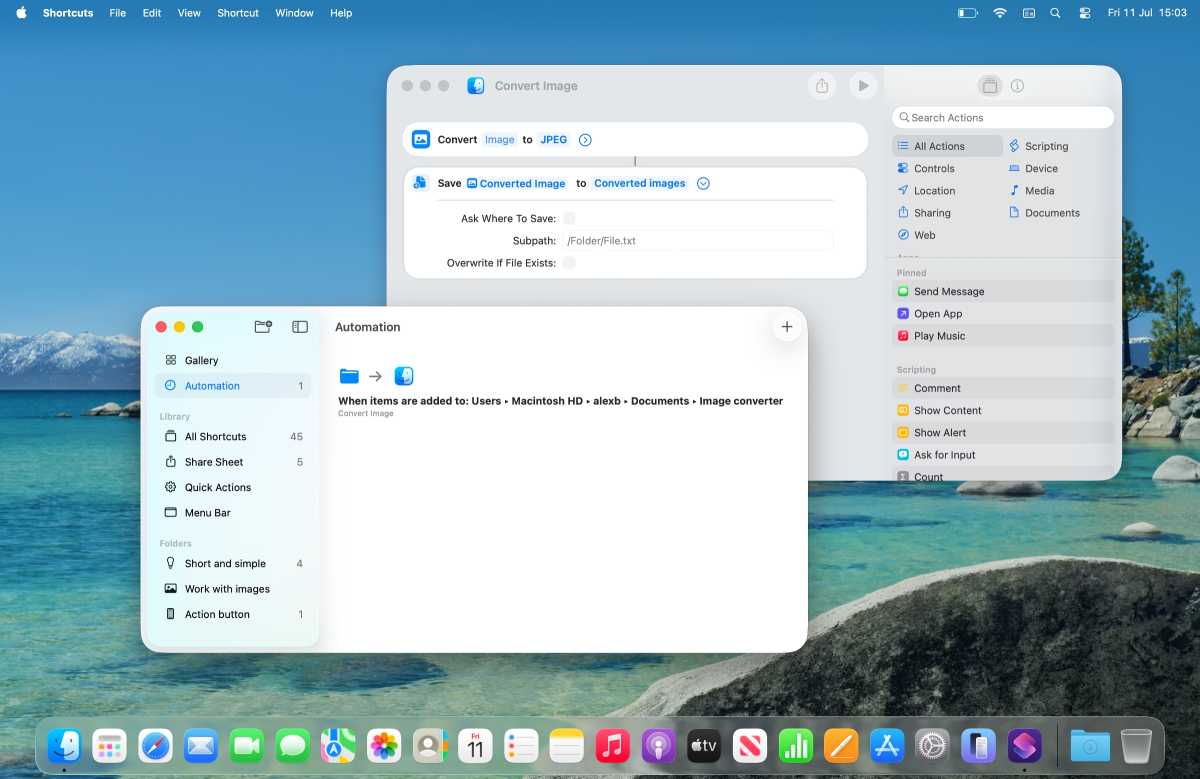
The shortcuts now support the features of Apple Intelligence.
Foundry
This opens the door to a pile of powerful and interesting workflows powered by artificial intelligence (AI). For example, you can ask Apple Intelligence to compare an audio recording with notes that you have drawn from a meeting, then have it filled the missing whites.
One of the best implementations of this is Apple Intelligence’s rewriting capacities. If you are stuck on how to formulate something – or just want other ideas that you might not have thought of you – you can build a shortcut that takes your text and reformulate it in something much more snapp.
The shortcut application has also acquired automation features, which ends it at speed with its iOS equivalent. I have waited for an absolute age for this, and it offers you all kinds of powerful options, such as creating a folder that automatically converts file formats for everything you deposit, or triggering a series of actions when you open an designated application. It took a long time to get here, but it’s better late than never.
Brand new projector
One of the largest renovations of MacOS Tahoe came in the spotlight. The research-bar-cum-app-launcher obtained a new set of superpowers and has become even more useful. As a result, you often don’t need to launch another application at all.
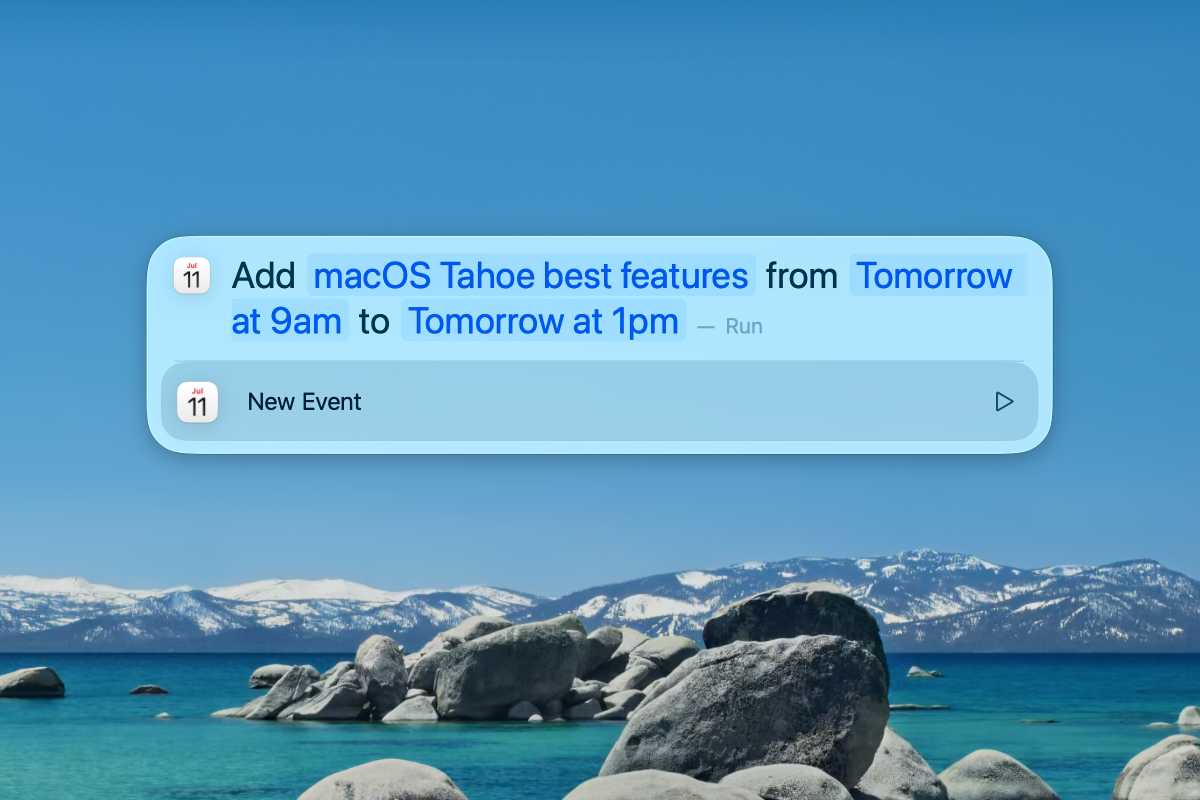
You can do tasks under spotlight instead of opening an application. For example, you can create a calendar event without opening the calendar.
Foundry
For example, to write an email, you should normally open your courier client and click on a bunch of menus to send your message. With the new projectors, you can simply hit a title by e-mail, a recipient and content, then trigger your missive without ever having to load the messaging application.
One of my favorite uses for this feature is to quickly create new calendar events. It helps me manage my day and add new work tasks to my weekly plans, all inside the spotlight.
With the addition of the functionality of the fast keys, do everything that requires even less effort. With fast keys, you can assign a shortcut to any action that you can perform under the spotlight. For example, with my calendar, I defined “ne” as shortened towards the creation of a new event. Then I just have to launch Spotlight, enter my new shortcut, then enter my new event details and press Back.
Speaking of shortcuts, they are now integrated into Spotlight also. To return to my example of reformulation above, MacOS Tahoe allows you to highlight a text, to highlight the shortcut, then to perform it inside your application. It is not necessary to launch the application of shortcuts or even to remove your hands from the keyboard.
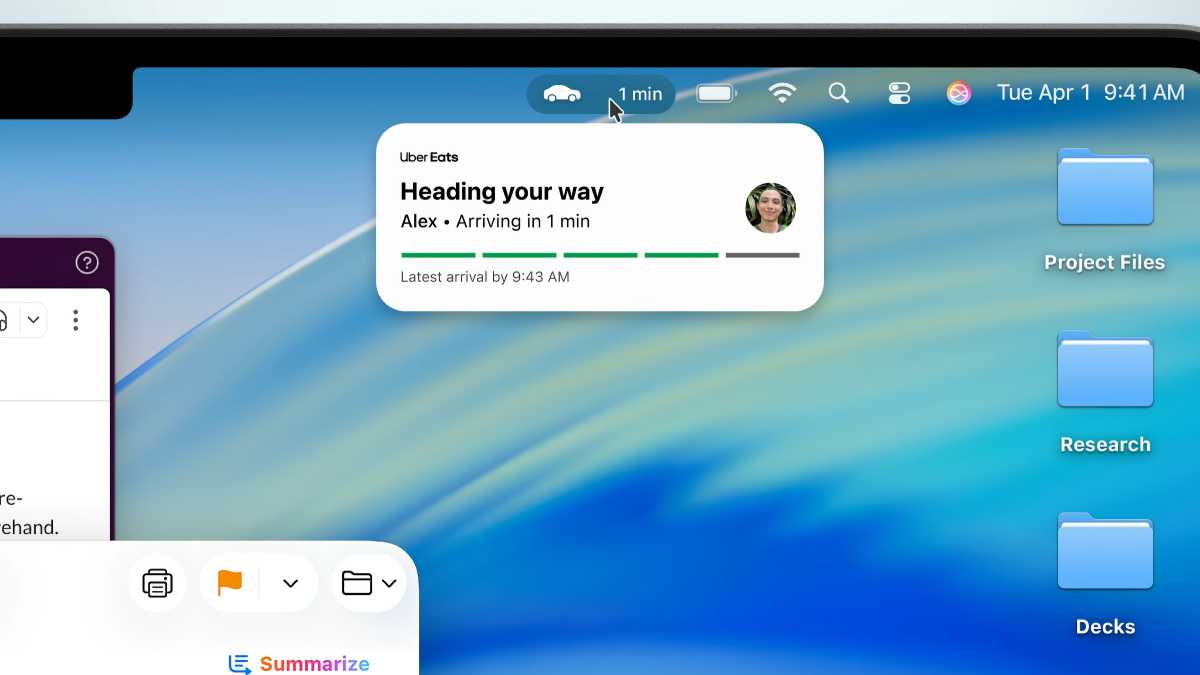
The live activities you are used to seeing on the iPhone are now available on the Mac.
Foundry
Live activities
The function of live activities was an excellent addition to iOS, allowing you to stay up to date with sports scores, deliveries and more of the locking screen of your iPhone. In MacOS Tahoe, your iPhone live activities are now reflected on your Mac. Simply click on the menu bar icon to see a widget of your chosen activity.
It may look like a small feature, but I found it extremely useful while working on my Mac. My iPhone is often in my pocket or on another desk far from where I work. If I have something important that I keep a trace with a live activity widget, it is difficult to continue to switch between my devices, especially when my iPhone is out of reach.
In MacOS Tahoe, this information is at a click on my mac’s desk. This means fewer interruptions of my work, without my losing path of activity. It is a great way to delete distractions and disturbances and clearly demonstrates Apple’s ability to link its hardware, software and disparate devices in a single transparent experience.


