Love or hate them, ‘AI slop’ videos are taking over the internet : NPR

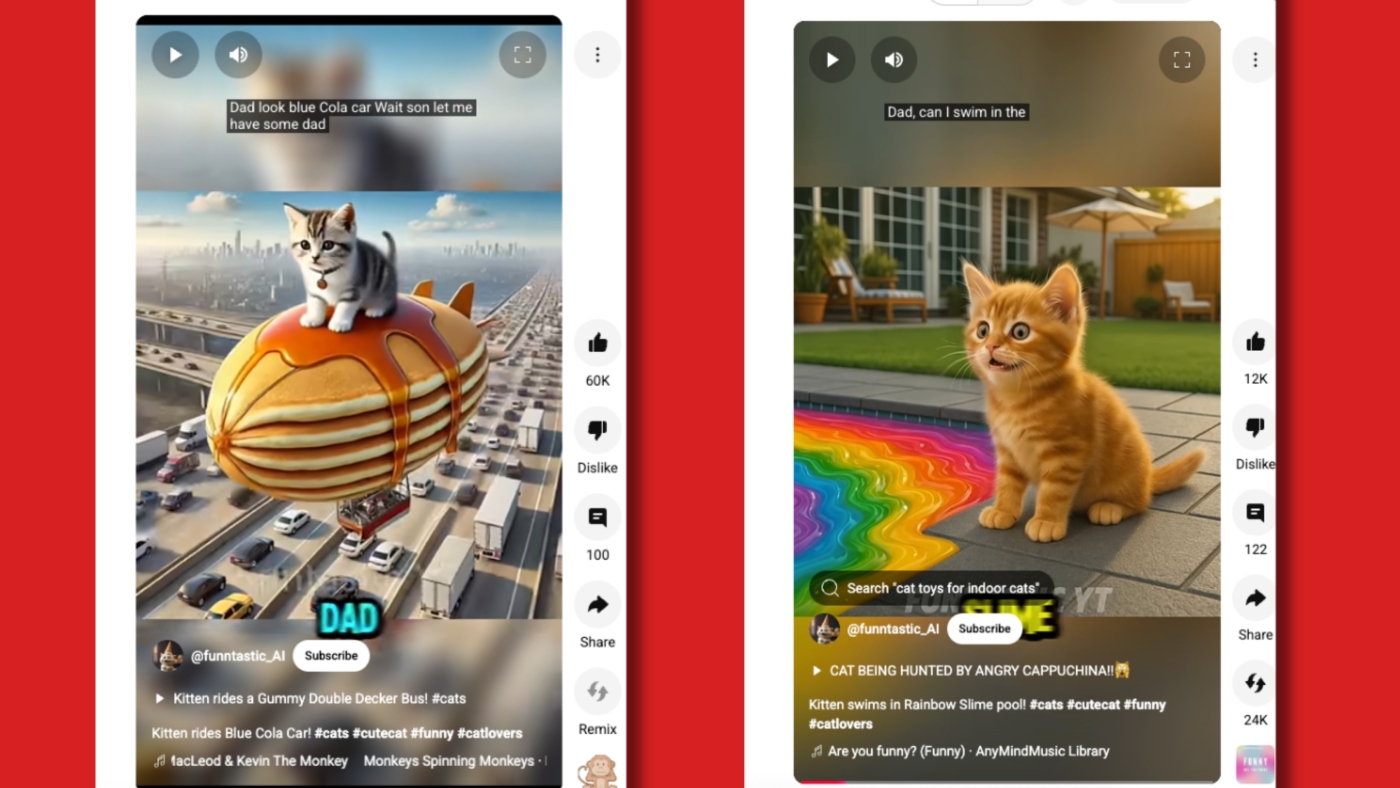

Screenshots of two videos on an adventurous kitten created by Mark Lawrence I Garilao using a genetive AI for its “Funtastic Yt” YouTube channel.
@ funntastic_ai / youtube / screenshot by NPR
hide
tilting legend
@ funntastic_ai / youtube / screenshot by NPR
Spend a little time scrolling through social networks these days and you will probably notice more and more videos made with artificial intelligence. Many are funky or fantastic. Others are downright bizarre. Some are intentionally misleading.
The rapid AI progress has led to an internet proliferation of what criticism calls “slal” or short videos which are quickly produced, often repetitive and manufactured using generative AI technology. The platforms are struggling with how to manage them.

Take these on the YouTube Funtastic Yt channel, which hosts dozens of videos in which a animated kitten has a brief mishap, often absurd. In one, the kitten is near a backyard swimming pool full of arc-en-ciel. “Dad, can I swim in this mud pool?” The Kitty asks.
His papa feline chamois then appeared in the neck of the pool deeply, unable to escape. “No threads, I’m stuck. Please help me,” he said.
And it’s the end of the sticker.
The video has all the characteristics of being made using AI: it has a colorful and simplistic animation and computer -offs. However, although he barely has a hint of intrigue, it’s funny, linked to the disease – and he has been seen more than 2 million times.
In others, the kitten goes up on an airship in pancakes, or a cola car, or swimming in a giant gumbox pool while his generally exasperated father looks.
For some criticisms, videos like these are discomfort that clogs people’s flows and fill the online landscape of low effort or meaningless content.
“I don’t think this video exists for any creative, expressive, informational or educational reason. It is purely committed,” said Adam Bumas, with the Technology Garbage Newsletter.
“The AI is really a super powerful spam,” said Jason Koebler, co-founder of the Tech News 404Media website which followed the rise in AI Sols. “The goal is to hit algorithm in one way or another – to gain essentially algorithmic lottery, to bring people to love, comment, share and, hope, become very viral.”

But Mark Lawrence I Garilao, who created these kitten clips and the canal, sees it differently. Garilao said that the manufacture of AI videos is creative and fun – and a way to use new technology.
Garilao is a 21 -year -old student whom NPR reached by phone in the Philippines, where he studied IT. He said he produced one or two clips a day, all with a similar theme revolving around the kitten and his father. Everyone takes one or two hours to produce, using Cat To make the characters, Klingai To create a video and other software to modify.
“When I think of history or what dialogue would be, I would do it-I sat right there and thought of a random, which I find funny. That’s it,” he said.
It is especially for entertainment, he said. But there is also a lot of money. The owner of YouTube Google pays channel owners via his AdSense program according to the number of people watching the videos and see announcements.
“The highest I did was in May. I won $ 9,000 in just one month,” said Garila. For a perspective, this increases to the salary of more than a year in the type of entry -level work that he said that he could expect his diploma.
Other channels produce videos at a much higher rate, hoping to enjoy views.

Koebler, from 404 MEDIA, said that the high volume of AI -mass AI is to crush other creators – like artists or photographers who work without AI – diverting attention from them.
“I think the discovery on the Internet has already started to collapse,” he said. “I think it becomes really difficult to stand out when the main referee of knowing whether something is seen or not is an algorithm of engagement.”
In some cases, AI Sols can be more than discomfort. A part is a direct disinformation, like false celebrity clips saving people from the Texas floods in July.
Other IA videos exploit trends. Garilao says that his pay day in May was supervised because he added characters of “Brainrot Italian” memes to his cat videos. They are popular characters generated by AI, like Ballerina Cappuccina, a dancer with a cup of coffee for a head and Tralalero Tralala, a shark wearing Nike sneakers.
Social media platforms recognize the challenge of assaulting so much content generated by AI. But they do not necessarily prohibit it.
Tiktok and Instagram now label certain content generated by AI. Meta says that it allows content generated by AI that meets community standards and allows users to personalize their Facebook flow and shape their experience on Instagram to avoid the things they don’t want to see. Tiktok says he has rules against Deepfakes.

And Youtube recently refined one of his policies: he has already prohibited people from earning money from “repetitive” content and extended this to “inauthentic” content.
YouTube says it was just a minor update and directed NPR to a video By the “creative link” of the René Ritchie company for more details. “It is a question of specifying that the policy includes the content produced in mass or repetitive, which is that content viewers often consider spam,” said Ritchie in the video.
We do not know what this change will mean in practice, however, according to Casey Fiesler, professor at the University of Colorado who studies technological politics and ethics.
“There is nothing in this change that explicitly suggests that it targets the content generated by AI,” she said.
At the same time, YouTube also encourages video creators to use AI via features of its application that do things like creating false backgrounds.
Koebler, from 404Media, says that he does not think that social media platforms really take a position against the content of the AI, in part because they are all invested.
“I think they think that maybe this thing is boring now, but in five years, they imagine a world where most content on the Internet are generated by AI, but it is the content that people will want to see,” he said.
And in the meantime, Garilao says a lot of people TO DO I want to see her videos ai. Its channel has nearly 600,000 subscribers and videos have collectively accumulated nearly 500 million views.
Comments on his videos accusing him of having produced Ai Salp used to disturb him, he recalled: “At the beginning, I said to myself:” Oh, guy, why do they hate my content? “”
Now, he said, he gives these comments an emoji of heart and thanks people for their commitment. The more there is, the better.
Note: Google, which has YouTube, and Meta are financial supporters of NPR.


