Make starting pitchers great again? MLB isn’t. The USPBL will try.

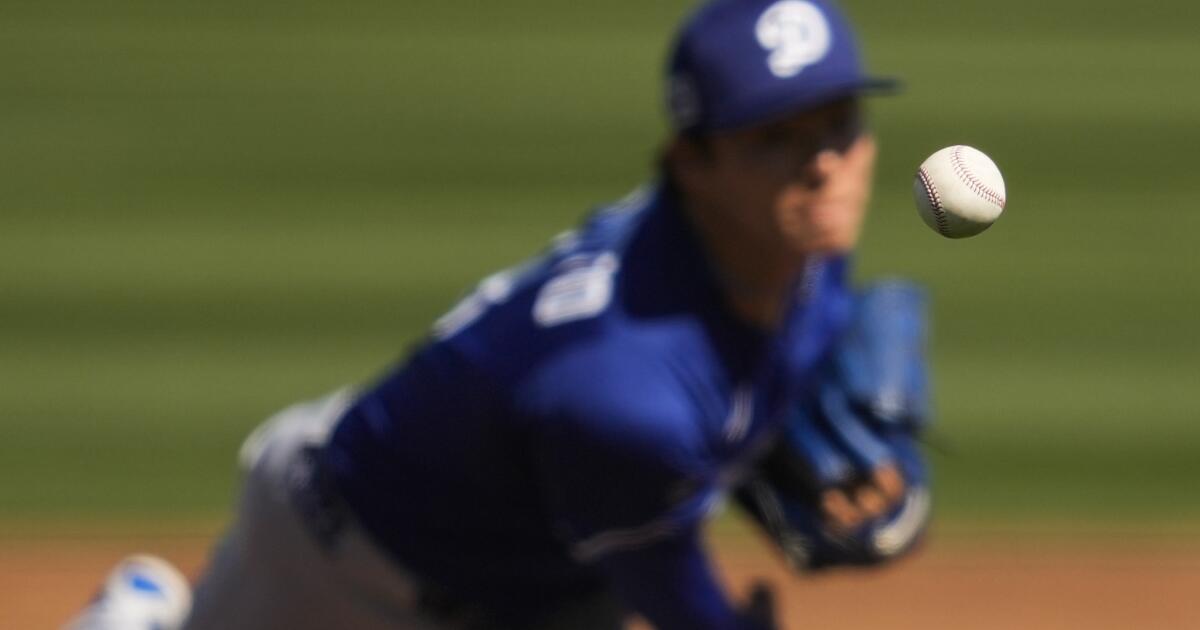
The independent minor leagues are the laboratories of baseball.
Pitch clocks? Are robot umpires coming to the major leagues this year? The home run derby helped settle ties, as we saw in last year’s All-Star Game? First tested in an independent league.
Some concepts are a hit. Some are failures.
The experiment to watch this year is almost spiritual in nature: Can professional baseball restore quality to beginner pitching?
Baseball’s obsession with speed has tarnished the soul of the sport. The marquee pitching match is an endangered species. The oohs and aahs at 100 mph have been replaced by yawns.
The potential solution, or at least part of a solution, is evident in this job description:
The United Shore Professional Baseball League (USPBL), an independent league based in Michigan, is recruiting for the position of “primary starting pitcher.”
The language is intentional. In today’s major leagues, a starting pitcher is typically selected, trained, and deployed to throw as hard as he can and as long as he can. Five innings is perfectly acceptable, with a parade of stronger reinforcements in the bullpen.
What the USPBL expects for a primary starting pitcher: “Develop the ability to become deeply involved in games.”
This was a no-brainer for a starting pitcher, but that’s no longer the case. Yoshinobu Yamamoto became Sandy Koufax last October, with back-to-back complete games during the Dodgers’ championship run.
However, in the regular season, the Dodgers did not pitch a complete game, nor did 12 other teams. Dodgers starters averaged 4.85 innings per game; no team averaged six innings.
In 2025, three major league pitchers have thrown 200 innings. In 2010, 45 did so.
“Being able to bring more Mark Buehrles or Cliff Lees back into the fold would be good for the game,” said Justin Orenduff, a first-round draft pick of the Dodgers in 2004 and now the USPBL’s executive director of baseball strategy and development.
Buehrle, a five-time All-Star, and Lee, a four-time All-Star, each displayed precision rather than power.
Lee, a two-time World Series Game 1 starter, didn’t average 92 mph with his fastball, but pitched 200 innings eight times. Buerhle, whose average fastball did not exceed 90 mph, pitched 200 innings for 14 straight years.
Neither could be drafted today. Major league teams crave speed, and young pitchers train to stimulate it. The number of players throwing at least 95 mph during the Perfect Game National Showcase increased sevenfold between 2014 and 2024, according to a Major League Baseball report.
The average MLB fastball dropped from 91 mph in 2008 to 94 mph in 2024, according to the report.
“Velocity is the No. 1 predictor of success,” then-Angels general manager Billy Eppler told me in 2018.
Speed is also associated with an increased risk of injury. Teams implemented well-intentioned measures — pitch counts, inning limits, more rest between appearances — that didn’t mitigate risks and could have led to more injuries.

Chicago Cubs starting pitcher Shota Imanaga prepares to pitch in the bullpen
(Ashley Landis / Associated Press)
Kyle Boddy, the founder of Driveline, the flagship speed training program, said a pitcher who throws hard won’t be able to manage his speed over an inflexible number of pitches.
“If he throws 60 or 70 pitches, he’s going to sit on 100,” Boddy told Baseball America. “He’s not stupid. And if we tell him, ‘There are no limits for you,’ but we keep eliminating him after 70 throws each time, he’s going to realize what’s happening.
“If he can’t control volume, the only lever he can control is intensity. Personally, I think it’s worse for his arm, going max effort for shorter stints.”
This ultimately goes against the development of starting pitchers capable of delivering six innings, according to the MLB report.
“Modern workload management strategies – ostensibly intended to prevent overuse, protect pitchers’ health, and maximize their efficiency – may actually increase injury risk by allowing and even incentivizing pitchers to throw with maximum effort on every pitch,” the report states, “rather than requiring pitchers to conserve energy and pace themselves in an effort to throw longer outings.”
Not only does throwing harder increase the risk of injury, according to the MLB report, but the resulting parade of outs runs “counter to contact-oriented approaches that create more balls in play and result in the type of on-field action fans want to see.” »
In the independent Atlantic League, the league conducted several years of testing of the “double hook” rule: when a team removes its starting pitcher, it loses its designated hitter. That would incentivize a major league team to use its starter for six or seven innings instead of four or five, but it wouldn’t solve the underlying problem: What would happen if the starting pitcher couldn’t work six or seven innings?
This is where Orenduff and the USPBL come in.

Dillon Chapa of the Westside Woolly Mammoths prepares to pitch in a USPBL game last season.
(Courtesy USPBL)
Every general manager says he would love a rotation of five 200-inning starters, if only he could find them. They can’t offer on-field training in the majors, lest their team find themselves at a competitive disadvantage.
In an independent league, Orenduff doesn’t have to worry about that. Tough game with the bases loaded in the fourth inning? Third time in order in the sixth inning? Go through it.
“It’s not going to be that fast,” he said.
It’s not about letting a starting pitcher get run over just to get through it. It is about getting rid of the shackles of these universal limitations.
“Basically, you want to start by showing the fans and the industry, like, 100 pitches is just a number,” he said. “It’s completely arbitrary.
“Some guys might be able to get to 110, 120. We want to be able to show that the game can still produce players who are successful on the mound, especially, but who are capable of going beyond the fifth inning and beyond 100 pitches if the expectations and the leadership and the structure are there to support them.”
The USPBL will have much of the same technology as major league teams, to measure turnover rates, recovery rates and all other rates. If you can maintain command and speed, if you can get maximum effortless outs on every pitch, and if you can bounce back between innings and between starts, you may be able to be the primary starting pitcher.
Frankly, Orenduff said, all the speed in the world can’t help your team if you can’t throw.
“That also has to be a measure: sustainability and availability,” he said.
He conducted a study evaluating the top three pitchers on each team since 2013. With the caveats that some pitchers have been traded and some prospects are still in development, Orenduff found that three out of four of those top drafted pitchers never pitched for the major league team that drafted them, representing a combined cost to all 30 MLB teams of $800 million in signing bonuses.
“We just need to have some sort of proof that we can help more players have longer careers by being a little more flexible in how we frame things for them,” Orenduff said.
I hope the USPBL can discover training methods that major league teams can use. It’s better than listening to a major league manager with a 13-man pitching staff say after a game that he’s out of pitchers, as we hear too often. Can you imagine what Tommy Lasorda would have to say about this?