Ryzen 9950X3D2 tested: AMD made a creator’s dream chip in gamer clothing


Summary created by Smart Answers AI
In summary:
- PCWorld testing reveals that AMD’s Ryzen 9 9950X3D2 offers minimal gaming improvements over the 9950X3D despite its X3D branding and $900 price tag.
- The processor excels at workstation tasks such as video editing and 3D rendering, with 192MB of V-Cache on both dies and targeting media production professionals.
- AMD is transparently positioning it as a creator-focused chip offering budget-friendly performance alternatives to Threadripper, making it unsuitable for typical gaming upgrades.
AMD’s V-Xache-infused X3D series of processors have been an absolute hit in the PC gaming space, pushing AMD to the forefront of the performance debate after years of Intel dominance. But after three generations of success, fans were probably wondering when AMD would go all out on a new design. Well, the Ryzen 9 9950X3D2 Dual Edition, the absolute pinnacle of consumer desktop performance, is here… and you probably shouldn’t buy it.
This seems pessimistic. But here I must pay tribute to AMD: the company isn’t it market this chip to PC gamers. And that easily could have been the case, taking advantage of a little consumer confusion to sell a flagship product to people who don’t need it. But AMD has been very clear in its intentions with the Ryzen 9 9950X3D2, from the start. This chip is not designed for PC gamers (although it is of course more than capable of gaming), it is for those who need extra performance in incredibly powerful multimedia and “AI” applications. Our early benchmarks bear this out, showing virtually no game changer in the $900 9950X3D2 compared to the 9950X3D launched last year at $700.
The reason is complicated. X3D chips use additional 3D V-Xache – it’s their “special sauce” that provides extra performance over AMD’s standard Ryzen chips which lack it. But for the dual CCD Ryzen 9 7950X3D and its successor the 9950X3D, V-cache is only present on one of the chips, available on eight of the processor’s 16 main cores. AMD itself told us years ago that there were minimal performance gains from fitting both CCDs in a given chip: most individual processes, including games, simply can’t take advantage of both. This is why, over the past four years, we have seen that V-Cache is only available for half of the cores in dual-chip chips.
Of course, “most” doesn’t mean “all.” Games, as highly focused programs, have different parameters than some other programs, namely the type of computing needed for media production. Highly optimized video editing, 3D rendering and similar programs could take advantage of the extra cache. This is the kind of user AMD wants to sell the Ryzen 9 9950X3D2 to, while also marketing the 9950X3D (sans 2) to regular gamers.
Well, regular gamers who can afford a $700 CPU, anyway. But I digress.
AMD’s Ryzen 9 9950X3D is an absolute monster
Our first hands-on with the Ryzen 9 9950X3D2 was done with a Falcon Northwest Talon, compared to the 9950X3D on the same machine. AMD didn’t provide PCWorld (or many outlets) with a Ryzen 9 9950X3D2 to review before the embargo, but the Falcon Northwest team was able to test us in one of its custom, expertly designed systems. It uses an Asus Strix The same machine should be available for purchase today.
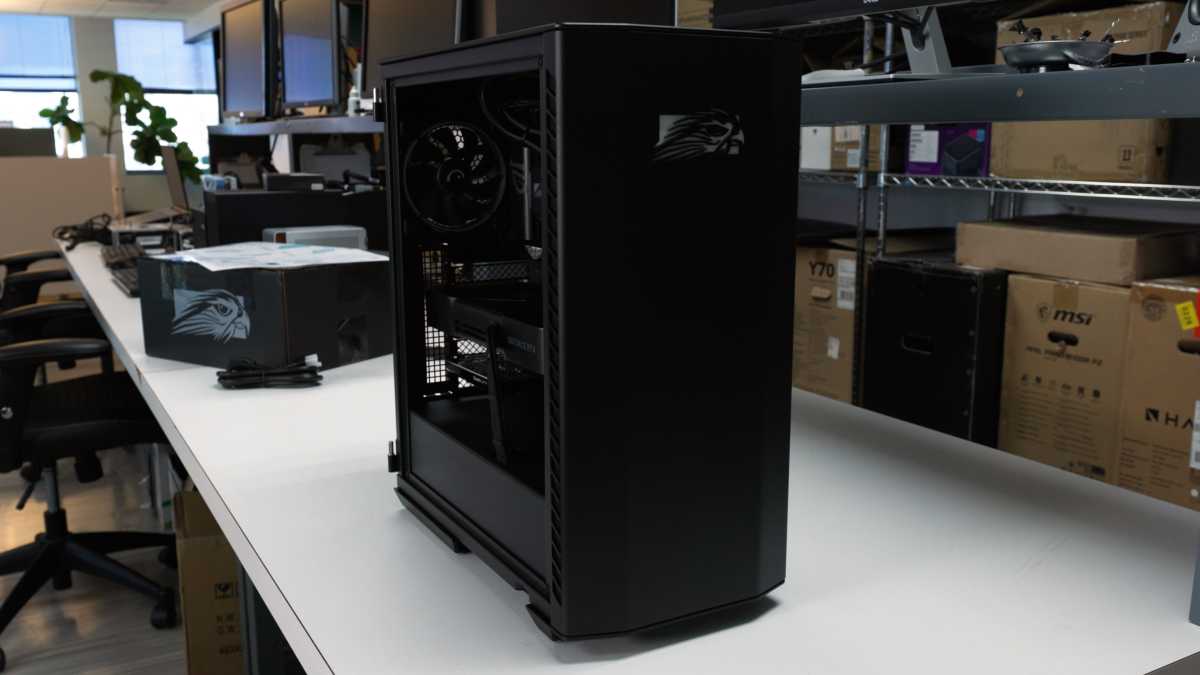
Foundry
The Ryzen 9 9950X3D2 has 192 MB of V cache spread across both CCDs, compared to the 9950X3D’s 128 MB of V cache on the main CCD. The new chip is slightly slower in its boost clock (5.6 GHz vs. 5.7 GHz), but consumes more power (200 watts vs. 170 watts). Otherwise, it uses the same 16-core, 32-thread Zen 5 configuration.
A touch: in the Vanilla 9950X3D, the die without 3D V-Cache increases speeds in non-gaming tasks, but by only a few megahertz. On the 9950X3D2, both chips run the slower speeds demanded by V-Cache, which can potentially affect peak performance in multithreaded tasks.
We also compared the output to the $499 Ryzen 7 9850X3D (8 cores, 16 threads), a more gamer-friendly X3D alternative with a CCD, and Intel’s Core Ultra 7 270K Plus on a benchmark machine. We have closely compared the hardware, but these comparisons should not be considered individual comparisons, all done within the same system; they’re just there for context. The flagship 9950X3D2, of course, was tested on Falcon Northwest’s Talon desktop.
First the good news. In multithreaded workstation benchmarks, which can at least theoretically take better advantage of 3D V-cache on both sides of the chip, the 9950X3D2 generally outperformed the 9950X3D. In some tests, Intel pulled ahead, and in a few tests, the 98050X3D did. But in general, those who splurge on the high-end AMD chip will see at least some performance improvement according to tests like Blender, Geekbench, and Pugetbench.
Tom’s Hardware put the 9950X3D2 through a battery of workstation-class tests and found that it performed significantly faster than the vanilla 9950X3D in some niche applications, like running chess engines, Linpack algebraic stress testing, and other data science tools, achieving about 20 percent more performance in very specific workstation tasks. This can represent real savings for professionals! But for general productivity, as mentioned, the 9950X3D2 is a hit or miss beast compared to its competitors.
Now let’s move on to the games, which most of you are probably here for. In testing in the PCWorld lab, the Ryzen 9 9950X3D2 was within a percentage point or two of the 9950X3D, some higher, some lower, but basically all within the margin of variability for a given test. To be clear, this is exactly what we would expect, and what AMD told us to expect. For pure gaming performance, upgrading to the 9950X3D2 over the 9950X3D is simply not practical. We’ve only done a handful of tests to confirm this.
In fact, if you decide to spend $200 more (or more, thanks to the likely scarcity of the chip), you might just shoot yourself in the foot. In our tests, the 9950X3D draws significantly more power from the entire system than the 9950X3D. Again, this is expected: its TDP is almost 20% higher. But the fact is that if you use this setup for gaming and not for very demanding, mostly industrial-grade media or “AI” purposes, you are spending more both on purchase and during general operation.
Gamers, the Ryzen 9 9950X3D2 is not for you
To summarize, the Ryzen 9 9950X3D2 Dual Edition is a no-compromise workstation processor for multimedia production or equally intense tasks. At $900, it could almost be considered a “budget” alternative to AMD’s Threadripper line, which is also capable of gaming but isn’t intended for that purpose. Despite the X3D branding – which is more about its technical construction than its associations with gaming – it’s not aimed at gaming PCs.
Opt for the cheaper 9950X3D unless you absolutely need that extra performance for non-gaming purposes. And don’t look for the Dual Edition in finished desktops, again, unless you can actually use it. The extra $200 (or more) can make a tangible difference in some ultra-specific workstation tasks — the kind of PCs Falcon Northwest specializes in — but outside of those, it can be hard to justify.