NASA shuts down Voyager 1 science instrument to conserve power in space


NASA has shut down one of Voyager 1’s science instruments to conserve dwindling power and keep the nearly 49-year-old spacecraft operating as it continues its journey through interstellar space more than 15 billion miles from Earth.
Engineers at NASA’s Jet Propulsion Laboratory (JPL) in Southern California on Friday sent commands to disable Voyager 1’s Low-Energy Charged Particles (LECP) experiment, a long-running instrument that has operated almost continuously since the spacecraft’s launch in 1977.
The move comes as the nuclear-powered probe loses about 4 watts of power each year and mission managers work to extend its remaining life.
“While shutting down a scientific instrument is no one’s preference, it is the best option available,” Kareem Badaruddin, Voyager mission manager at JPL, said in a statement. “Voyager 1 still has two operational science instruments: one that listens for plasma waves and one that measures magnetic fields. They are still working very well, sending back data from a region of space that no other artificial craft has ever explored.”
Trump looks to the moon with nuclear reactor plans as China and Russia team up in space race
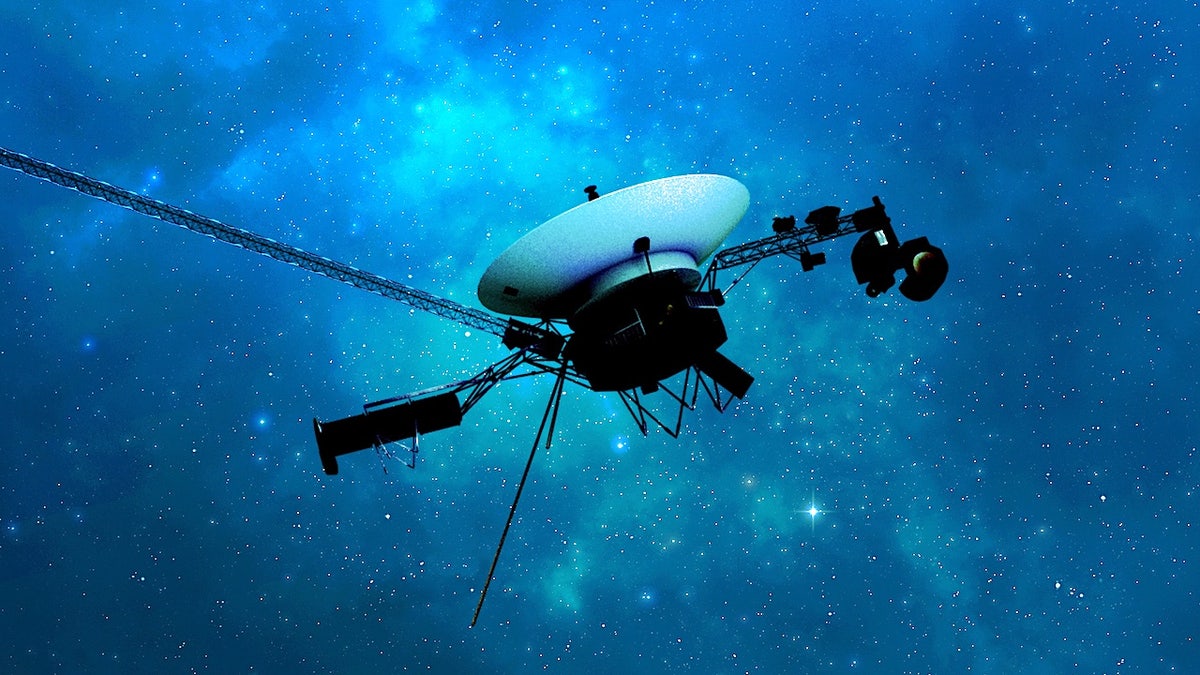
NASA’s Voyager 1 spacecraft is depicted in this artist’s concept traveling through interstellar space, or the space between the stars, which it entered in 2012. (NASA/JPL-Caltech)
The shutdown underscores the increasingly delicate balance facing the Voyager team as both spacecraft age well beyond their initial mission plans.
Voyager 1 and its twin, Voyager 2, are powered by radioisotope thermoelectric generators that convert heat from decaying plutonium into electricity. After nearly five decades in space, engineers have had to regularly turn off heaters and instruments while ensuring the spacecraft doesn’t cool so much as to endanger key systems, including fuel lines.
“The team remains focused on maintaining both Voyagers for as long as possible,” Badaruddin added.
Musk’s Nominated Ally NASA Snub Preceded Sudden Criticism of ‘Big, Beautiful Bill,’ Trump Feud
Pressure to act intensified after Voyager 1 experienced an unexpected drop in power during a routine roll maneuver on Feb. 27, according to NASA.
Engineers were concerned that any further drops would trigger the spacecraft’s undervoltage fault protection system, designed to automatically shut down components to protect the probe. Recovery from such an error can be lengthy and carries additional risks, providing an incentive for the team to move before the spacecraft does so on its own.
The two Voyager probes remain the only spacecraft far enough from Earth to collect data on “detecting pressure fronts and regions of varying particle density in space beyond our heliosphere,” according to NASA.
IS THIS SPACE CAPSULE HOW WILL WE LIVE AND WORK IN ORBIT IN THE FUTURE?
“Engineers are confident that shutting down LECP will give Voyager 1 about a year of breathing room,” a NASA press release said. “They are using this time to finalize a more ambitious energy-saving solution for both Voyagers that they call ‘the Big Bang,’ designed to further expand Voyager operations.”
“The idea is to swap out a group of powered devices all at once – hence the nickname – by turning off certain elements and replacing them with lower-power alternatives to keep the spacecraft warm enough to continue collecting scientific data,” the statement continued.
The decision to deactivate the LECP was not taken suddenly. NASA said the mission’s science and engineering teams agreed years ago on the order in which spacecraft systems would be shut down as available power decreased. Of the 10 original instruments carried by the twin probes, seven have now been deactivated. Voyager 2’s LECP instrument was shut down in March 2025.
CLICK HERE TO DOWNLOAD THE FOX NEWS APP
Since Voyager 1 is now more than 25 billion miles from Earth, orders take about 23 hours to arrive. The shutdown sequence itself takes more than three hours. Part of the LECP system – a small motor that spins the sensor so it can scan in all directions – will remain powered because it only draws about half a watt. Engineers hope this will leave open the possibility of restarting the instrument in the future if more power becomes available.