New Species of Giant Long-Necked Dinosaur Identified in Argentina


Fossils discovered on a remote ranch in Argentina belong to a new genus and species of macronarian sauropod dinosaur, according to an international team of paleontologists led by the Ludwig-Maximilians-Universität München.
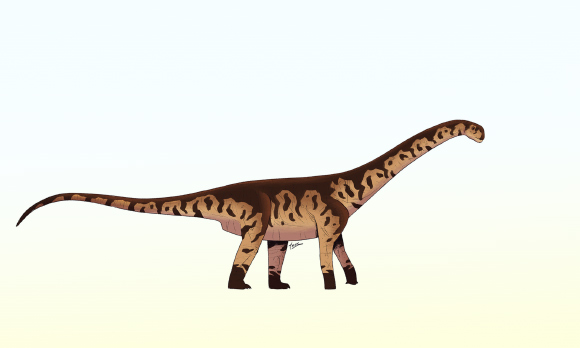
Reconstruction of Bicharracosaurus dionidei. Image credit: Felipe Cutro-Lev.
The newly described sauropod species lived on the southern supercontinent of Gondwana around 157 million years ago, during the Late Jurassic.
Appointed Bicharracosaurus dionideiThe dinosaur spanned approximately 20 m (65 ft) in length.
“Sauropods are one of the major lineages of dinosaurs that represent one of the most important groups of herbivorous vertebrates during the Mesozoic,” said lead author Alexandra Reutter, a doctoral student at Ludwig-Maximilians-Universität München, and colleagues.
“Sauropods first appeared in the Late Triassic and survived until the end of the Cretaceous.”
“The group was taxonomically diverse and included the largest land animals that ever lived.”
“Within Sauropods, a number of early branching clades that flourished during the Jurassic were largely replaced by the derived neosauropods toward the end of this period.”
“Neosauropods split early in their evolution into two major clades, the Diplodocoidea and the Macronaria, but, although this main subdivision of Neosauropoda has been generally accepted since it was first proposed in the 1990s, there is still considerable debate over the referral of many taxa, particularly from the Jurassic, to either of these subclades, or to Neosauropoda in general. »
The fossilized bones of Bicharracosaurus dionidei – including part of the spine, ribs and hip – were brought to the attention of paleontologists by local farmer Dionide Mesa in March 2001.
The site is part of the Cañadón Calcáreo Formation, exposed in the central and northern parts of the Chubut Province of Argentina.
Scientists have long relied on fossils from North America, Europe and other parts of the northern hemisphere to reconstruct the rise of neosauropods.
The Cañadón Calcáreo Formation and the Tendaguru Formation in Tanzania are among the rare Gondwana deposits from this period to preserve several sauropod skeletons.
“For a long time, there was only one important site on the southern continents, in Tanzania,” said lead author Professor Oliver Rauhut, a paleontologist at the Bayerische Staatssammlung für Paläontologie und Geologie and the Ludwig-Maximilians-Universität München.
“The fossil site in the Argentine province of Chubut, from where Bicharracosaurus dionidei is native, provides us with important comparative material, allowing us to continually supplement and reevaluate our understanding of the evolutionary history of these animals, particularly in the southern hemisphere.
Fossilized remains suggest Bicharracosaurus dionidei belonged to Macronaria, the group of massive herbivores that later produced giants such as Brachiosaurus.
But the new dinosaur’s anatomy also shares surprising similarities with the Diplodocidae, a different branch of sauropods known for animals such as Diplodocus.
To determine where the animal fits in the dinosaur family tree, the researchers tested its relationships using two separate phylogenetic data sets.
Most analyzes placed Bicharracosaurus dionidei within Macronaria, and several suggested affinities with Brachiosauridae, the lineage that includes Brachiosaurus himself and the African giant Giraffatitan.
“Our phylogenetic analyzes of the skeleton indicate that Bicharracosaurus dionidei was related to the Brachiosauridae, which would make it the first Brachiosauridae from the Jurassic of South America,” Reutter said.
The team’s paper was published online in the journal PeerJ.
_____
A. Reutter and others. 2026. Bicharracosaurus dionideigen. and sp. nov., a new macronarian (Dinosauria, Sauropoda) from the Cañadón Calcáreo Formation of the Upper Jurassic of Argentina and the problematic early evolution of macronarians. PeerJ 14:e20945; doi: 10.7717/peerj.20945


