Nobel laureate Narges Mohammadi transferred to a Tehran hospital, her foundation says : NPR

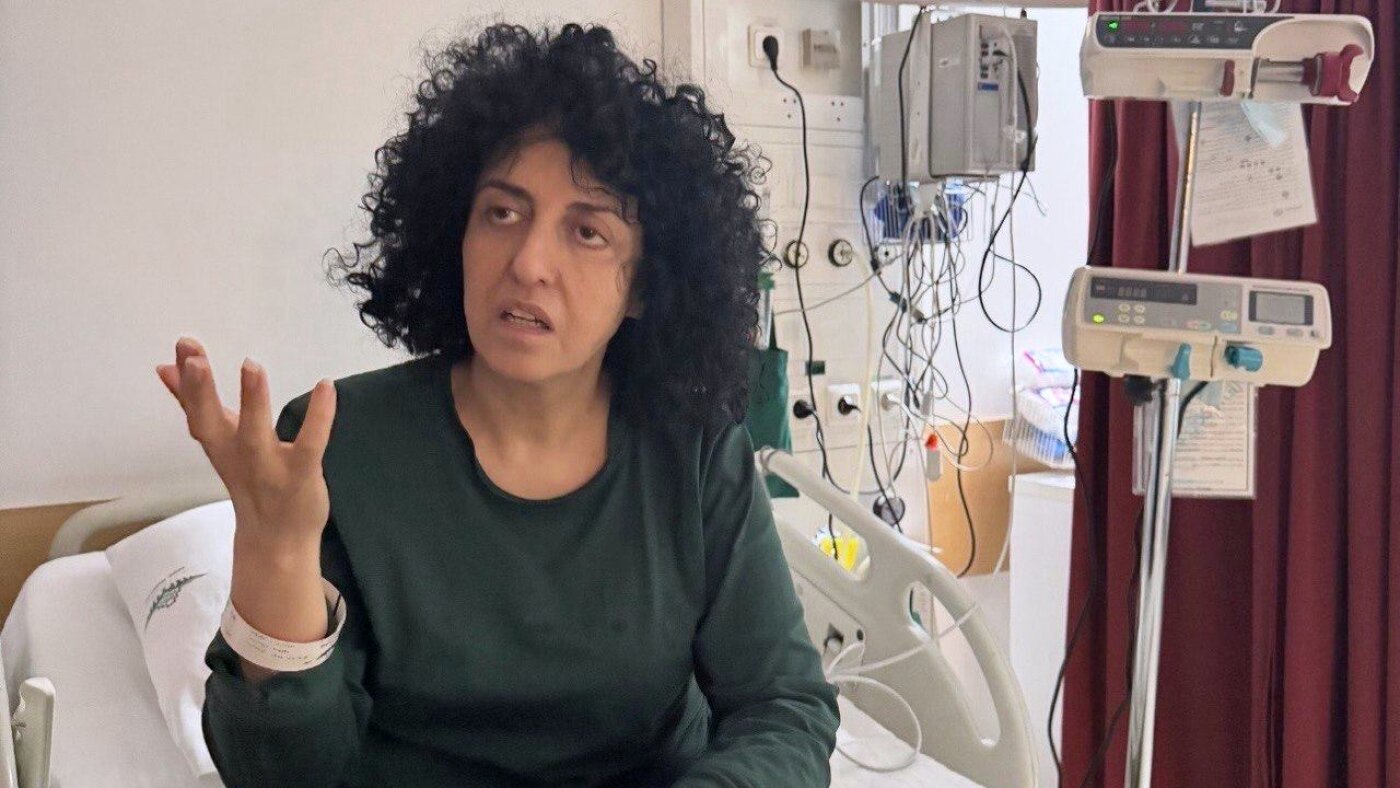

Prominent Iranian human rights activist Narges Mohammadi at a hospital in Tehran, Iran, May 10, 2026.
Narges Foundation Archives/via AP
hide caption
toggle caption
Narges Foundation Archives/via AP
BEIRUT — Nobel Peace Prize laureate and activist Narges Mohammadi has been transferred to a Tehran hospital more than a week after collapsing in prison, her foundation announced Sunday.
His transfer comes after days of advocacy from his family and others who described his condition as critical. Her foundation said she received a suspended prison sentence on bail. It is unclear how long his sentence will be suspended, the foundation said.

Mohammadi had been incarcerated in Zanjan prison since December. She lost consciousness twice and was transferred to a local hospital on May 1.
A statement from his foundation, shared with the Associated Press, said the suspended sentence was not enough and that Mohammadi needed “permanent and specialized care.”
The statement added that “we must ensure that she never returns to prison to face the 18 years remaining on her sentence. Now is the time to demand her unconditional release and the dropping of all charges.”
Mohammadi’s lawyer, Mostafa Nili, based in Iran, said on social media that the transfer order was issued following the decision of the Forensic Medicine Organization – government-appointed forensic doctors – “which said that due to her multiple illnesses, she should continue her treatment outside the prison and under the supervision of its own medical team.”
There was no immediate comment from Iranian authorities.
Mohammadi’s brother, Hamidreza Mohammadi, who lives in Oslo, Norway, said forensic doctors had previously recommended he be transferred to Tehran, but the decision was blocked. He blamed Iranian intelligence services.
“I’m relieved now. I can breathe lightly,” his brother told the AP in a message.
The 53-year-old women’s rights activist was awarded the Nobel Prize in 2023 while in prison and has been imprisoned several times throughout her career. Her current imprisonment began when she was arrested in Mashhad, in northeastern Iran.
Mohammadi’s family said her health deteriorated in prison, in part because she was severely beaten during her arrest. She had a heart attack in March and had a blood clot in her lungs before her imprisonment that required blood thinners and monitoring to manage it.
Since she was taken to Zanjan Hospital’s cardiac care unit, Mohammadi’s blood pressure had fluctuated between extremely low and extremely high, and she was given oxygen to breathe and could not speak, according to her brother.
The Nobel committee had called on Iranian authorities to immediately transfer Mohammadi to its dedicated medical team in Tehran, saying that “without such treatment, his life remains in danger.”


